
Life, 1925-02-05 · page 22 of 36
Life — February 5, 1925 — page 22: what you’re looking at
What you’re looking at
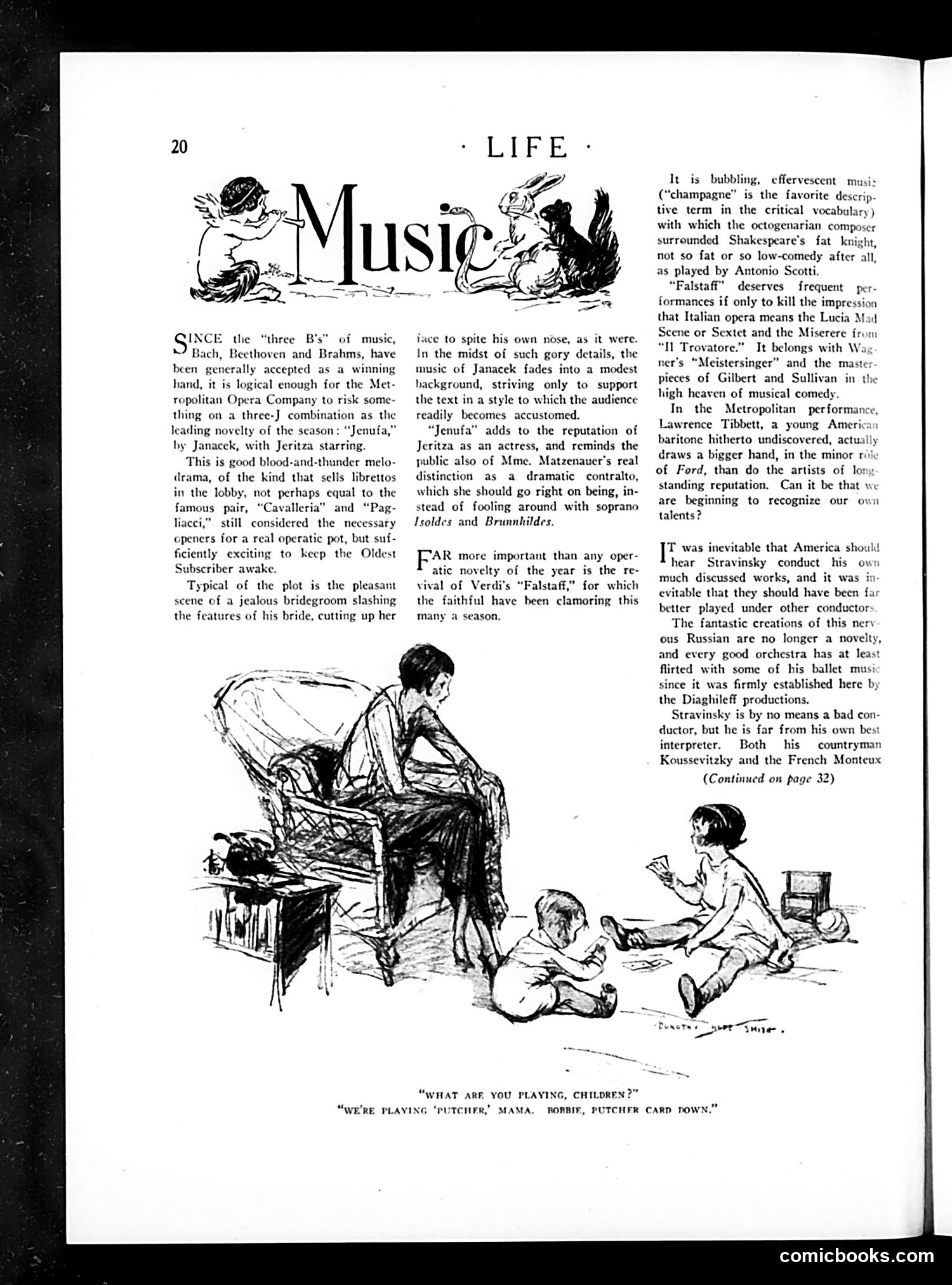
This page reviews recent Metropolitan Opera productions for a sophisticated American audience. The main text discusses three operatic novelties: Janacek's *Jenufa* (featuring soprano Jeritza), Verdi's *Falstaff* revival, and Stravinsky conducting his own works. The **cartoon at bottom** depicts a domestic scene where children are playing "Putcher" (pitcher)—a children's game involving cards. When the mother asks what they're playing, one child responds they're playing "Putcher, Mama, Bobbie, Putcher card down." The joke is subtle wordplay: the children's innocent card game mirrors the violent plot of *Jenufa* (where a jealous bridegroom slashes his bride's face). The contrast between children's innocent play and opera's melodramatic brutality creates the humor—satirizing how opera plots, despite their gory content, are entertainment for respectable audiences. The page celebrates emerging American talent (Lawrence Tibbett) while critiquing Stravinsky as an inferior conductor of his own compositions.
📄 Transcribed text from this page (OCR, searchable)
Machine-transcribed from the original scan — historical spelling and the odd misread are preserved.
GINCE the “three B's” of music, *“* Bach, Beethoven and Brahms, have been generally accepted as a winning hand, it is logical enough for the Met- ropolitan Opera Company to risk some- thing on a three-J combination as the leading novelty of the season: “Jenufa,” by Janacek, with Jeritza starring. This is good blood-and-thunder melo- drama, of the kind that sells librettos in the lobby, not perhaps equal to the famous pair, “Cavalleria” and “Pag- liacci,” still, considered the necessary openers for a real operatic pot, but suf- ficiently exciting to keep the Oldest Subscriber awake. Typical of the plot is the pleasant scene of a jealous bridegroom slashing the features of his bride, cutting up her “WE'RE PLAVING ‘PUTCHFR,’ MAMA, face to spite his own nose, as it were. In the midst of such gory details, the music of Janacek fades into a modest background, striving only to support the text in a style to which the audience readily becomes accustomed. “Jenufa” adds to the reputation of Jeritza as an actress, and reminds the public also of Mme. Matzenauer’s real distinction as a dramatic contralto, which she should go right on being, in- stead of fooling around with soprano Isoldes and Brunnhildes. FA® more important than any oper- atic novelty of the year is the re- vival of Verdi's “Falstaff,” for which the faithful have been clamoring this many a season. “WHAT ARE YOU PLAYING, CHILDREN?” RORBIF, PUTCHFR It is bubbling, effervescent musi: (“champagne” is the favorite descrip- tive term in the critical vocabulary) with which the octogenarian composer surrounded Shakespeare's fat kni not so fat or so low-comedy after as played by Antonio Scotti. “Falstaff’ deserves frequent per- formances if only to kill the impressi that Italian opera means the Lucia Mad Scene or Sextet and the Miserere from “Il Trovatore.” It belongs with \ ner’s “Meistersinger” and the master pieces of Gilbert and Sullivan in high heaven of musical comedy. In the Metropolitan performance, Lawrence Tibbett, a young Americ baritone hitherto undiscovered, actually draws a bigger hand, in the minor rile of Ford, than do the artists of lony standing reputation. Can it be that we are beginning to recognize our own talents? T was inevitable that America should hear Stravinsky conduct his own much discussed works, and it was in evitable that they should have been far better played under other conductors The fantastic creations of this nervy ous Russian are no longer a novelty, and every good orchestra has at least flirted with some of his ballet musi since it was firmly established here by the Diaghileff productions. Stravinsky is by no means a bad con- ductor, but he is far from his own best interpreter. Both his countryman Koussevitzky and the French Monteux (Continued on page 32) comicbooks.com