
Life, 1921-06-02 · page 21 of 44
Life — June 2, 1921 — page 21: what you’re looking at
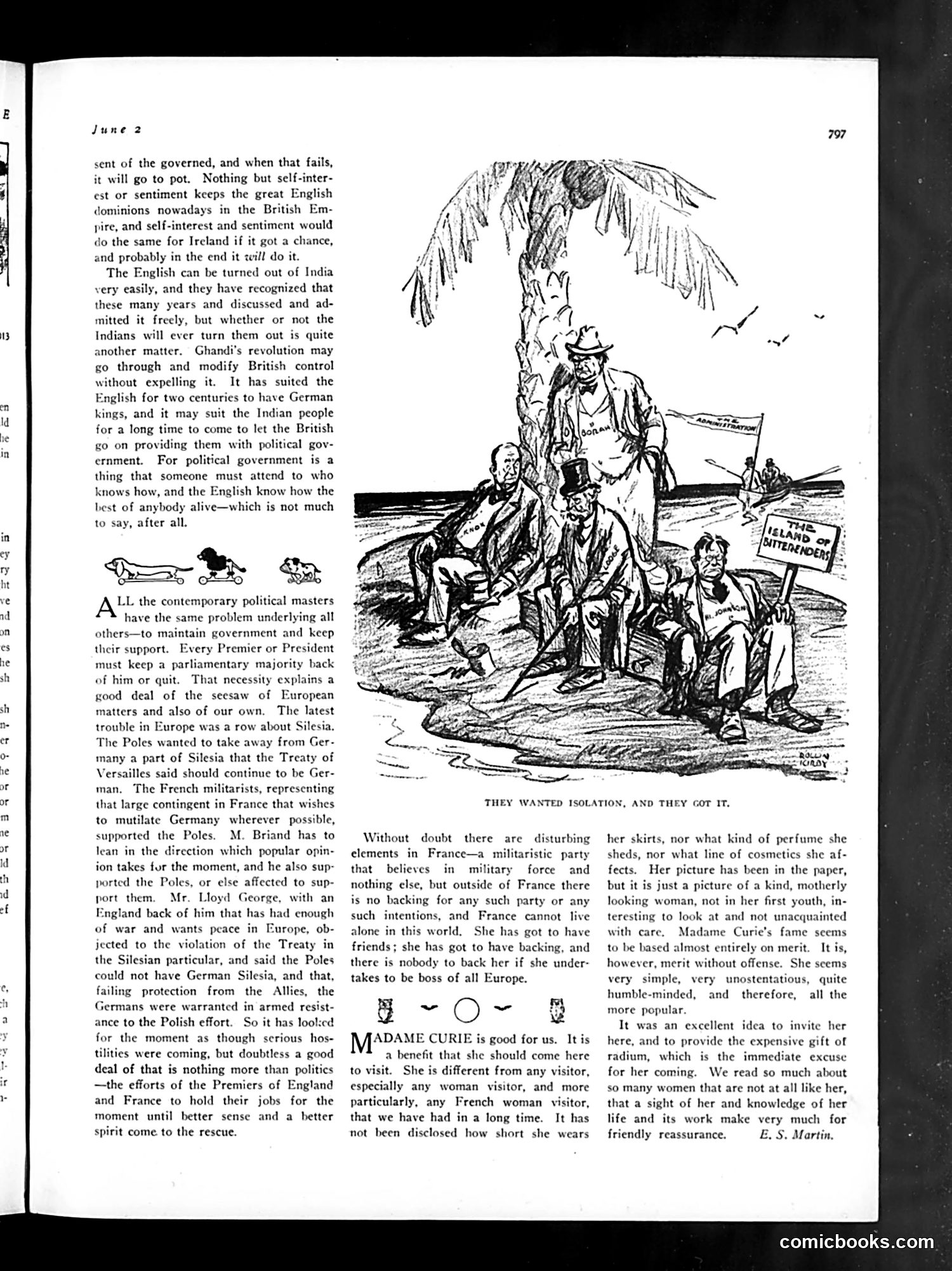
What you’re looking at
This cartoon illustrates post-WWI European territorial disputes, specifically the Silesian question between Poland and Germany following the Treaty of Versailles. The figures appear to represent European nations as characters beneath a dying tree labeled "Island of Nationalism." The satire critiques European leaders—particularly French Premier Briand and British PM Lloyd George—trapped by nationalist politics. The text explains that French militarists wanted to weaken Germany by supporting Polish claims to German Silesia, while Lloyd George opposed violating the treaty. The cartoon's title mocks how European nations pursued isolationist, nationalist agendas rather than cooperative peace-building. The "dying tree" symbolizes how nationalism and military posturing were destroying Europe's post-war recovery. The page also discusses Madame Curie's upcoming American visit as a positive counterpoint—a figure of international scientific cooperation and simple dignity versus political posturing.
📄 Transcribed text from this page (OCR, searchable)
Machine-transcribed from the original scan — historical spelling and the odd misread are preserved.
June 2 sent of the governed, and when that fails, it will go to pot. Nothing but self-inter- est or sentiment keeps the great English dominions nowadays in the British Em- pire, and self-interest and sentiment would do the same for Ireland if it got a chance, and probably in the end it ill do it. The English can be turned out of India very easily, and they have recognized that these many years and discussed and ad- mitted it freely, but whether or not the Indians will ever turn them out is quite another matter. Ghandi’s revolution may go through and modify British control without expelling it. It has suited the English for two centuries to have German kings, and it may suit the Indian people for a long time to come to let the British go on providing them with political gov- ernment. For political government is a thing that someone must attend to who knows how, and the English know how the hest of anybody alive—which is not much to say, after all. Gar By & AY the contemporary political masters have the same problem underlying all others—to maintain government and keep their support. Every Premier or President must keep a parliamentary majority back of him or quit. That necessity explains a good deal of the seesaw of European matters and also of our own, The latest trouble in Europe was a row about Silesia. The Poles wanted to take away from Ger- many a part of Silesia that the Treaty of Versailles said should continue to be Ger- man. The French militarists, representing that large contingent in France that wishes to mutilate Germany wherever possible, supported the Poles. M. Briand has to lean in the direction which popular opin- ion takes tur the moment, and he also sup- ported the Poles, or else affected to sup- port them. Mr. Lloyd George, with an England back of him that has had enough of war and wants peace in Europe, ob- jected to the violation of the Treaty in the Silesian particular, and said the Poles could not have German Silesia, and that, failing protection from the Allies, the Germans were warranted in armed resist- ance to the Polish effort. So it has looled for the moment as though serious hos- tilities were coming, but doubtless a good deal of that is nothing more than politics —the efforts of the Premiers of England and France to hold their jobs for the moment until better sense and a better spirit come to the rescue. THEY WANTED ISOLATION, AND THEY GOT IT, Without doubt there are disturbing elements in France—a militaristic party that believes in military force and nothing else, but outside of France there is no backing for any such party or any such intentions, and France cannot live alone in this world, She has got to have friends; she has got to have backing, and there is nobody to back her if she under- takes to be boss of all Europe. B~O~ 8 DAME CURIE is good for us. It is a benefit that she should come here to visit. She is different from any visitor, especially any woman visitor, and more particularly, any French woman visitor, that we have had in a long time. It has not been disclosed how short she wears her skirts, nor what kind of perfume she sheds, nor what line of cosmetics she af- fects. Her picture has been in the paper, but it is just a picture of a kind, motherly looking woman, not in her first youth, in- teresting to look at and not unacquainted with care, Madame Curie’s fame seems It is, however, merit without offense. She seems very simple, very unostentatious, quite humble-minded, and therefore, all the more popular. to be hased almost entirely on merit. It was an excellent idea to invite her here, and to provide the expensive gift of radium, which is the immediate excuse for her coming. We read so much about so many women that are not at all like her, that a sight of her and knowledge of her life and its work make very much for friendly reassurance. E, S. Martin. comicbooks.com