
Life, 1921-06-02 · page 20 of 44
Life — June 2, 1921 — page 20: what you’re looking at
What you’re looking at
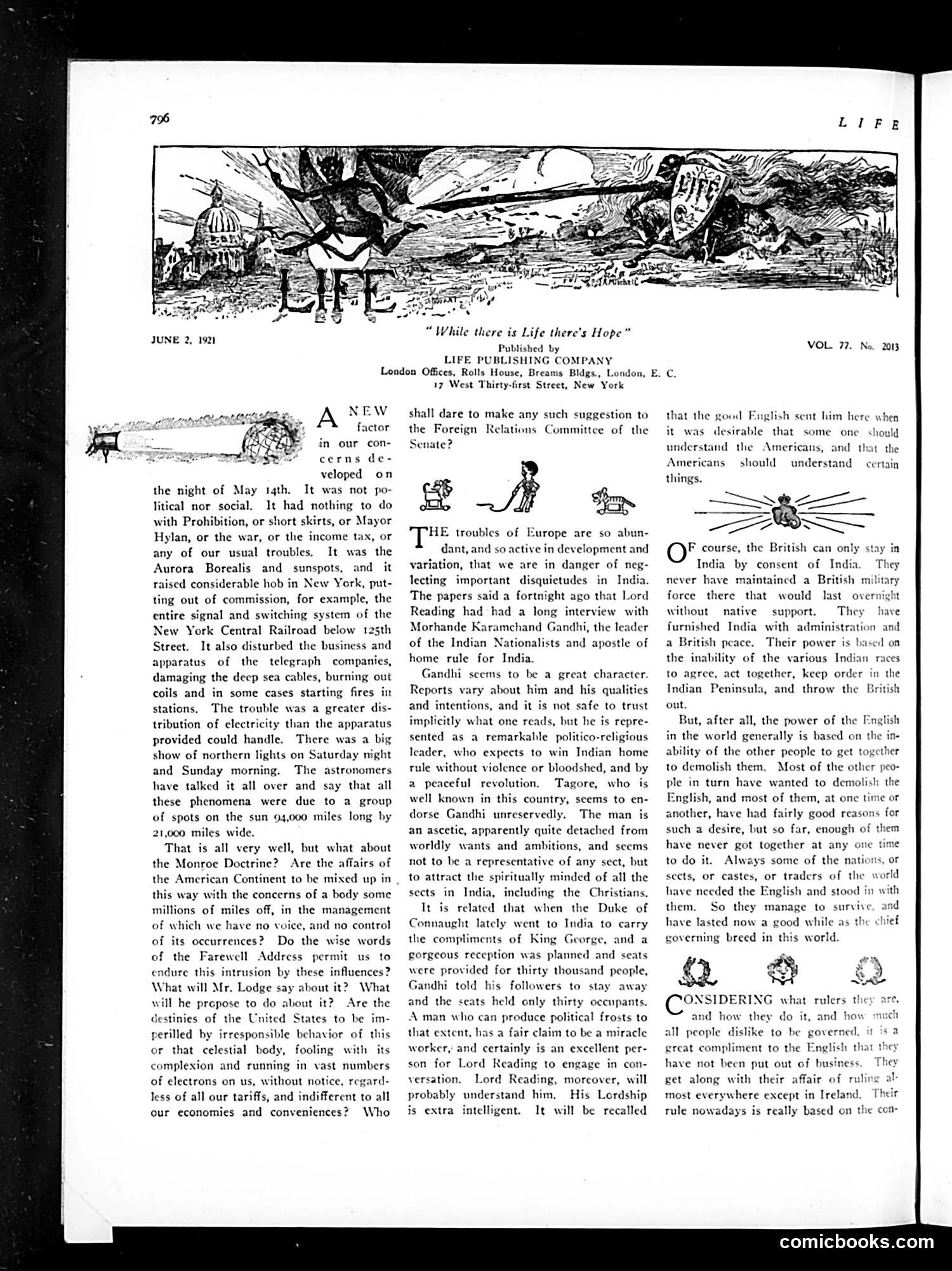
This page contains two satirical essays rather than visual cartoons. **The first essay** mocks American political anxiety by sarcastically invoking the Monroe Doctrine in response to solar sunspots and aurora borealis that disrupted telegraph and railroad systems on May 14th. The author ridicules isolationist Senator Henry Lodge (a prominent Monroe Doctrine advocate) by suggesting celestial phenomena constitute "foreign interference" requiring political response—absurdist satire attacking overreliance on protectionist doctrine. **The second essay** discusses Lord Reading's (British Viceroy) meeting with Mohandas Gandhi, leader of Indian independence movements. The author characterizes Gandhi as an ascetic, non-violent revolutionary attracting spiritual followers across religious lines. He notes Gandhi's power demonstrated when he drew only 30 people to an event intended for 30,000—showing his influence over Indians despite (or through) rejection of pomp. The piece appears sympathetic to Gandhi's character while cautiously noting uncertainty about his true intentions.
📄 Transcribed text from this page (OCR, searchable)
Machine-transcribed from the original scan — historical spelling and the odd misread are preserved.
“While there is Life there’s Hope” Published by LIFE PUBLISHING COMPANY VOL. 77. No. 2013 London Offices, Rolls House, Breams Bldgs., London, E. C, NEW A* actor in our con- cerns de- veloped on the night of May 14th. It was not po- litical nor social. It had nothing to do with Prohibition, or short ts, or Mayor Hylan, or the war, or the income tax, or any of our usual troubles, It was the Aurora Borealis and sunspots, and it sed considerable hob in New York, put- ting out of commission, for example, the entire signal and switching em of the New York Central Railroad below 125th Street. It also disturbed the business and apparatus of the telegraph companie: damaging the deep sea cables, burning out coils and in some cases starting fires itt stations. The trouble was a greater dis tribution of electricity than the apparatus provided could handle. There was a big show of northern lights on Saturday night and Sunday morning. The astronomers have talked it all over and say that all these phenomena were due to a group of spots on the sun 94,000 miles long by 21,000 miles wide. That is all very well, but what about the Monroe Doctrine? Are the affairs of the American Continent to be mixed up in this way with the concerns of a body some millions of miles off, in the management of which we have no voice, and no control of its occurrences? Do the wise words of the Farewell Address permit us to endure this intrusion by these influences? What will Mr. Lodge say about it? What will he propose to do about it? Are the destinies of the United tes to be im- perilled by irresponsible behavior of this or that celestial body, fooling with its complexion and running in vast numbers of electrons on us, without notice, regard- less of all our tariffs, and indifferent to all our economies and conveniences? Who 17 West Thirty-first Street, New York shall dare to make any such suggestion to the Foreign Relat Senate? & ts HE troubles of Europe are so abun- ns Committce of the dant, and so active in development and variation, that we are in danger of neg- lecting important disquietudes in India. The papers said a fortnight ago that Lord Reading had had a long interview with Morhande Karamchand Gandhi, the leader of the Indian Nationalists and apostle of home rule for India. Gandhi scems to be a great character. Reports vary about him and his qualities and intentions, and it is not safe to trust implicitly what one reads, but he is repre- sented as a remarkable politico-religious leader, who expects to win Indian home rule without violence or bloodshed, and by a peaceful revolution. Tagore, who is well known in this country, seems to en- dorse Gandhi unreservedly. The man is an ascetic, apparently quite detached from worldly wants and ambitions, and seems not to be a representative of any sect, but to attract the spiritually minded of all the sects in India, including the Christians, It is related that when the Duke of Connaught lately went to India to carry the compliments of King George, and a gorgeous reception was planned and seats were provided for thirty thousand people, Gandhi told his followers to stay away and the seats held only thirty occupants. Aman who can produce political frosts to that extent, has a fair claim to be a miracle worker, and certainly is an excellent per- son for Lord Reading to engage in con- versation. Lord Reading, moreover, will probably understand him. His Lordship is extra intelligent. It will be recalled that the good English sent him here when it was desirable that understand the some one Americans, and that the should understand Americans certain , the British can only stay in OF India by consent of India. T never have maintained a British m force there that would last overni without native support. They have furnished India with administration and a British peace. Their power is based on the inability of the various Indian races to agree, act together, keep order in the Indian Peninsula, and throw the British out. But, after all, the power of the English in the world generally is based on the ability of the other people to get to demolish them. Most of the other peo- ple in turn have wanted to demolish the English, and most of them, at one another, have had fairly good reas: for eof such a desire, but so far, enough of them have never got together at any one time to do it. Always some of the natic sects, or castes, or traders of the have needed the English and stood in with them. So they manage to survive, and have lasted now a good while as the chiet governing breed in this world. 2 8 8 C° IDERING what rulers the and how they do it, how all people dislike to be gov great compliment to the Engli have not been put out of bu get along with their affair of ruling a Their most everywhere except in Ireland. rule nowadays is really based on the con- comicbooks.com