
Life, 1921-03-17 · page 28 of 40
Life — March 17, 1921 — page 28: what you’re looking at
What you’re looking at
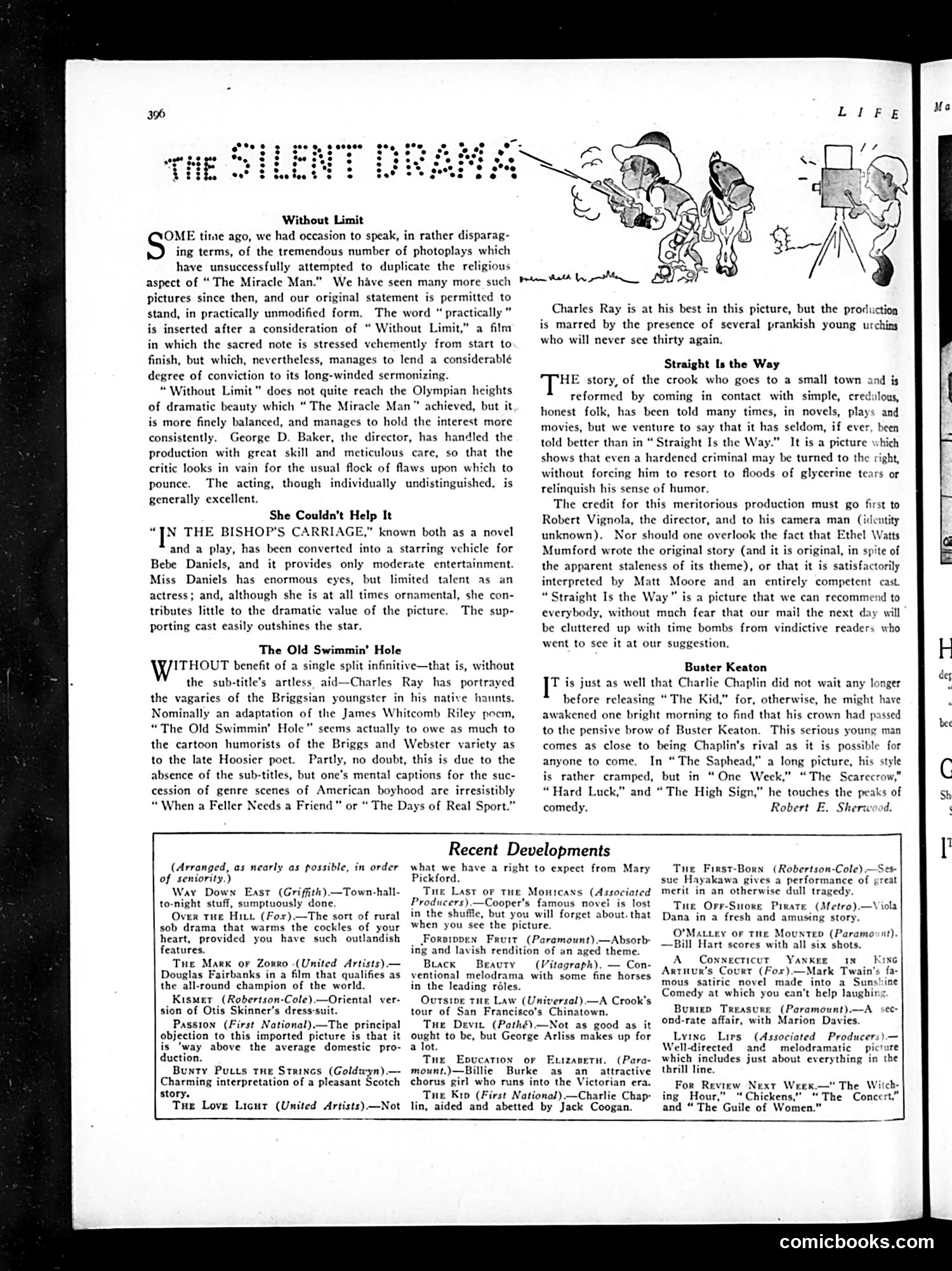
This page reviews five silent films from approximately 1921. The cartoons at the top illustrate film production—showing directors, cameramen, and actors on set. The reviews discuss: - **"Without Limit"**: A religious drama attempting to replicate "The Miracle Man's" success, praised for balanced direction by George D. Baker - **"In the Bishop's Carriage"**: Stars Bebe Daniels, criticized for her "enormous eyes" but limited acting talent - **"The Old Swimmin' Hole"**: Charles Ray adapts James Whitcomb Riley's poem; the reviewer compares it to newspaper comic strips by Briggs and Webster - **"Straight Is the Way"**: A redemption story about a criminal reformed by honest townsfolk; recommended without reservation - **"The Kid"**: Brief mention of Chaplin's film, comparing it favorably to Buster Keaton's work The tone is sophisticated and critical, typical of Life magazine's cultural commentary. References to "glycerine tears" mock melodramatic sentimentality common in early cinema.
📄 Transcribed text from this page (OCR, searchable)
Machine-transcribed from the original scan — historical spelling and the odd misread are preserved.
Without Limit OME time ago, we had occasion to speak, in rather disparag- ing terms, of the tremendous number of photoplays which have unsuccessfully attempted to duplicate the religious aspect of “The Miracle Man.” We have seen many more such pictures since then, and our original statement is permitted to stand, in practically unmodified form. The word “ practically” is inserted after a consideration of “ Without Limit,” a film in which the sacred note is stressed vehemently from start to finish, but which, nevertheless, manages to lend a considerablé degree of conviction to its long-winded sermonizing. “Without Limit” does not quite reach the Olympian heights of dramatic beauty which “ The Miracle Man” achieved, but it is more finely balanced, and manages to hold the interest more consistently. orge D. Baker, the director, has handled the production with great skill and meticulous care, so that the critic looks in vain for the usual flock of flaws upon which to pounce. The acting, though individually undistinguished, is generally excellent. She Couldn't Help It N THE BISHOP’S CARRIAGE,” known both as a novel and a play, has been converted into a starring vehicle for Bebe Daniels, and it provides only moderate entertainment. Miss Daniels has enormous eyes, but limited talent as an actress; and, although she is at all times ornamental, she con- tributes little to the dramatic value of the picture. The sup- porting cast easily outshines the star. The Old Swimmin’ Hole ITHOUT benefit of a single split infinitive—that is, without the sub-title’s artless. aid—Charles Ray has portrayed the vagaries of the Briggsian youngster in his native haunts. Nominally an adaptation of the James Whitcomb Riley pocm, “The Old Swimmin’ Hole” seems actually to owe as much to the cartoon humorists of the Briggs and Webster variety as to the late Hoosier poct. Partly, no doubt, this is due to the absence of the sub-titles, but one’s mental captions for the suc- cession of genre scenes of American boyhood are irresistibly “ When a Feller Needs a Friend” or “ The Days of Real Sport.” Charles Ray is at his best in this picture, but the production is marred by the presence of several prankish young urchi who will never see thirty again. Straight Is the Way THe story, of the crook who goes to a small town and is reformed by coming in contact with simple, credulous, honest folk, has been told many times, in novels, plays and movies, but we venture to say that it has seldom, if ever, been told better than in “ Straight Is the Way.” It is a picture which shows that even a hardened criminal may be turned to the right, without forcing him to resort to floods of glycerine tears or relinquish his sense of humor. The credit for this meritorious production must go first to Robert Vignola, the director, and to his camera man (identity unknown). Nor should one overlook the fact that Ethel Watts Mumford wrote the original story (and it is original, in spite of the apparent staleness of its theme), or that it is satisfactorily interpreted by Matt Moore and an entirely competent cast. “Straight Is the Way” is a picture that we can recommend to everybody, without mach fear that our mail the next day will be cluttered up with time bombs from vindictive readers who went to see it at our suggestion, Buster Keaton T is just as well that Charlie Chaplin did not wait any longer before releasing “The Kid,” for, otherwise, he might have awakened one bright morning to find that his crown had passed to the pensive brow of Buster Keaton. This serious young man comes as close to being Chaplin's rival as it is possible for anyone to come. In “The Saphead,” a long picture, his style is rather cramped, but in “One Week,” “The Scarecrow,” “Hard Luck,” and “The High Sign,” he touches the peaks of comedy. Robert E. Sherwood. s nearly as possible, in order East (Griffith).—Town-hall- to-night stuff, sumptuously done. Over tHe Hirt (For).—The sort of rural sob drama that warms the cockles of your heart, provided you have such outlandish features. Tue Marx or Zorro (United Artists) — Douglas Fairbanks in a film that qualifies as the all-round champion of the world. Kismet (Robertson-Cole).—Oriental ver- sion of Otis Skinner’s dress-suit. Passion (First National).—The principal objection to this imported picture is that it is ‘way above the average domestic pro- duction. Bunty Putts tne Strincs (Goldwyn).— Charming interpretation of a pleasant Scotch story. Tue Love Licur (United Artists)—Not Recent Developments | what we have a right to expect from Mary Pickford. Tue Last or tHe Montcaxs (Associated Producers).—Cooper’s famous novei is lost in the shuffle, but you will forget about. that when you see the picture. _ Foroippen Fruit (Paramount).—Absorb- ing and lavish rendition of an aged theme. Btack Beauty ( graph). — Con- ventional melodrama with some fine horses in the leading réles. Ovtsipe tHe Law (Universal) —A Crook's tour of San Francisco’s Chinatown. Tue Devit (Pathé).—Not as good as it ought to be, but George Arliss makes up for a lot. Tne Epucation or Etizapetu. (Para- mount.)—Billie Burke as an_ attractive chorus girl who runs into the Victorian era. _ Tue Kio (First National) —Charlie Chap- lin, aided and abetted by Jack Coogan. Tue First-Born (Robertson-Cole).- sue Hayakawa gives a performance of great merit in an otherwise dull tragedy. Tue. Orr-Suore Pirate (Metro).—Viola Dana in a fresh and amusing story. O’Matrey or the Mountep (Paramownt). —Bill Hart scores with all six shots. YANKEE IN 1 *).—Mark Twain's fa- mous satiric novel made into a Su Comedy at which you can't help laughir Buriep Treasure (Paramount).—A ond-rate affair, with Marion Davies. Lyinc Lips (Associated Producers) — Well-directed and melodramatic _ picture which includes just about everything in the thrill line. For Review Next Weex.—" The Witch- ing Hour,” “Chickens,” “The Concert,” and “ The Guile of Women.” =| comicbooks.com Mo