
Life, 1921-03-17 · page 27 of 40
Life — March 17, 1921 — page 27: what you’re looking at
What you’re looking at
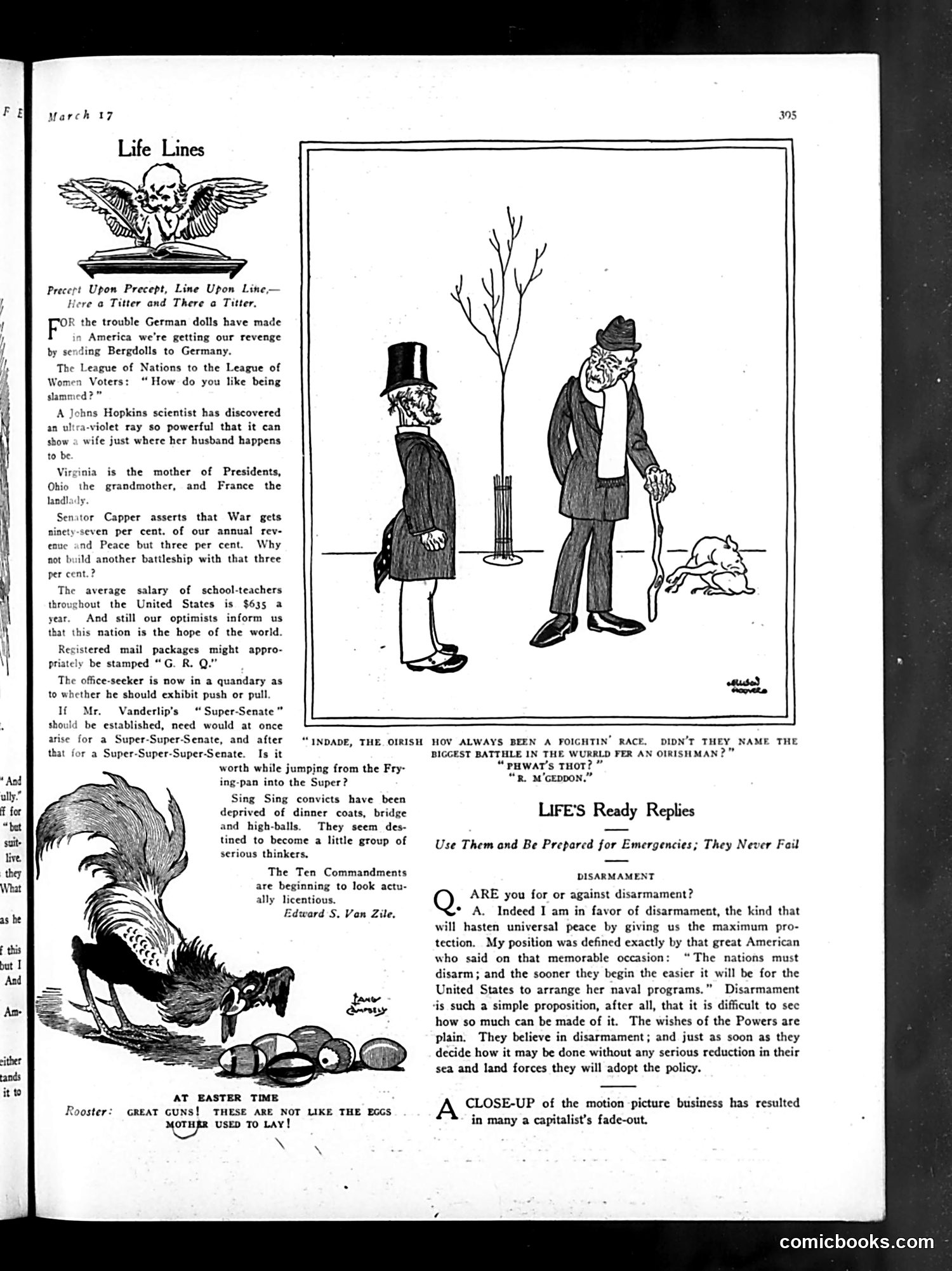
This page contains satirical commentary typical of Life's post-WWI era content. The main cartoon depicts two Irish men discussing "Armaggeddon" (mispronounced as "R. M'Geddon"), using heavy Irish dialect—a common satirical device of the period playing on Irish-American stereotypes and their association with fighting. The "Life's Ready Replies" section mocks political doublespeak about disarmament, presenting a response that contradicts itself: advocating disarmament while simultaneously justifying maintaining naval superiority. This satirizes politicians' hollow peace rhetoric during post-war treaty negotiations. The scattered "Life Lines" jokes reference contemporary issues: German war reparations, the League of Nations, teacher salaries, military spending, and Sing Sing prison conditions. The rooster cartoon makes an Easter pun about eggs. The cartoons reflect American anxieties about international diplomacy, economic priorities, and class divisions in the 1920s.
📄 Transcribed text from this page (OCR, searchable)
Machine-transcribed from the original scan — historical spelling and the odd misread are preserved.
Precept Upon Precept, Line Upon Line,— Here @ Titter and There a Titter, i | Sa the trouble German dolls have made in America we're getting our revenge by sending Bergdolls to Germany. The League of Nations to the League of Women Voters: “ How do you like being slammed?” A Johns Hopkins scientist has discovered an ultra-violet ray so powerful that it can show a wife just where her husband happens to be. Virginia is the mother of Presidents, Ohio the grandmother, and France the landlady. Senator Capper asserts that War gets ninety-seven per cent. of our annual rev- enuc and Peace but three per cent. Why not build another battleship with that three per cent.? The average salary of school-teachers throughout the United States is $635 a year. And still our optimists inform us that this nation is the hope of the world. Resistered mail packages might appro- priately be stamped “G. R. Q.” The office-seeker is now in a quandary as to whether he should exhibit push or pull. Mr. Vanderlip’s “ Super-Senate " be established, need would at once arise for a Super-Super-Senate, and after “INDADE, THE OIRISH HOV ALWAYS BEEN A FOIGHTIN’ RACE, DIDN’T THEY NAME THE that for a Super-Super-Super-Senate. Is it BIGGEST BATTHLE IN THE WURRLD FER AN OIRISH MAN?” worth while jumping from the Fry- “ PHWAT's THOT?” ing-pan into the Super? “R, M'GEDDON.’ Sing Sing convicts have been deprived of dinner coats, bridge LIFE’S Ready Replies and high-balls. They seem des- — tined to become a little group of : : Use Them and Be Prepared for Emergencies; They Never Fail serious thinkers, The Ten Commandments are beginning to look actu- A ally licentious. ARE you for or against disarmament? Edward S. Von Zile. A. Indeed I am in favor of disarmament, the kind that will hasten universal peace by giving us the maximum pro- tection. My position was defined exactly by that great American who said on that memorable occasion: “The nations must disarm; and the sooner they begin the easier it will be for the United States to arrange her naval programs.” Disarmament ‘is such a simple proposition, after all, that it is difficult to sec how so much can be made of it. The wishes of the Powers are plain. They believe in disarmament; and just as soon as they decide how it may be done without any serious reduction in their sea and land forces they will adopt the policy. DISARMAMENT AT EASTER TIME Rooster: GREAT GUNS! THESE ARE NOT LIKE THE EGGS A CLOSE-UP of the motion picture business has resulted Mora USED To Lay! in many a capitalist’s fade-out. \ comicbooks.com