
Life, 1920-06-03 · page 25 of 52
Life — June 3, 1920 — page 25: what you’re looking at
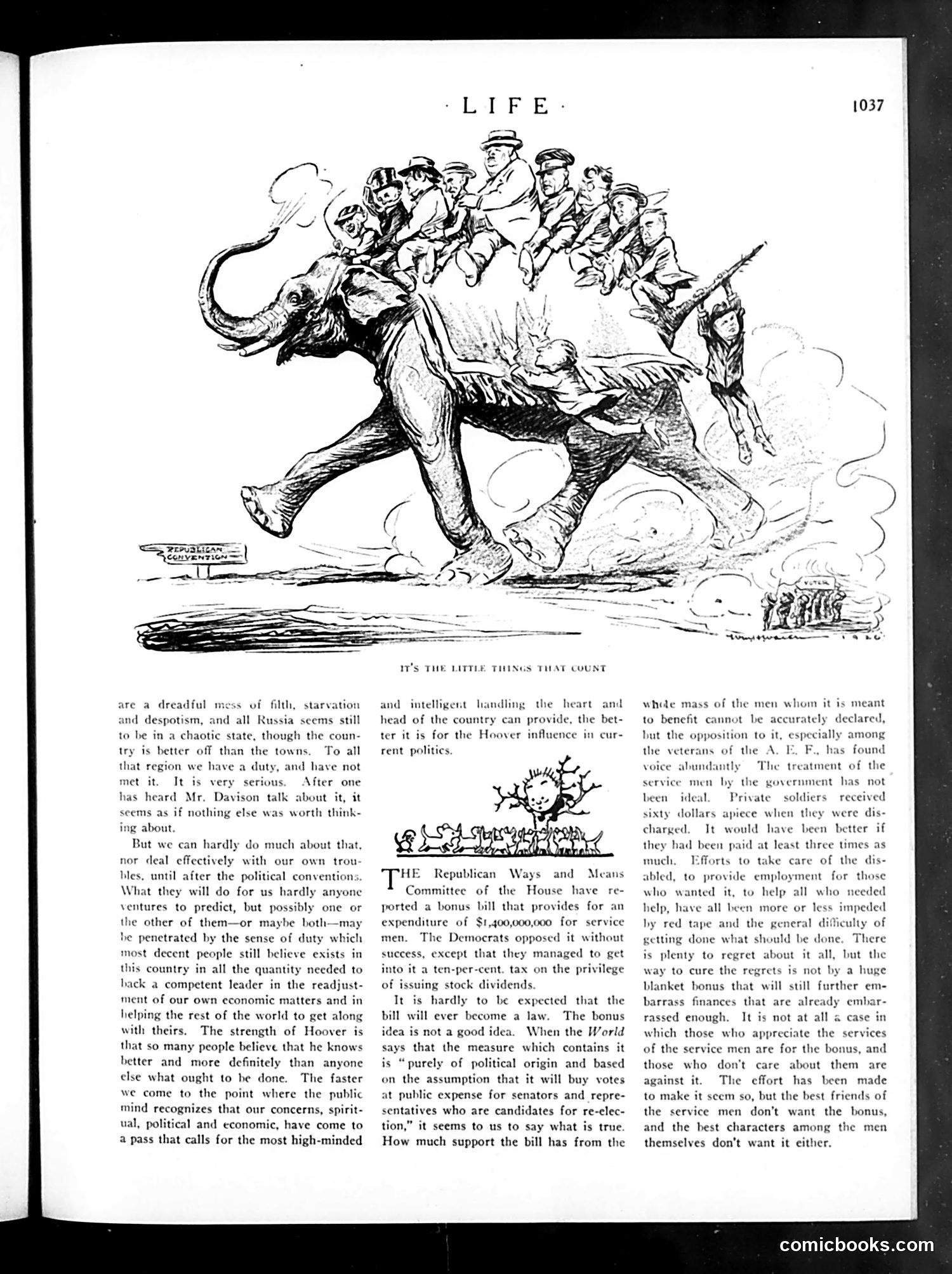
What you’re looking at
The cartoon depicts an elephant—the Republican Party symbol—carrying numerous politicians on its back while trudging through clouds of dust. A soldier with a rifle stands nearby, observing. **The satire targets the 1928 bonus bill debate.** The text criticizes a $1.4 billion service bonus proposed by Republicans as politically motivated—designed to "buy votes" rather than genuinely help veterans. The cartoon suggests politicians are using returning soldiers as mere weight or burden for partisan gain. **Key context:** After WWI, veterans received only $60 upon discharge and faced unemployment and bureaucratic obstacles. While acknowledging legitimate grievances, the article argues the proposed bonus is financially irresponsible. The "little things that count" implies sincere aid (employment, disability care) matters more than a massive cash payout designed for electoral advantage. The soldier's presence symbolizes those for whom politicians claim to legislate while actually prioritizing their own political survival.
📄 Transcribed text from this page (OCR, searchable)
Machine-transcribed from the original scan — historical spelling and the odd misread are preserved.
Servs ica CONVENTION, are a dreadful w of filth, starvation and despotism, and all Russia seems still to be in a chaotic state, though the coun- try is better off than the towns. To all that region we have a duty, and have not met it. It is has heard Mr. After one Davison talk about it, it seems as if nothing else was worth think- ing about. very serious. But we can hardly do much about that, nor deal effectively with our own trou- Mes, until after the political conventions. What they will do for us hardly anyone ventures to predict, but possibly one or the other of them—or maybe both—may he penetrated by the sense of duty which most decent people still believe exists in this country in all the quantity needed to hack a competent leader in the readjust- ment of our own economic matters and in helping the rest of the world to get along with theirs. The strength of Hoover is that so many people believe that he knows better and more definitely than anyone else what ought to be done. The faster we come to the point where the public mind recognizes that our concerns, spirit- ual, political and economic, have come to a pass that calls for the most high-minded I's THE LITTLE THINGS THAT COUNT and intelligent handling the heart and head of the country can provide, the bet- ter it is for the Hoover influence in cur- rent politics. Means. have re- HE Republican Ways and of the ported a bonus bill that provides for an Committee House expenditure of $1,400,000,000 for service men. The Democrats opposed it without success, except that they managed to get into it a ten-per-cent. tax on the privilege of issuing stock dividends. It is hardly to be expected that the bill will ever become a law. The bonus idea is not a good idea. When the World says that the measure which contains it is “purely of political origin and based on the assumption that it will buy votes at public expense for senators and repre- sentatives who are candidates for re-elec- tion,” it seems to us to say what is true. How much support the bill has from the whole mass of the men whom it is meant to benefit cannot be accurately declared, hut the opposition to it, especially among the veterans of the A. E. F., has found voice abundantly ce treatment of the service men by the government has not been ideal Private soldiers received sixty dollars apiece when they were dis- charged. It would have been better if they had been paid at least three times as much. Efforts to take care of the dis- abled, to provide employment for those who wanted it, to help all who needed help, have all been more or less impeded hy red tape and the general dificulty of getting done what should be done, There it all, but the way to cure the regrets is not by a huge is plenty to regret about Dlanket bonus that will still further em- barrass finances that are already embar- rassed enough. It is not at all a case in which those who appreciate the services of the service men are for the bonus, and don't about them are against it. The effort has made to make it scem so, but the best friends of the service don’t want the bonus, and the best characters among the men themselves don’t want it either. those who care been men comicbooks.com