
Life, 1920-06-03 · page 24 of 52
Life — June 3, 1920 — page 24: what you’re looking at
What you’re looking at
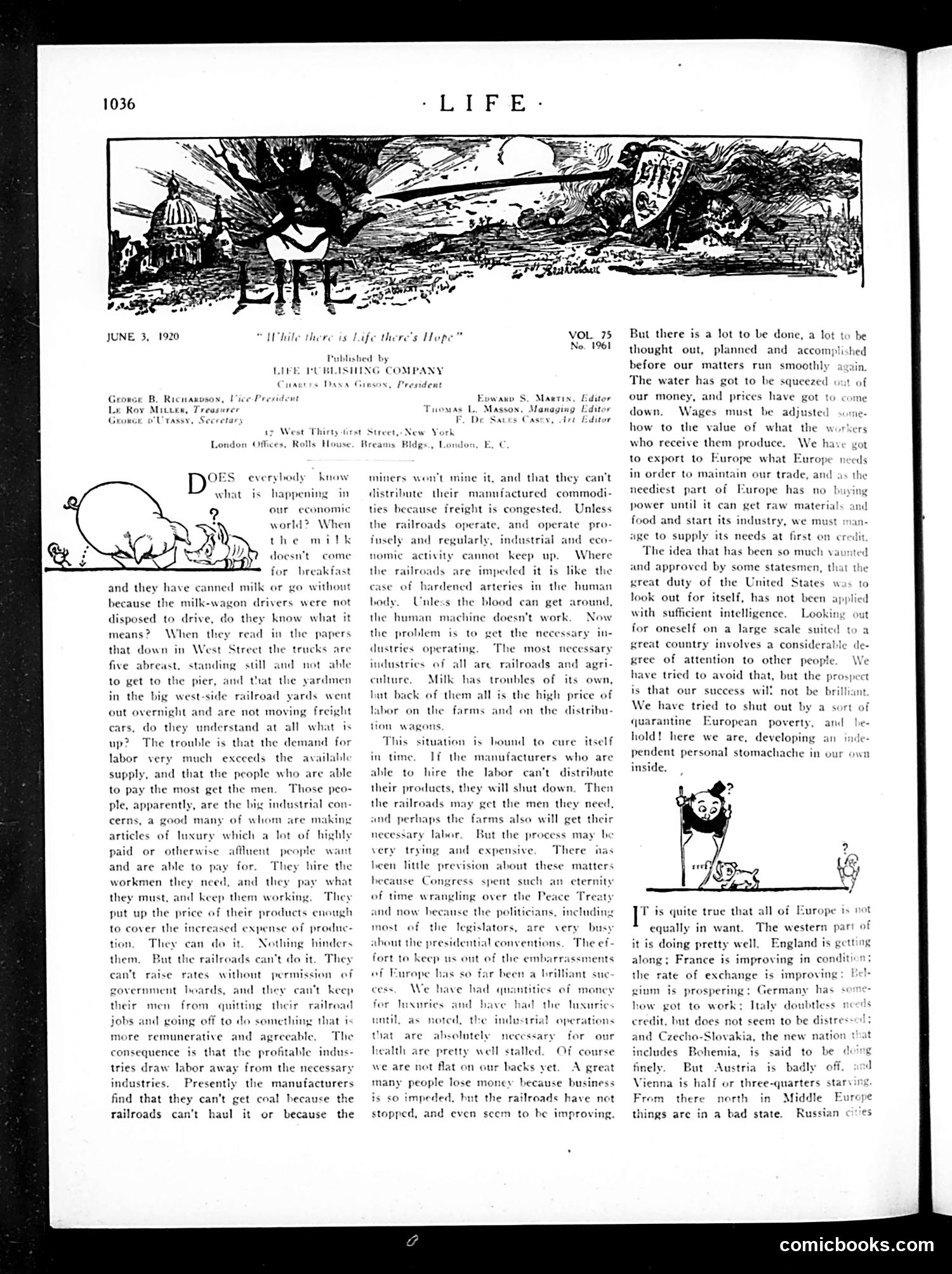
This page discusses post-WWI economic disruption, particularly labor shortages affecting railroads and milk delivery—critical infrastructure for American industry. The cartoon (upper left) depicts a cow, illustrating the article's opening about milk supply failures when wagon drivers strike or quit. The text explains that wage-seeking workers abandon railroad jobs for better-paying luxury industries, creating a cascade: railroads can't operate → coal doesn't move → manufacturers can't produce → the economy seizes up like "hardened arteries." The author argues railroads, unlike private manufacturers, can't simply raise prices to retain workers (government boards control rates). The solution requires voluntary worker restraint until conditions improve—though the author acknowledges this will be "very trying and expensive." The piece reflects 1920 anxieties about labor unrest, inflation, and postwar economic chaos, while blaming politicians distracted by Peace Treaty negotiations for failing to address industrial problems proactively.
📄 Transcribed text from this page (OCR, searchable)
Machine-transcribed from the original scan — historical spelling and the odd misread are preserved.
JUNE 3, 1920 White there is 1 VOL 75 ife there's Hop Me 1981 Published by LIFE Grorce B. Ricuaxvson, Vice Preside Le Roy Mites, 7 Groxce o'Urassy, Sec Thirty tirst Street, Rolls House London Offices, OES everybody | know what is happening in 2 and they have canned milk or go without our economic When milk world? the doesn’t come for breakfast because the milk-wagon drivers were not disposed to drive, do they know what it means? When they read in the that down in West Street the still A that thy in the big west-side railroad yards went papers trucks are able yardmen five abreast, standing and not to get to the pier, ar out overnight and are not moving freight cars, do they understand at all what is up? The trouble is that the demand for labor the supply to pay the most get the men. ple very much exceeds available and that the people who are able Those peo- apparently, are the big industrial con- od many of whom are cerns, a g making articles of luxury which a lot of highly paid or otherwise affluent people want and are able to pay They hire the workmen they need, and they pay what they must, and keep them working. They put up the price of their products enough to cover the increased expense of produe- tion. They Nothing hinders them. But the railroads can't do it. They can't can do it raise rates without permission of government boards, and their they can't keep their railroad that i The indus- men from quitting jobs and going off to do something more remunerative and agreeable, consequence is that the profitable tries draw labor away from the necessary industries. Presently the manufacturers find that they can’t get coal because the railroads can’t haul it or because the PUBLISHING COMPANY < Dasa Ginsos, President Eowaxp S. Martin Tuomas L. Masson F. De Sat New York Lon Editor Managing Editor s Casey, ort Editor Rreams Bldgs, miners won't mine it, and that they can't distribute commodi- ties because freight is congested. Unless their manufactured the railroads operate, and operate pre zularly, industrial and. ecc Where like the in the human fusely and r nomic activity cannot keep up. the railroads are impeded it is case of hardened arteries body. Unless the blood can get around, Now the problem is to get the necessary in- The railroads and ie the human machine doesn’t work dustries operatin, most necessary industries of all are Milk troubles of its hut back of them all is the labor on the culture. has own, high price of far on the distribu- tion wagons. This in time. If able to situation is hound to cure itself who are distribute Then the railroads may get the men they need, and perhaps the the manufacturers hire the labor can't their products, they will shut down arms also will get their necessary labor. But the process may be very trying and expensive. There iias Leen little prevision about these matters because Congress spent such an eternity of time wrangling over the Peace Treaty and now hecause the politicians, including most of the legislators, are very busy chout the presidential conventions. The ef- fort to keep us out of th of Europe has so far been a brilliant suc cess, We have had quantitics of money Tuan and have had the luxuries until, as ne the industrial operations lat are absolutely necessary for health are well stalled. OF we are not flat on our backs yet our pretty course A great many people lose money because business is so impeded, hut the railroads have not stopped, and even scem to he improving. But there is a lot to be done, a lot to be thought out, planned and accomplished before our matters run smoothly The water has got to be squeezed our money, and pr down, es have got to Wages must be adjusted how to the what the workers We have got to export to Europe what Europe needs in order to maint value of who receive them produce. in our trade, and as the Europe has no buyir power until it can get raw material neediest part of food and start its industry, we must age to supply its needs at first on er The idea that has been so much vaur and approved by some statesmen, great duty of the United States look out for itself, has not been with sufficient intelligence. Lookin for oneself on a large scale suited t great country involves a considerable « gree of attention to other peop! have tried to avoid that, but the prospect is that our success will not be quarantine European poverty, and hold! here we are, developing an j pendent personal stomachache in our « inside. is quite true that all of Europe is not The western pari of England is getting it is doing pretty well equally in want along; France is improving in condition; the rate of exchange is improving = gium is prospering: Germany has s« how got to work; Italy doubtless 1 credit, but does not seem to be distres and Czecho-Slovakia, the new nation t cludes Bohemia, is said to be ¢ finely, But Austria is badly off Vienna is half or three. Fre there things are in a bad state. juarters stars Middle Europe Russian cities north in comicbooks.com