
Life, 1920-04-01 · page 30 of 60
Life — April 1, 1920 — page 30: what you’re looking at
What you’re looking at
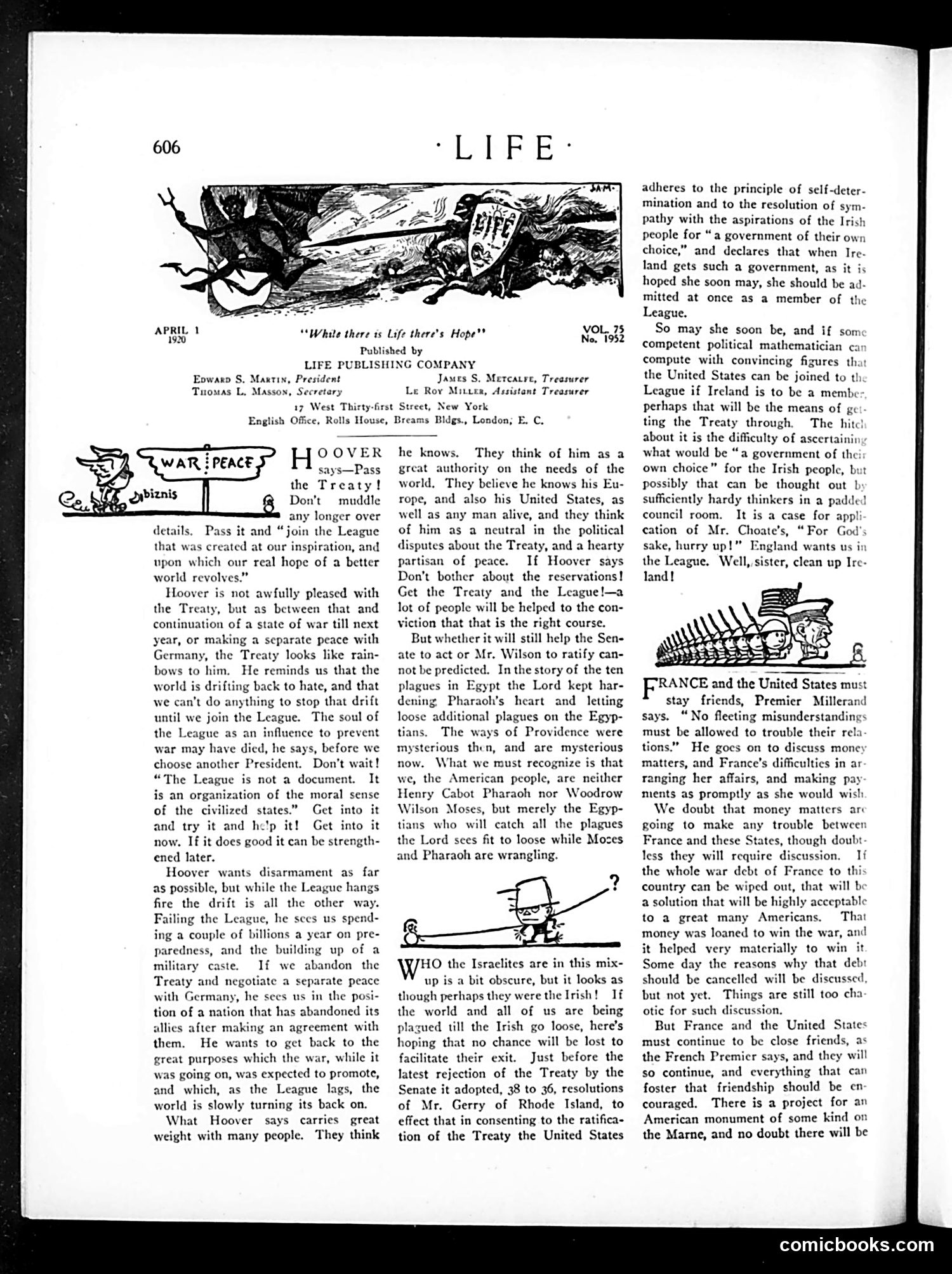
This page addresses post-WWI American politics, specifically the League of Nations treaty debate. The main text discusses Herbert Hoover's advocacy for ratifying the Treaty and joining the League, arguing it's necessary to prevent future war and moral drift. A secondary editorial satirizes the Senate's repeated rejection of the Treaty by comparing it to the Biblical plagues of Egypt. The author depicts Senators and President Wilson as "Pharaoh" and "Moses" respectively, with ordinary Americans as helpless "Egyptians" caught in their political dispute. The editorial sarcastically adds that Irish independence—apparently a complicating factor—will supposedly resolve everything. The cartoon (top left) depicts a graveyard/death imagery, likely referencing war's devastation and the failure of peace efforts. Overall, the page criticizes Congressional obstruction of Wilson's League of Nations as dangerous and absurd political theater.
📄 Transcribed text from this page (OCR, searchable)
Machine-transcribed from the original scan — historical spelling and the odd misread are preserved.
APRIL 1 1920 “White there is Life there's: Hope"* VOL. 75 No, 1952 Published by LIFE PUBLISHING COMPANY Epwaro S. Maxtix, President Tuomas L, Masson, Secretary James S. Mercatre, Treasurer Le Rov Miter, Assistant Treasurer 17 West Thirty-first Street, New York English Office, Rolls House, Breams Bldgs., London, E. C. OOVER says—Pass the Treaty! Don't muddle any longer over s. Pass it and “join the League that was created at our inspiration, and upon which our real hope of a better world revolves.” Hoover is not awfully pleased with the Treaty, but as between that and continuation of a state of war till next year, or making a separate peace with Germany, the Treaty looks like rain- bows to him. He reminds us that the world is drifting back to hate, and that we can’t do anything to stop that drift until we join the League. The soul of the League as an influence to prevent war may have died, he says, before we choose another President. Don't wait! “The League is not a document. It is an organization of the moral sense of the civilized states.” Get into it and try it and he'p it! Get into it now. If it does good it can be strength- encd later. Hoover wants disarmament as far as possible, but while the League hangs fire the drift is all the other way. Failing the League, he sees us spend- ing a couple of billions a year on pre- paredness, and the building up of a military caste. If we abandon the Treaty and negotiate a separate peace with Germany, he sees us in the posi- tion of a nation that has abandoned its allies after making an agreement with them. He wants to get b: to the great purposes which the war, while it was going on, was expected to promote, and which, as the League lags, the world is slowly turning its back on. What Hoover says carries great weight with many people. They think he knows. They think of him as a great authority on the needs of the world. They believe he knows his Eu- rope, and also his United States, as well as any man alive, and they think of him as a neutral in the political disputes about the Treaty, and a hearty partisan of peace. If Hoover says Don’t bother about the reservations! Get the Treaty and the League!—a lot of people will be helped to the con- viction that that is the right course. But whether it will still help the Sen- ate to act or Mr. Wilson to ratify can- not be predicted. In the story of the ten plagues in Egypt the Lord kept har- dening Pharaoh's heart and letting loose additional plagues on the Egyp- tians. The ways of Providence were mysterious then, and are mysterious now. What we must recognize is that we, the American people, are neither Henry Cabot Pharaoh nor Woodrow Wilson Moses, but merely the Egyp- tians who will catch all the plagues the Lord sees fit to loose while Mozes and Pharaoh are wrangling. 2 HO the Israelites are in this mix- up is a bit obscure, but it looks as though perhaps they were the Irish! If the world and all of us are being plagued till the Irish go loose, here’s hoping that no chance will be lost to facilitate their exit. Just before the latest rejection of the Treaty by the Senate it adopted, 38 to 36, resolutions of Mr. Gerry of Rhode Island, to effect that in consenting to the ratifica- tion of the Treaty the United States adheres to the principle of self-deter- mination and to the resolution of sy pathy with the aspirations of the Irish people for “a government of their own choice,” and declares that when Ire- land gets such a government, as it is hoped she soon may, she should be ad- mitted at once as a member of the League. So may she soon be, and if some competent political mathematician can compute with convincing figures that the United States can be joined to th League if Ireland is to be a membe- perhaps that will be the means of gei- ting the Treaty through. The hitc! about it is the difficulty of ascertaininy what would be “a government of the; own choice” for the Irish people, but possibly that can be thought out | sufficiently hardy thinkers in a padded council room. It is a case for appli cation of Mr. Choate’s, “For God's England wants us in ister, clean up Ire- sake, hurry up!” the League. Well, land! RANCE and the United States must stay friends, Premier Millerand says. “No fleeting misunderstandings must be allowed to trouble their rela tions.” He gocs on to discuss money matters, and France's difficulties in ar ranging her affairs, and making pay ments as promptly as she would wish. We doubt that money matters arc going to make any trouble between France and these States, though doubt less they will require discussion. If the whole war debt of France to this country can be wiped out, that will bc a solution that will be highly acceptable to a great many Americans. That money was loaned to win the war, and it helped very materially to win it Some day the reasons why that debt should be cancelled will be discussed, but not yet. Things are still too cha otic for such discussion. But France and the United States must continue to be close friends, as the French Premier says, and they will so continue, and everything that can foster that friendship should be en couraged. There is a project for an American monument of some kind on the Marne, and no doubt there will be comicbooks.com