
Life, 1920-04-01 · page 26 of 60
Life — April 1, 1920 — page 26: what you’re looking at
What you’re looking at
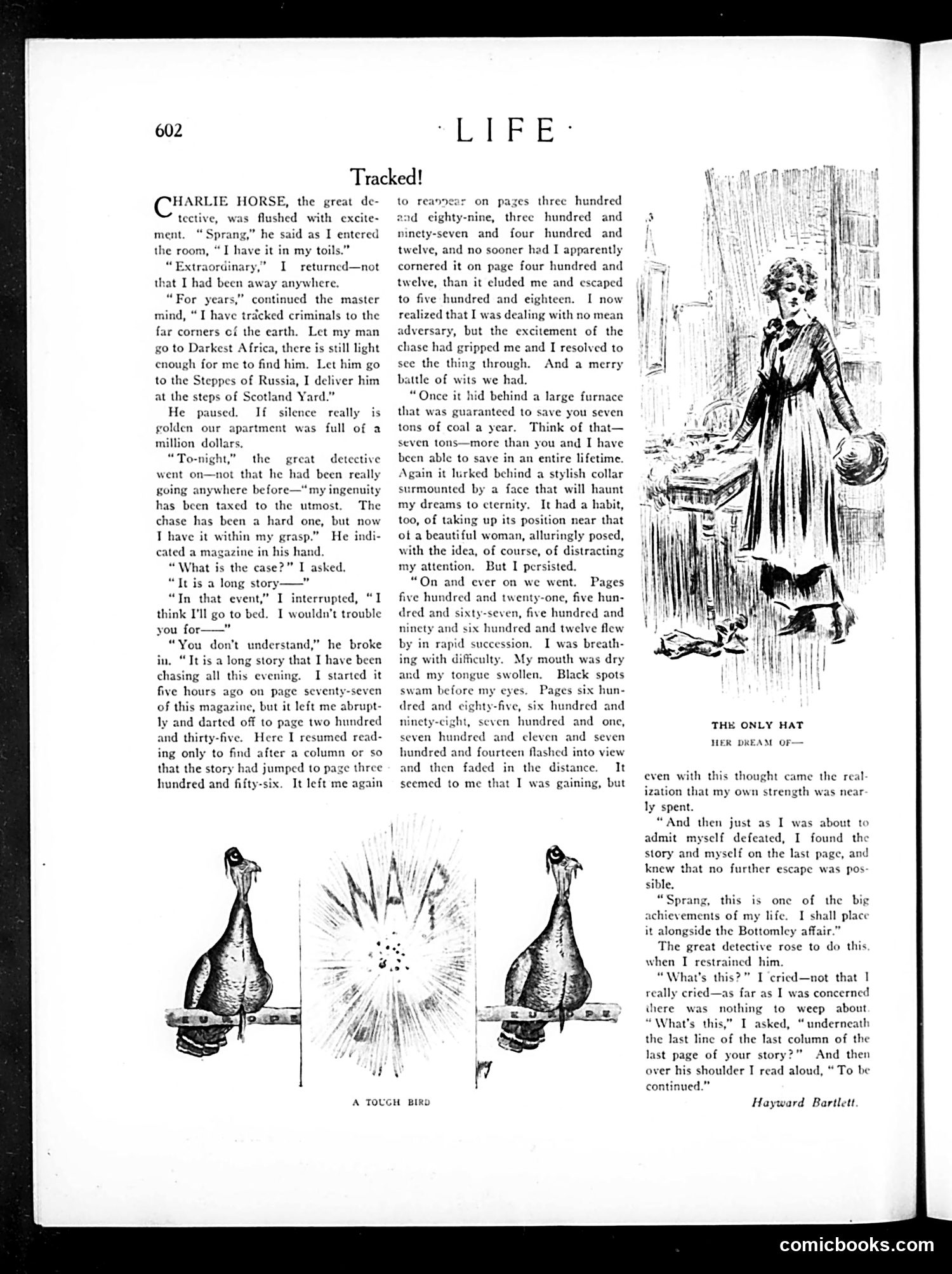
This is a humorous short story by Hayward Bartlett mocking the frustrating experience of reading serialized fiction in magazines like *Life*. The narrator describes "Charlie Horse," a celebrated detective, pursuing what he believes is a criminal—but it's actually a magazine story that jumps chaotically between non-consecutive pages (77, 235, 300+, etc.). The "chase" becomes a comedic metaphor for the reader's exasperating hunt through the publication. The satire targets two things: **magazine advertising** and **serialization practices**. Stories were deliberately fragmented across pages to force readers past advertisements—the real money-makers. The furnace ad, fashion collar advertisement, and beautiful woman imagery the detective encounters while pursuing the story are actual ads interrupting the narrative. The final punchline—"To be continued"—extends the frustration indefinitely, ensuring readers will return next issue and encounter more ads. The accompanying cartoon "A Tough Bird" appears unrelated, showing an explosion around a stylized bird.
📄 Transcribed text from this page (OCR, searchable)
Machine-transcribed from the original scan — historical spelling and the odd misread are preserved.
“LIPFE* Tracked! HARLIE HORSE, the great de- tective, was flushed with excite- ment. “Sprang,” he said as I entered the room, “I have it in my toils.” aordinary,” I returned—not that I had been away anywhere. “For y ” continued the master mind, “I have tracked criminals to the far corners ci the earth. Let my man go to Darkest Africa, there is still light cnough for me to find him. Let him go to the Steppes of Russia, I deliver him at the steps of Scotland Yard.” He paused. If really is golden our apartment was full of a million dollars. silence the great detective went on—not that he had been really going anywhere before—my ingenuity has been taxed to the utmost. The chase has been a hard one, but now T have it within my gras} He indi- cated a magazine in his hand. “What is the case?” I asked. “Tt is a long story——” “In that event,” I interrupted, “I think I'll go to bed. I wouldn't trouble you for——” “You don’t understand,” he broke in. “It is a long story that I have been chasing all this evening. I started it five hours ago on page seventy-seven of this magazine, but it left me abrupt- ly and darted off to page two hundred and thirty-five. Here I resumed read- ing only to find after a column or so that the story had jumped to page three hundred and fifty-six. It left me again three hundred and eight hundred and ninety-seven hundred and twelve, and no sooner had I apparently cornered it on page four hundred and twelve, than it eluded me and escaped to five hundred and eighteen. I now realized that I was dealing with no mean adversary, but the excitement of the chase had gripped me and I resolved to see the thing through. And a merry battle of wits we had. “Once it hid behind a large furnace that was guaranteed to save you seven tons of coal a year. Think of that— seven tons—more than you and I have been able to save in an entire lifetime. Again it lurked behind a stylish collar surmounted by a face that will haunt my dreams to cternity. It had a habit, too, of taking up its position near that ot a beautiful woman, alluringly posed, with the idea, of course, of distracting my attention. But I persisted. “On and ever on we went. Pages five hundred and twenty-one, five hun- dred and sixty-seven, five hundred and ninety and six hundred and twelve flew by in rapid succession. I was breath- ing with difficulty. My mouth was dry and my tongue swollen. Black spots Pages six hun- dred and eighty-five, six hundred and to reannear on pages nine, three and four swam before my eyes. ninety-cight, seven hundred and one, seven hundred and cleven and seven hundred and fourteen flashed into view and then faded in the distance. It seemed to me that I was gaining, but A TOUGH BIRD THE ONLY HAT HER DREAM OF— even with this thought came the real ization that my own strength was near ly spent. “And then just as I was about to admit myself defeated, I found the story and myself on the last page, and knew that no further escape was pos sible. “Sprang, this is one of the big achievements of my life. I shall place it alongside the Bottomley affair.” The great detective rose to do this. when I restrained him. “What's this?” I cricd—not that | really cried—as far as I was concerned there nothing to weep about “What's this,” I asked, “underneath the last line of the last column of the last page of your story?” And then over his shoulder T read aloud, “ To be continued.” was Hayward Bartlett comicbooks.com