
Life, 1920-04-01 · page 25 of 60
Life — April 1, 1920 — page 25: what you’re looking at
What you’re looking at
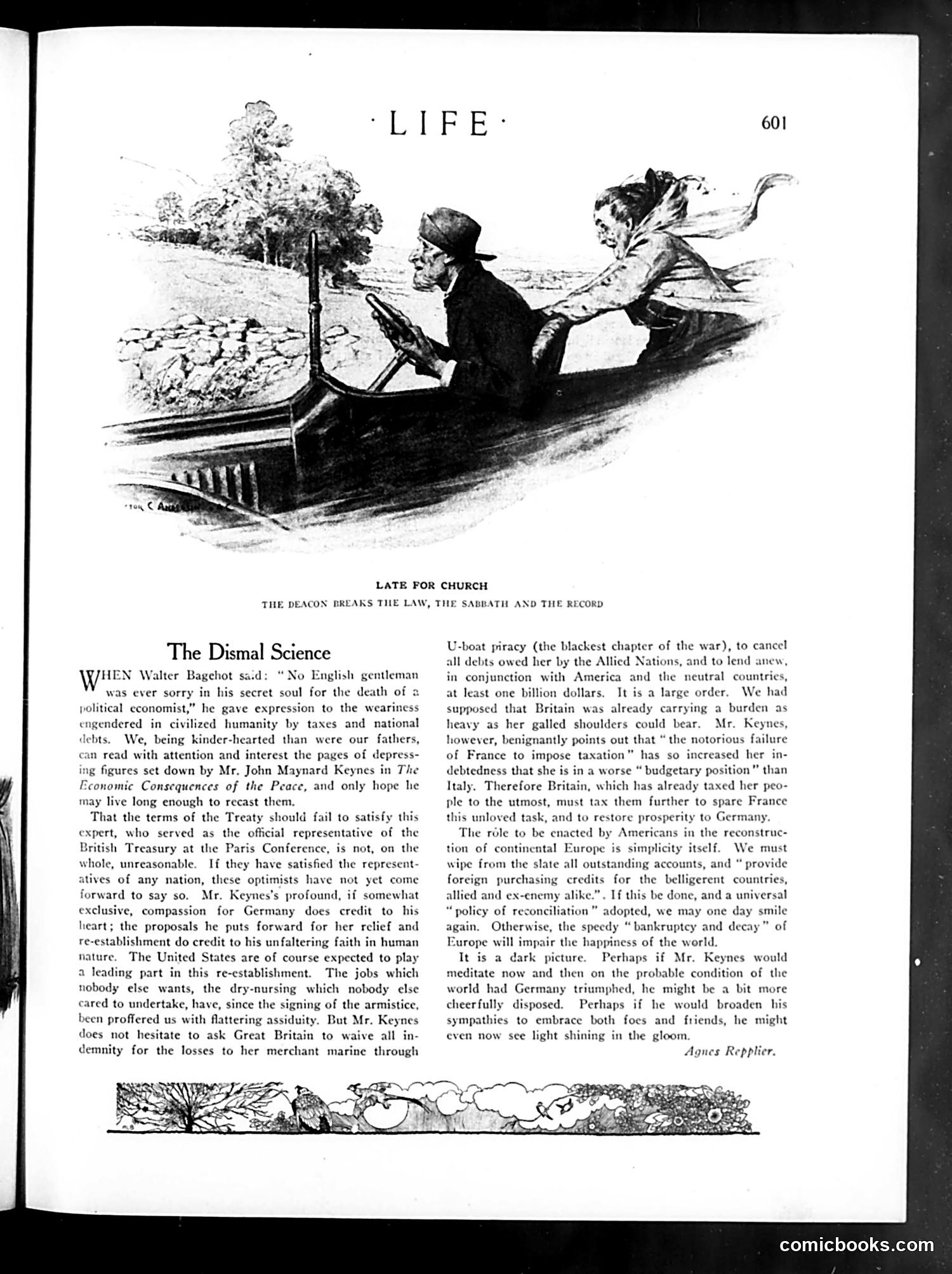
The cartoon depicts a deacon in a boat speeding recklessly, breaking the Sabbath law by traveling on Sunday. The humor plays on the irony: a church official violates religious law (no work/travel on the Sabbath) by rushing to church itself, apparently running late. The accompanying article, "The Dismal Science," discusses economist John Maynard Keynes's post-WWI proposals for Germany's economic relief and Allied debt forgiveness. Critic Agnes Repplier argues Keynes is overly compassionate toward Germany—asking Britain to cancel debts and provide loans despite her own financial strain. She suggests he lacks perspective on the war's actual outcome and should "broaden his sympathies to embrace both foes and friends." The cartoon's ironic title echoes the article's theme: good intentions creating contradictory outcomes.
📄 Transcribed text from this page (OCR, searchable)
Machine-transcribed from the original scan — historical spelling and the odd misread are preserved.
LATE FOR CHURCH THE DEACON BREAKS THE LAW, THE SABBATH AND THE RECORD The Dismal Science Walter Bagehot said: “No English gentleman Ww was ever sorry in his secret soul for the death of political economist,” he gave expression to the weariness engendered in civilized humanity by taxes and national We, being kinder-hearted than were our fathers, read with attention and interest the pages of depre ing figures set down by Mr. John Maynard Keynes in The Economic Consequences of the Peace, and only hope he may live long enough to recast them. That the terms of the Treaty should fail to satisfy this expert, who served as the official representative of the British Treasury at the Paris Conference, is not, on the whole, unreasonable. If they have satisfied the represent- atives of any nation, these optimists have not yet come forward to say so. Mr. Keynes’s profound, if somewhat exclusive, compassion for Germany does credit to his heart; the proposals he puts forward for her relief and re-establishment do credit to his unfaltering faith in human nature. The United States are of course expected to play a leading part in this re-establishment. The jobs which nobody else wants, the dry-nursing which nobody else cared to undertake, have, since the signing of the armistice, been proffered us with flattering assiduity. But Mr. Keynes does not hesitate to ask Great Britain to waive all in- demnity for the losses to her merchant marine through debts. U-boat piracy (the blackest chapter of the war), to cancel all debts owed her by the Allied Nations, and to lend anew, in conjunction with America and the neutral countries, at least one billion dollars. It is a large order. We had supposed that Britain was already carrying a burden as heavy as her galled shoulders could bear. Mr. Keynes, however, benignantly points out that “the notorious failure of France to impose taxation” has so increased her in- debtedness that she is in a worse “ budgetary position” than Italy. Therefore Britain, which has already taxed her peo- ple to the utmost, must tax them further to spare France this unloved task, and to restore prosperity to Germany. Americans in the reconstruc- We must The role to be enacted b: tion of continental Europe is simplicity itself. wipe from the slate all outstanding accounts, and “ provide foreign purchasing credits for the belligerent countries, alike.” If this be done, and a universal “policy of reconciliation” adopted, we may one day smile again. Otherwise, the speedy “bankruptcy and decay” of allied and ex-enem Surope will impair the happiness of the world. It is a dark picture. Perhaps if Mr. Keynes would meditate now and then on the probable condition of the world had Germany triumphed, he might be a bit more cheerfully disposed. Perhaps if he would broaden his sympathies to embrace both foes and friends, he might even now see light shining in the gloom. Agnes Repplier. comicbooks.com