
Life, 1920-04-01 · page 17 of 60
Life — April 1, 1920 — page 17: what you’re looking at
What you’re looking at
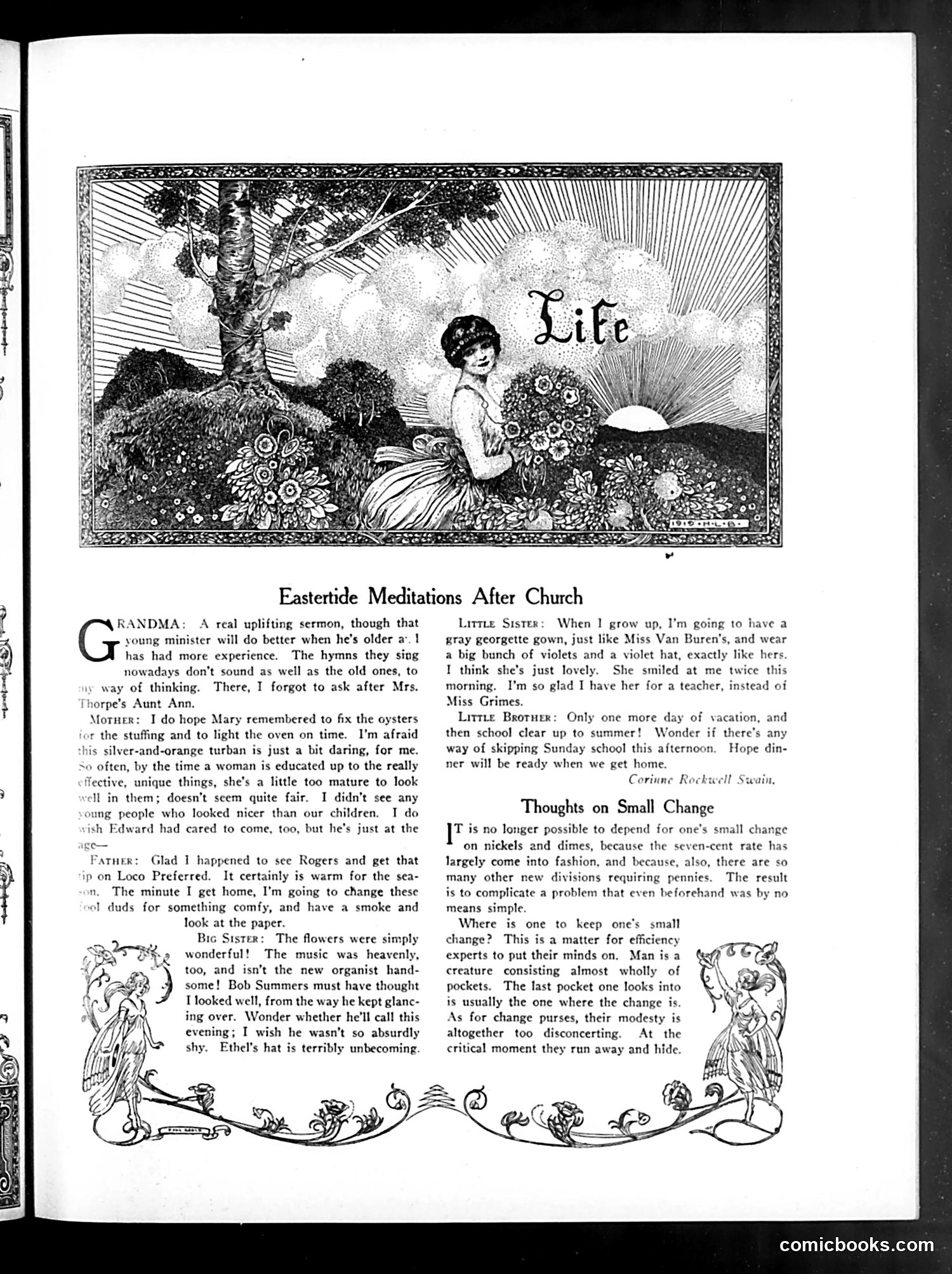
This page contains two distinct pieces of social satire from early 20th-century Life magazine. **"Eastertide Meditations After Church"** is a satirical family dialogue mocking the disconnect between church attendance and actual behavior. Each family member's "pious" church experience immediately gives way to mundane or self-interested thoughts: the grandmother critiques the sermon, the mother worries about her outfit and dinner preparations, the father thinks about stock tips, the big sister obsesses over a boy's attention, and the little brother schemes to skip Sunday school. The satire targets bourgeois hypocrisy—the gap between public religious devotion and private materialism and vanity. **"Thoughts on Small Change"** humorously complains about modern currency complications. The "seven-cent rate" reference appears garbled by OCR, but the piece satirizes how new monetary subdivisions (pennies, nickels, dimes) create practical annoyances—men have too many pockets, change purses are unreliable. It's gentle satire on everyday modern inconveniences and inefficiency.
📄 Transcribed text from this page (OCR, searchable)
Machine-transcribed from the original scan — historical spelling and the odd misread are preserved.
ray, 3552 a oF Pe OG st Eastertide Meditations After Church RANDMA: A real uplifting sermon, though that young minister will do better when he's older a’. 1 has had more experience. The hymns they sing nowadays don’t sound as well as the old ones, to vy way of thinking. There, I forgot to ask after Mrs. Thorpe’s Aunt Ann. Morner: I do hope Mary remembered to fix the oysters r the stuffing and to light the oven on time. I'm afraid this silver-and-orange turban is just a bit daring, for me. often, by the time a woman is educated up to the really fective, unique things, she’s a little too mature to look ell in them; doesn’t seem quite fair. I didn’t see any g people who looked nicer than our children. I do vish Edward had cared to come, too, but he's just at the c— Fatner: Glad I happened to see Rogers and get that ip on Loco Preferred. It certainly is warm for the sea- n. The minute I get home, I’m going to change these ol duds for something comfy, and have a smoke and look at the paper. Bic Sister: The flowers were simply wonderful! The music was heavenly, too, and isn’t the new organist hand- some! Bob Summers must have thought I looked well, from the way he kept glanc- ing over. Wonder whether he'll call this evening; I wish he wasn’t so absurdly shy. Ethel’s hat is terribly unbecoming. Littte Sister: When 1 grow up, I'm going to have a gray georgette gown, just like Miss Van Buren’s, and wear a big bunch of violets and a violet hat, exactly like hers. I think she’s just lovely. She smiled at me twice this morning. I’m so glad I have her for a teacher, instead of Miss Grimes. Littte Brotuer: Only one more day of vacation, and then school clear up to summer! Wonder if there's any way of skipping Sunday school this afternoon. Hope din- ner will be ready when we get home. Corinne Roe Thoughts on Small Change T is no longer possible to depend for one’s small change on nickels and dimes, because the seven-cent rate has largely come into fashion, and because, also, there are so many other new divisions requiring pennies. The result is to complicate a problem that even beforehand was by no means simple. Where is one to keep one’s small change? This is a matter for efficiency experts to put their minds on. Man is a creature consisting almost wholly of pockets. The last pocket one looks into is usually the one where the change is. As for change purses, their modesty is altogether too disconcerting. At the critical moment they run away and hide. Swain, comicbooks.com