
Life, 1908-10-22 · page 14 of 24
Life — October 22, 1908 — page 14: what you’re looking at
What you’re looking at
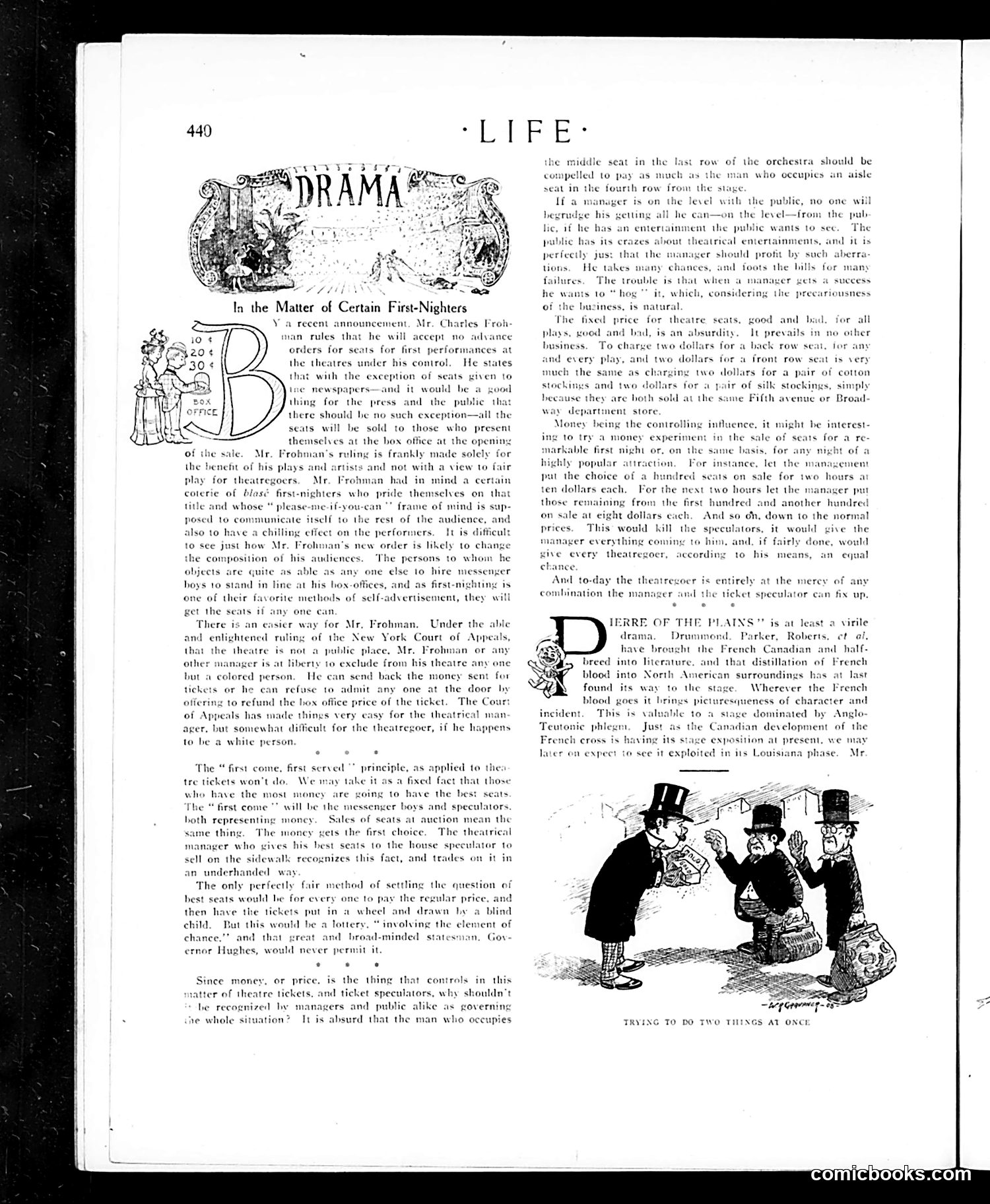
This article critiques Charles Frohman's (prominent theatrical producer) new policy eliminating advance seat orders for theater premieres. The satire targets wealthy, pretentious "first-nighters"—elite theatergoers who prided themselves on attending opening nights and allegedly disrupted performances with their affected behavior. Frohman claimed his rule benefited artists, but the author argues it changes nothing: wealthy speculators and messenger boys will still monopolize best seats. The piece exposes the hypocrisy: theater operates on money, not fairness, yet pretends otherwise. The accompanying cartoon depicts men "trying to do two things at once"—likely showing the absurdity of competing interests in theater ticketing. The article also references Governor Hughes and New York Court of Appeals rulings allowing theaters to refuse service to Black patrons, illustrating systemic racism underlying these supposedly egalitarian policies.
📄 Transcribed text from this page (OCR, searchable)
Machine-transcribed from the original scan — historical spelling and the odd misread are preserved.
“LIPE- In the Matter of Certain First-Nighters Y a recent announcement. Mr. Char! Froh man rules that he will accept no advance orders for seats for first performances at the theatres under his control, He states that with the exception of seats given to Ine newspapers—and it would be a ¢ for the press and the public there should he no such exception seats will be sold to those who present themselves at the box office at the openiny of the sale. Mr. Frohman’s ruling is frankly made sole the heneft of his plays and artist not with a view to fair play for theatregoers. Mr. Frohman had in mind a certain erie of biasé first-nighters who pride themselves on that title 1 whose * please-me-if-you-can "" f ¢ of mind is sup- le itself to the rest of the audience, and It is difficult posed to commur also to have a chilling effect on the performers, to see just how Mr. Frohman’s new order is likely to change ¢ composition of his audiences. ‘The persons to whom he jects are quite as able as any one else to hire messe boys to stand in line at his box-offices, and as first-ni one of their favorite methods of self-advertisement, th get the seats if any one can 1 for Mr, Frohman, Under the able and enlightened ruling of the New York Court of Appeals, lic place, Mr. Frohman or any cre is an ensier wa that the theatre is not ay exclude from his theatre any one un send back the money sent for other manager is at liberty but a colored person. He tickets or he can refuse to admit any one at the door by offering to refund the box office price of the ticket. The of Appeals has made things very easy for the theatrical man ager, but somewhat dificult for the theatregoer, if he happens to he a white person pplied tot that those to have the best seats. The “ first come, first served We may take its who have the most money * will be the tre tickets won't do Th first come hoth representing money he money gets the first choice ager boys and speculators. Sales of seats at auction mean the same thing The theatrical manager who gives his best seats to the house speculator to sell on the sidewalk recognizes this fact, and trades on it in an underhanded way The only perfectly fair method of settling the question of hest seats would he for every one to pay the resular price, and then have the tickets put in a wheel and drawn by a blind child. But this w he a lottery, “involving the clement of chance.”? and that great and broad-minded statesman, Gov ernor Hughes, would never permit it Since money, or price. is the thing that controls in this er of theatre tickets, and ticket speculators, why shouldn't he recognized by managers and public alike as governing ye whole situation? It is absurd that the man who occupies he middle seat in the last row of the orchestra should be compelled to pay as much ay the man who occupies an aisle seat in the fourth row from the stage If a manager the level with the public, no one will getting all he can—on the level—from the pub if he bas an entertainment the public wants to see. The public has its crazes about theatrical entertainments, and it is perfectly just that the manager should profit by such aberra tions, He takes ny ch and foots the bills for many failures, The trouble is that when a manager gets a success he wants to “hog it, which, considering the precariousness of the business, is natural The fixed price for theatre seats, good and bad, for all plays, good and Dad, is an absurdity. It prevails in no other business. To charge two dollars for a back row seat, jor any und every play, and two dollars for a front row seat is very much the same as charging two dollars for a pair of cotton chings and two dollars for a pair of silk stockings, simply bee hey are both sold at the same Fifth avenue or Broad way riinent store Money being the controlling influence, it might be interest- ing to try a money experimen’ © sale of seats for a re nthe same basis, for any night of a popular « For instance, let the management the choice of a hundred seais on sale for two hours a For the next two hours let the manager put those remaining from the first hundred and another hundre« on sale at eight dollars each. And so dh, down to the normal ten dollars each, prices. This would Kill the speculators, it would give the manager every coming to him, and, if fairly done, would give every theatregoer, according to his means, chance. Anil to-day the the combination the manager egoer is entirely at the merey of any € ticket speculator can fix up. IERRE OF THE PLAINS” is at least a virile drama, Drummond. Parker, Roberts, ct al, ave brought the French Canadian and half- breed into literature that distillation of French blood into North American surroundings has at last found way to the stage. Wherever the French blood goes it brings picturesqueness of character and This is valuable 10 a stage dominated by Anglo: Teutonic phleget. Just as the Canadian development of th French cross is having its stage exposition at present. we 1 1 later en expect to see it exploited in its Louisiana phase G TO DO TWO THINGS AT ONCE