
Life, 1894-12-13 · page 4 of 16
Life — December 13, 1894 — page 4: what you’re looking at
What you’re looking at
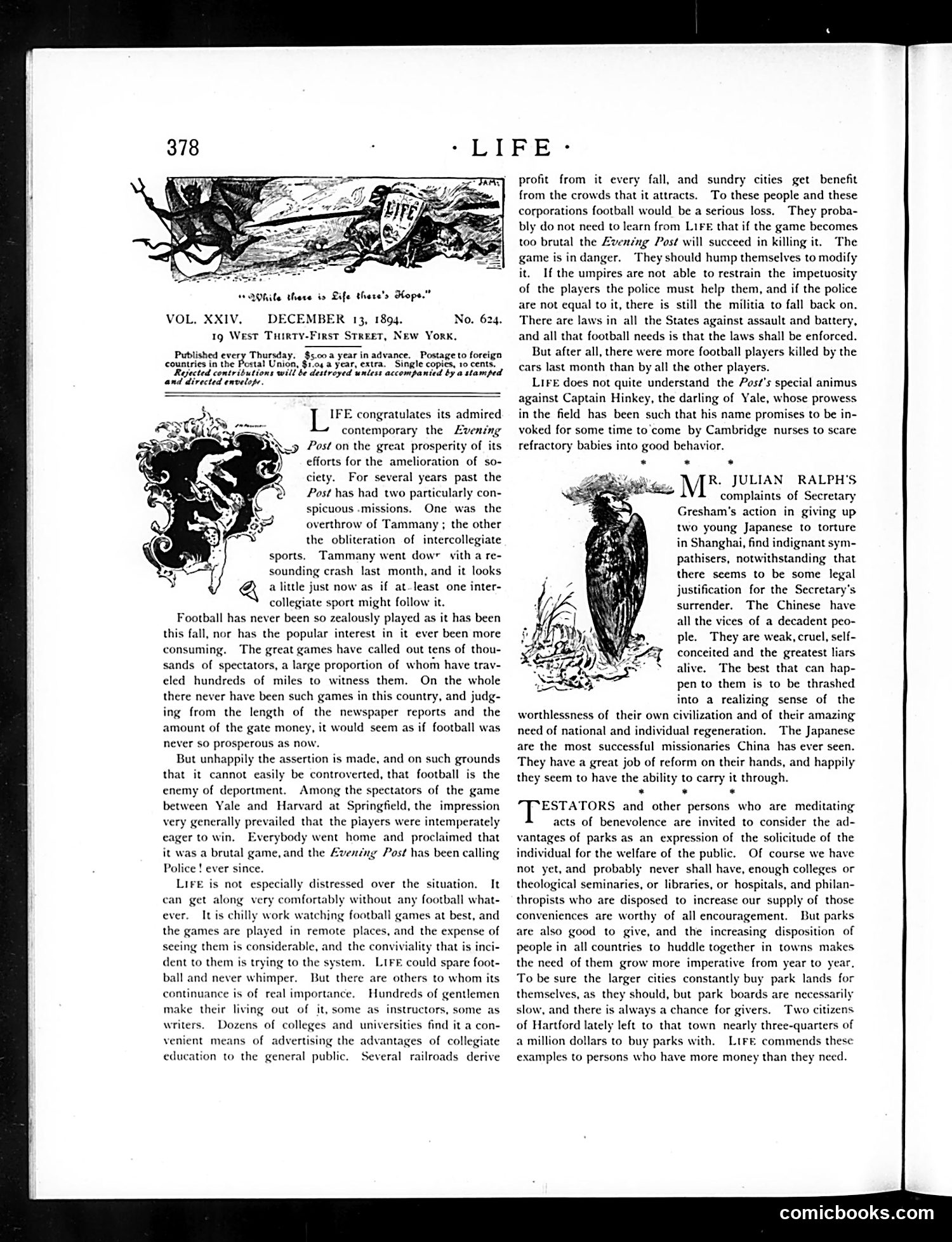
**Main Cartoon ("Life there is Life there's Hope"):** The image shows a skeletal Death figure, likely referencing the grim toll of American football. This cartoon critiques the sport's danger and casualties—the text discusses deaths from football "last month" and notes the "Evening Post will succeed in killing it." **Context:** In 1894, college football had become brutally violent with minimal safety rules. The text references recent deaths, calls for law enforcement intervention, and mentions a Yale-Harvard game where spectators complained players were "intemperately eager to win." The editorial satirizes football's popularity despite its body count, suggesting authorities should regulate the sport to prevent further fatalities. The cartoon darkly comments on football's compatibility with death itself.
📄 Transcribed text from this page (OCR, searchable)
Machine-transcribed from the original scan — historical spelling and the odd misread are preserved.
> LIFE: QWhile there is Life there's Hops. VOL. XXIV, DECEMBER 13, 1894. No. 62. 19 West Tuirty-First Street, New York, Published every Thursday, $5.00 a year in advance. Postage to foreign countries in the Postal Union, $1.04 a year, extra. Single copies, 10 cents. Rejected contributions will be destreyed untess accompanied by a stamped and directed envelope. IFE congratulates its admired contemporary the Evening 5 Poston the great prosperity of its efforts for the amelioration of so- ciety. For several years past the Post has had two particularly con- spicuous .missions. One was the overthrow of Tammany ; the other the obliteration of intercollegiate sports. Tammany went dowr vith a re- sounding crash last month, and it looks a little just now as if at-least one inter- collegiate sport might follow it. Football has never been so zealously played as it has been this fall, nor has the popular interest in it ever been more consuming. The great games have called out tens of thou- sands of spectators, a large proportion of whom have trav- eled hundreds of miles to witness them. On the whole there never have been such games in this country, and judg- ing from the length of the newspaper reports and the amount of the gate money, it would seem as if football was never So prosperous as now. But unhappily the assertion is made, and on such grounds that it cannot easily be controverted, that football is the enemy of deportment. Among the spectators of the game between Yale and Harvard at Springfield, the impression very generally prevailed that the players were intemperately Everybody went home and proclaimed that nd the Evening Post has been calling eager to win. it was a brutal game. Police ! ever since. Lire is not especially distressed over the situation. It can get along very comfortably without any football what- ever. Itis chilly work watching football games at best, and the games are played in remote places, and the expense of seeing them is considerable, and the conviviality that is inci- dent to them is trying to the system. LIFE could spare foot- ball and never whimper. But there are others to whom its continuance is of real importance. Hundreds of gentlemen make their living out of it, some as instructors, some as Dozens of colleges and universi find it a con- antages of collegiate veral railroads derive writers. venient means of advertising the ad) education to the general public. $ profit from it every fall, and sundry cities get benefit from the crowds that it attracts. To these people and these corporations football would be a serious loss. They proba- bly do not need to learn from LiFe that if the game becomes too brutal the Evening Post will succeed in killing it. The game is indanger. They should hump themselves to modify it. If the umpires are not able to restrain the impetuosity of the players the police must help them, and if the police are not equal to it, there is still the militia to fall back on. There are laws in all the States against assault and battery, and all that football needs is that the laws shall be enforced. But after all, there were more football players killed by the cars last month than by all the other players. LiFe does not quite understand the Post's special animus against Captain Hinkey, the darling of Yale, whose prowess in the field has been such that his name promises to be in- voked for some time to’come by Cambridge nurses to scare refractory babies into good behavior. . * . Soe, [PR JULIAN RALPH'S complaints of Secretary Gresham's action in giving up two young Japanese to torture in Shanghai, find indignant sym- pathisers, notwithstanding that there seems to be some legal justification for the Secretary's surrender. The Chinese have all the vices of a decadent peo- ple. They are weak, cruel, self- conceited and the greatest liars alive. The best that can hap- pen to them is to be thrashed into a realizing sense of the worthlessness of their own civilization and of their amazing need of national and individual regeneration. The Japanese are the most successful missionaries China has ever seen. They have a great job of reform on their hands, and happily they seem to have the ability to carry it through. . . . ESTATORS and other persons who are meditating acts of benevolence are invited to consider the ad- vantages of parks as an expression of the solicitude of the individual for the welfare of the public. Of course we hat not yet, and probably never shall have, enough colleges theological seminaries, or libraries, or hospitals, and philan- thropists who are disposed to increase our supply of those conveniences are worthy of all encouragement. But par! are also good to give, and the increasing disposition of people in all countries to huddle together in towns makes the need of them grow more imperative from year to year, To be sure the larger cities constantly buy park lands for themselves, as they should, but park boards are necessarily slow, and there is always a chance for givers. Two citizens of Hartford lately left to that town nearly three-quarters of a million dollars to buy parks with. LiFe commends these examples to persons who have more money than they need. comicbooks.com