
Life, 1890-06-05 · page 7 of 16
Life — June 5, 1890 — page 7: what you’re looking at
What you’re looking at
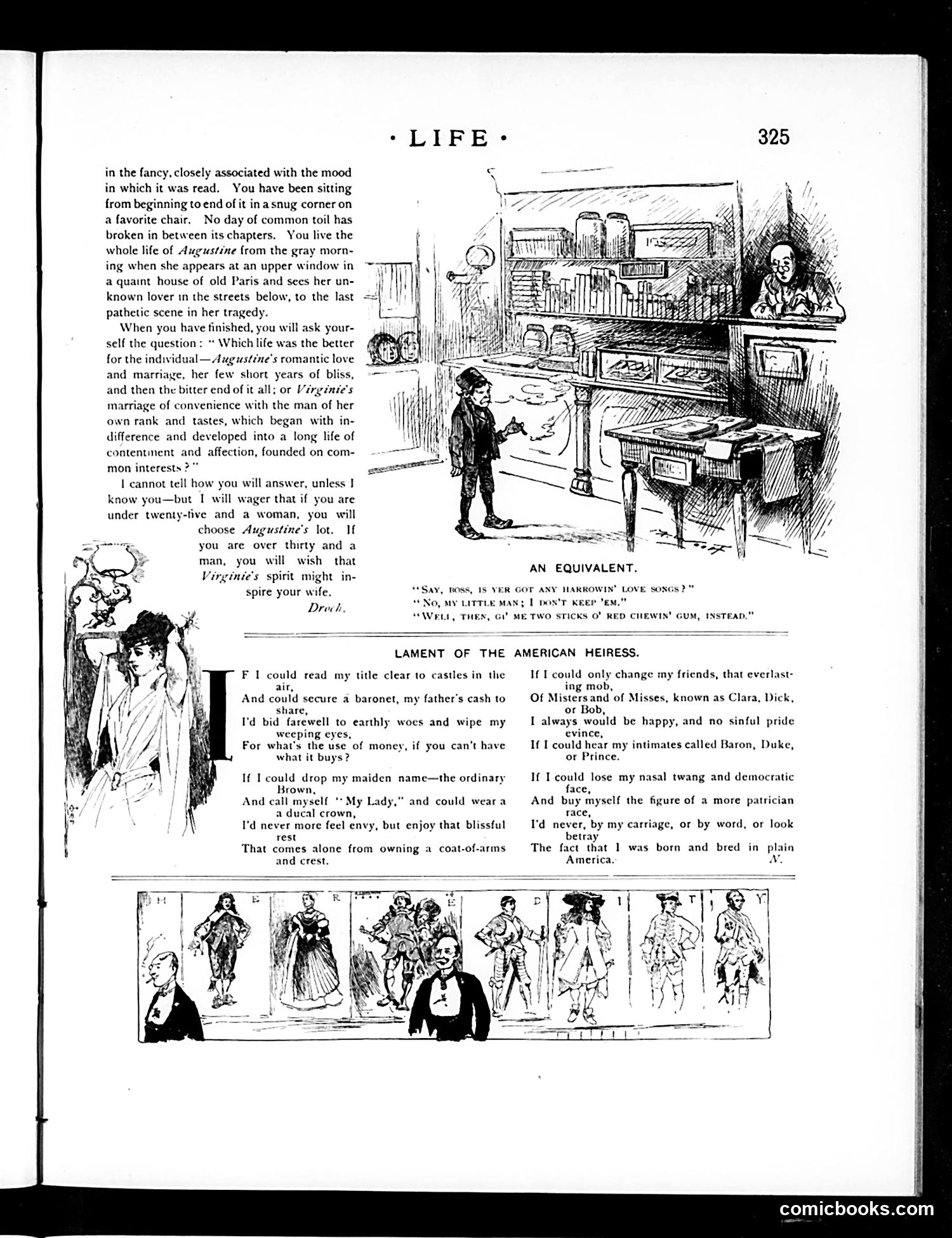
This page satirizes American women's social aspirations through two pieces: **"An Equivalent"** (top cartoon): Shows a woman rejecting romantic gestures. The dialogue mocks courtship rituals—she dismisses "barrow's love songs" in favor of chewing gum, suggesting materialistic preferences over romance. **"Lament of the American Heiress"** (main poem): A wealthy American woman laments her inability to acquire European markers of status—aristocratic titles, coats-of-arms, or advantageous marriages to European nobility. The satire targets the Gilded Age phenomenon where wealthy American heiresses married impoverished European aristocrats for titles. The bottom illustration shows various historical costume figures, likely contrasting European nobility with American plainness. The overall message: American wealth cannot buy genuine aristocratic legitimacy.
📄 Transcribed text from this page (OCR, searchable)
Machine-transcribed from the original scan — historical spelling and the odd misread are preserved.
in the fancy, closely associated with the mood in which it was read. You have been sitting from beginning to end of it ina snug corner on a favorite chair. No day of common toil has broken in between its chapters. You live the whole life of Augustine {rom the gray morn- ing when she appears at an upper window in a quaint house of old Paris and sees her un- known lover in the streets below, to the last pathetic scene in her tragedy. When you have finished, you will ask your- self the question : * Which life was the better for the individual — Augustine's romantic love and marriage, her few short years of bliss, and then the bitter end of it all; or Vergénge's marriage of convenience with the man of her own rank and tastes, which began with in- difference and developed into a long life of contentinent and affection, founded on com- mon interests ?” 1 cannot tell how you will answer, unless | know you—but I will wager that if you are under twenty-tive and a woman, you will choose Augustine's lot. If you are over thirty and a man, you will wish that Virginie's spirit might in- spire your wife. Droch, AN EQUIVALENT. 'SAY, HOSS, IS VER GOT ANY HAKROWIN’ LOVE soncs ?* “No, MY LITTLE M. CWELI, THES, I bon'T Keer ‘eM,’ ME TWO STICKS O' RED CHEWIN' GUM, INSTEAD.” LAMENT OF THE AMERICAN HEIRESS. F I could read my title clear to castles in the air, And could secure a baronet, my father's cash to share, I'd bid farewell to earthly woes and wipe my weeping eyes, For what's the use of money, if you can’t have what it buys? If I could drop my maiden name—the ordinary Brown, And call myself ‘* My Lady," and could wear a a ducal crown, I'd never more feel envy, but enjoy that blissful rest That comes alone from owning a coat-of-arms and crest. If I could only change my friends, that everlast- ing mob, Of Misters and of Misses, known as Clara, Dick, or Bob, I always would be happy, and no sinful pride evince, If I could hear my intimates called Baron, Duke, or Prince. If T could lose my nasal twang and democratic face, And buy myself the figure of a more patrician race, I'd never, by my carriage, or by word, or look betray The fact that 1 was born and bred in plain America. comicbooks.com