
Life, 1890-06-05 · page 6 of 16
Life — June 5, 1890 — page 6: what you’re looking at
What you’re looking at
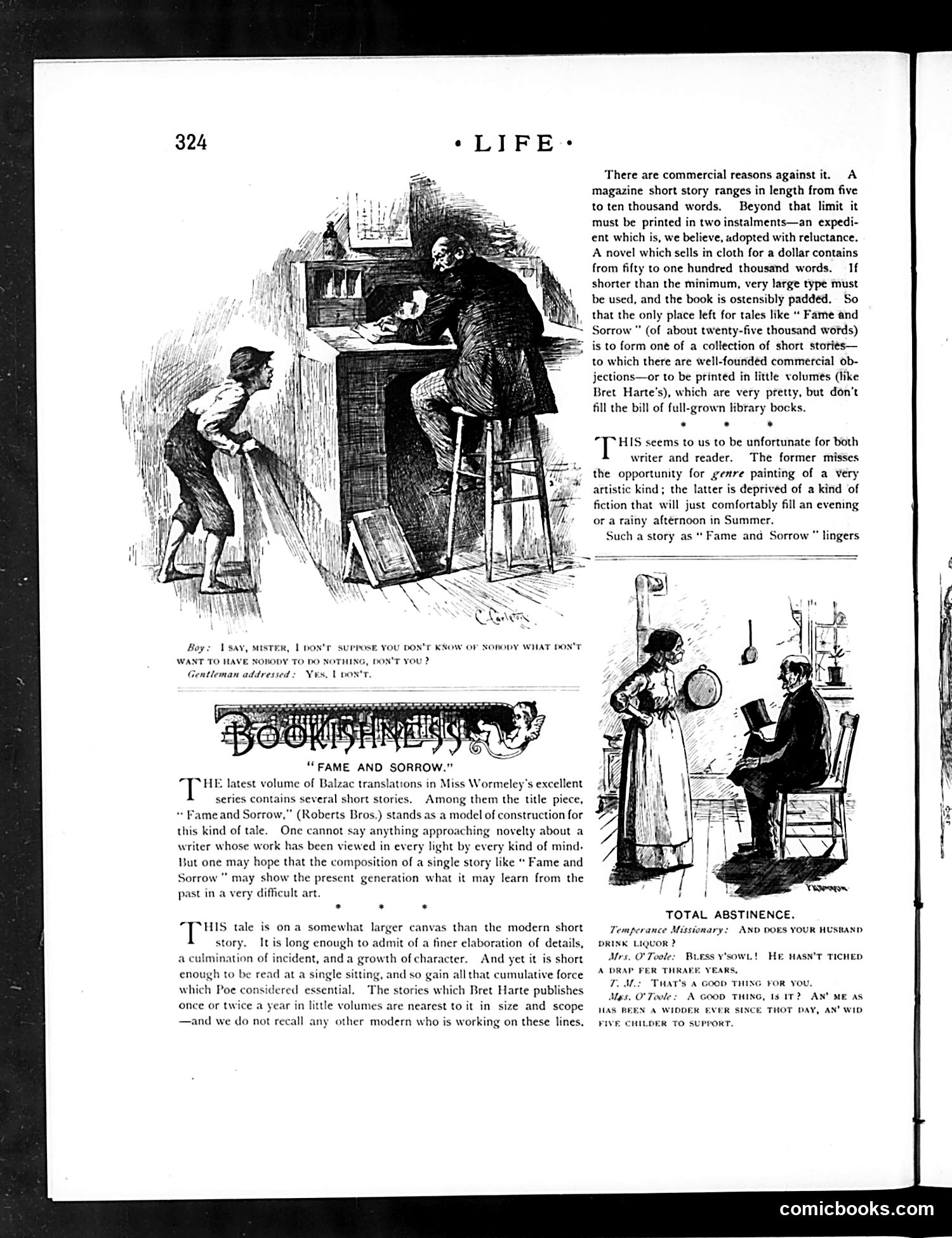
This page discusses the literary form of short stories, specifically reviewing Balzac translations and a work titled "Fame and Sorrow" by Roberts Bros. publishers. The two illustrations are Victorian-era satirical sketches showing domestic scenes. The top cartoon depicts a boy speaking to a gentleman at a desk, with dialogue about not knowing "of sorrow what don't want to have sorrow to do nothing, don't you?" - appearing to mock pretentious or circumlocutory speech. The bottom illustration, labeled "Total Abstinence," shows what appears to be a temperance-related domestic scene between a woman and man, likely satirizing abstinence pledges or prohibition advocacy that was gaining traction in this era. Both sketches use humor to comment on social attitudes and domestic life of the period.
📄 Transcribed text from this page (OCR, searchable)
Machine-transcribed from the original scan — historical spelling and the odd misread are preserved.
Boy: 1 Sav, MISTER, | DON'T SUPPOSE YOU DON'T KNOW OF NONODY WHAT DON'T WANT TO HAVE NOBODY TO PO NOTHING, DON'T OU ? Gentleman addressed; Yes. 1 pox't. “FAME AND SORROW.” “TCHE latest volume of Balzac translations in Miss Wormeley’s excellent series contains several short stories. Among them the title piece, meand Sorrow,” (Roberts Bros.) stands as a model of construction for this kind of tale. One cannot say anything approaching novelty about a writer whose work has been viewed in every light by every kind of mind. ut one may hope that the composition of a single story like * Fame and Sorrow” may show the present generation what it may learn from the past in a very difficult art. I It is long enough to admit of a finer elaboration of details, a culmination of incident, anda growth of character. And yet it is short enough to be read at a single sitting, and so gain all that cumulative force which Poe cons The stories which Bret Harte publishes rin little volumes are nearest to it in size and scope —and we do not recall any other modern who is working on these lines. “HIS tale is on a somewhat larger canvas than the modern short story. ed essential, or twice a y There are commercial reasons against it. A magazine short story ranges in length from five to ten thousand words. Beyond that limit it must be printed in two instalments—an expedi- ent which is, we believe, adopted with reluctance. A novel which sells in cloth for a dollar contains from fifty to one hundred thousand words. If shorter than the minimum, very large type must be used, and the book is ostensibly padded. So that the only place left for tales like “ Fame and ~ Sorrow ” (of about twenty-five thousand words) ~ is to form one of a collection of short stories— to which there are well-founded commercial ob- jections—or to be printed in little volumes (like Bret Hart which are very pretty, but don’t fill the bill of full-grown library bocks. . * * *TTHIS seems to us to be unfortunate for both writer and reader. The former misses the opportunity for gesre painting of a very artistic kind; the latter is deprived of a kind of fiction that will just comfortably fill an evening or a rainy afternoon in Summer, Such a story as “Fame and Sorrow " lingers TOTAL ABSTINENCE. Temperance Missionary: AND DOES YOUR HUSBAND DRINK LIQUOR ? Ars, O' Toole: BLESS y'sOwL ! A DRAP FER THRAEE YEARS, T. M.: THAT'S 4 GooD THING FOR You, Mas. O'Toole: A GOOD THING, 18 IT? AN’ ME AS HAS BEEN A WIDDER EVER SINCE THOT DAY, AN’ WID FIVE CHILDER TO SUPPORT. He Hasn't TICHED comicbooks.com