
Life, 1886-09-23 · page 5 of 16
Life — September 23, 1886 — page 5: what you’re looking at
What you’re looking at
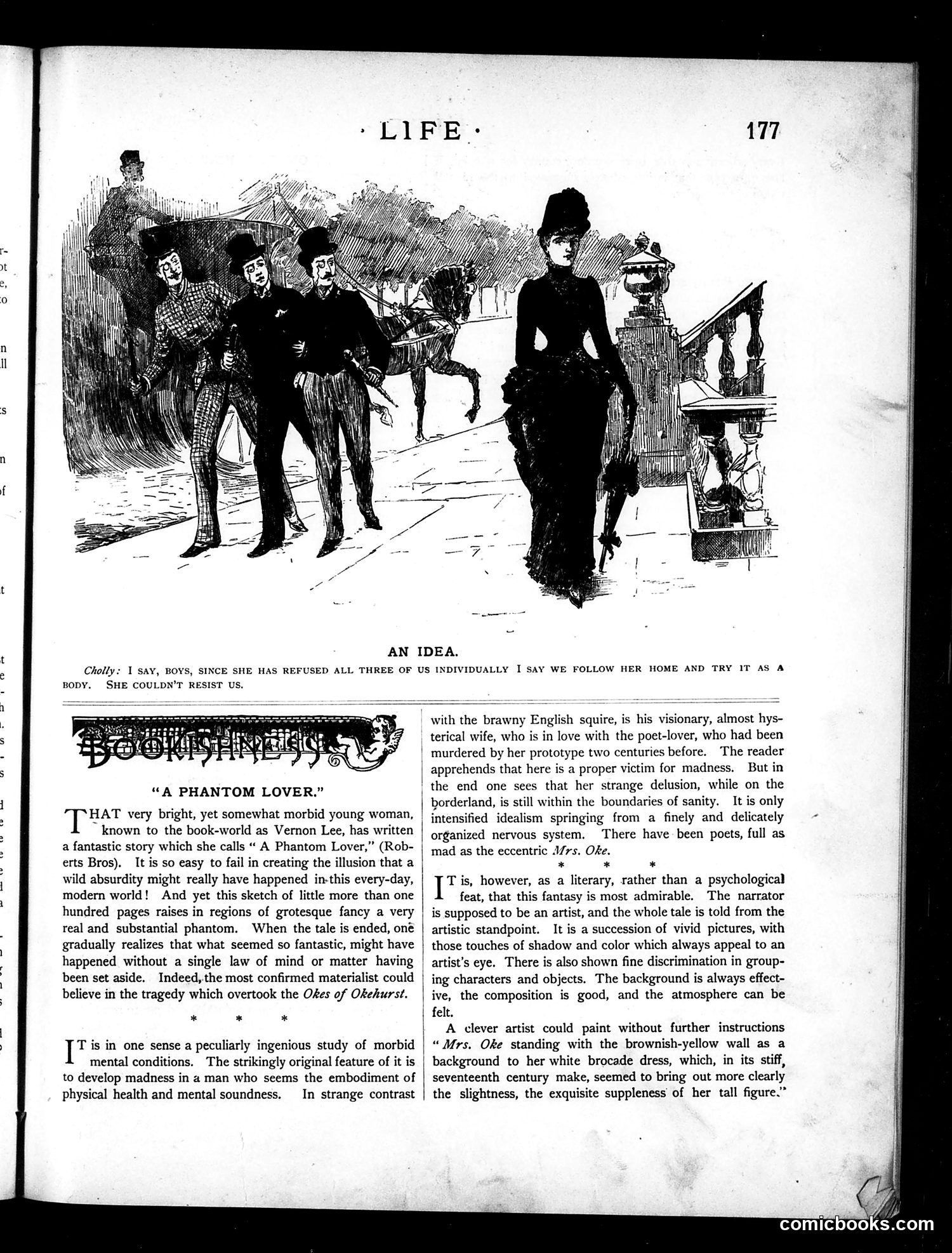
The main cartoon titled "AN IDEA" depicts a woman in black walking past three men who propose following her home "as a body" since "she couldn't resist us." This is satirical commentary on aggressive male pursuit and harassment—presenting the men's presumption as absurd. Below, the text discusses "A Phantom Lover," a literary work by Roberts Bros. The review describes it as a fantastical story about a young woman's mental delusion involving a poet-lover. The critique praises its artistic merit: vivid imagery, skilled character development, and effective composition. The satire appears to mock both male entitlement (top cartoon) and romantic fantasy detached from reality (the book review), suggesting contemporary anxieties about women's judgment and modern courtship.
📄 Transcribed text from this page (OCR, searchable)
Machine-transcribed from the original scan — historical spelling and the odd misread are preserved.
AN IDEA. Cholly: 1 SAY, BOYS, SINCE SHE HAS REFUSED ALL THREE OF US INDIVIDUALLY I SAY WE FOLLOW HER HOME AND TRY IT AS A BODY, SHE COULDN’T RESIST US. “A PHANTOM LOVER.” HAT very bright, yet somewhat morbid young woman, known to the book-world as Vernon Lee, has written a fantastic story which she calls “ A Phantom Lover,” (Rob- erts Bros). It is so easy to fail in creating the illusion that a wild absurdity might really have happened in-this every-day, modern world! And yet this sketch of little more than one hundred pages raises in regions of grotesque fancy a very real and substantial phantom. When the tale is ended, oné gradually realizes that what seemed so fantastic, might have happened without a single law of mind or matter having been set aside. Indeed,.the most confirmed materialist could believe in the tragedy which overtook the Okes of Okehurst. * * * FF is in one sense a peculiarly ingenious study of morbid mental conditions. The strikingly original feature of it is to develop madness in a man who seems the embodiment of physical health and mental soundness. _In strange contrast with the brawny English squire, is his visionary, almost hys- terical wife, who is in love with the poet-lover, who had been murdered by her prototype two centuries before. The reader apprehends that here is a proper victim for madness. But in | the end one sees that her strange delusion, while on the borderland, is still within the boundaries of sanity. It is only intensified idealism springing from a finely and delicately organized nervous system. There have been poets, full as mad as the eccentric rs. Oke. * * * T is, however, as a literary, rather than a psychological feat, that this fantasy is most admirable. The narrator is supposed to be an artist, and the whole tale is told from the artistic standpoint. It is a succession of vivid pictures, with those touches of shadow and color which always appeal to an | artist’s eye. There is also shown fine discrimination in group- ing characters and objects. The background is always effect- ive, the composition is good, and the atmosphere can be | felt. A clever artist could paint without further instructions “Mrs. Oke standing with the brownish-yellow wall as a background to her white brocade dress, which, in its stiff, seventeenth century make, seemed to bring out more clearly the slightness, the exquisite suppleness of her tall figure.” comicbooks.com