
Life, 1886-09-23 · page 4 of 16
Life — September 23, 1886 — page 4: what you’re looking at
What you’re looking at
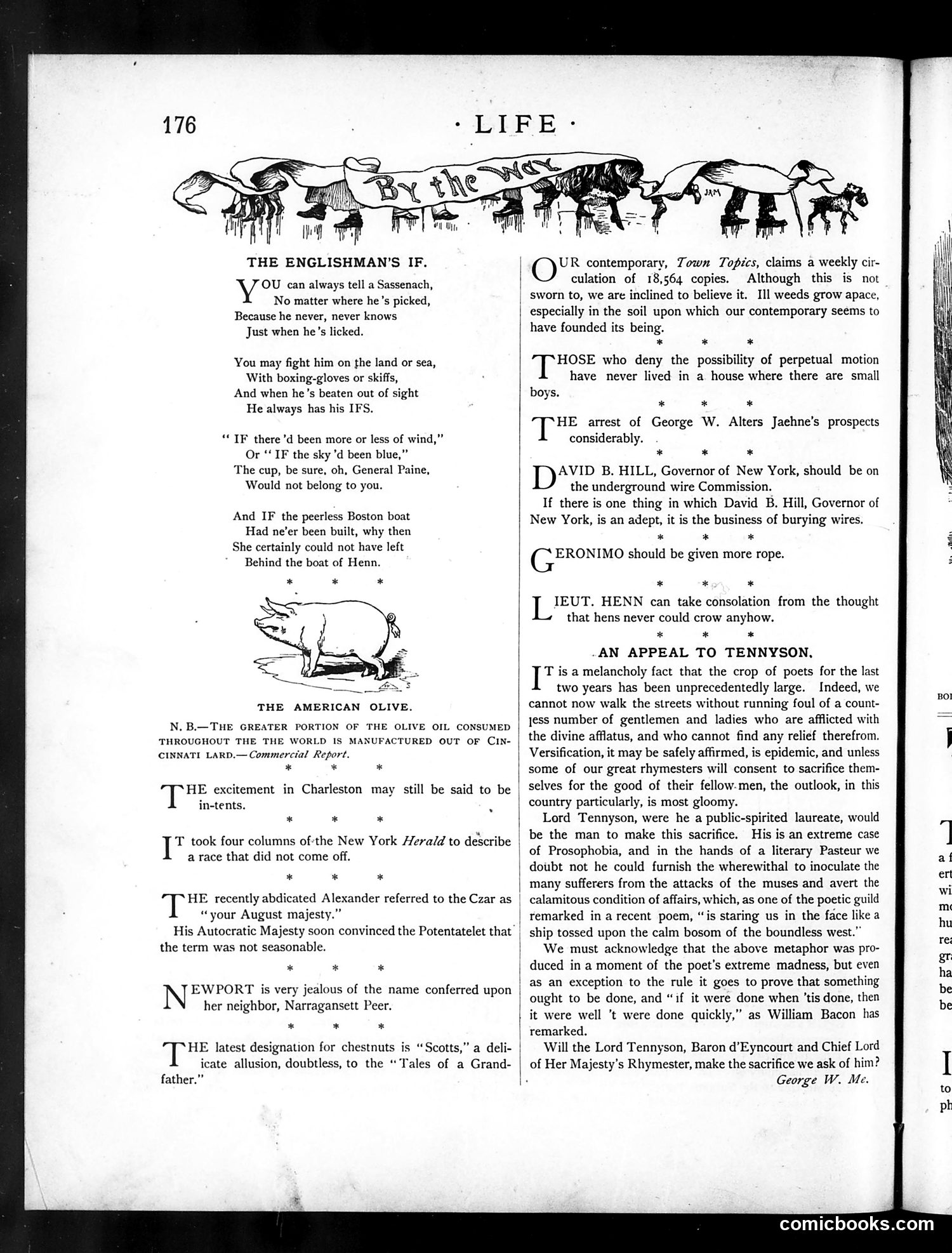
**"The Englishman's If"** is a satirical poem mocking British stoicism and conditional thinking. It playfully suggests an Englishman can be identified by his refusal to explain himself—he "never knows / Just when he's licked" and maintains composure regardless of circumstances (fighting on land or sea, losing boxing matches). The humor lies in stereotyping British emotional restraint and the upper-class tendency to avoid direct confrontation. **"The American Olive"** appears to be a brief note about olive oil consumption, likely satirizing American commercial interests. The right column contains miscellaneous short satirical observations about contemporary figures including Governor David B. Hill of New York and "An Appeal to Tennyson," criticizing poets' apparent detachment from social suffering. The pig illustration accompanies "The American Olive" reference.
📄 Transcribed text from this page (OCR, searchable)
Machine-transcribed from the original scan — historical spelling and the odd misread are preserved.
THE ENGLISHMAN’S IF. OU can always tell a Sassenach, No matter where he’s picked, Because he never, never knows Just when he’s licked. You may fight him on the land or sea, With boxing-gloves or skiffs, And when he’s beaten out of sight He always has his IFS. “IF there ’d been more or less of wind,” Or ‘IF the sky 'd been blue,” The cup, be sure, oh, General Paine, Would not belong to you. And IF the peerless Boston boat Had ne’er been built, why then She certainly could not have left Behind the boat of Henn. THE AMERICAN OLIVE. N, B.—THE GREATER PORTION OF THE OLIVE OIL CONSUMED THROUGHOUT THE THE WORLD IS MANUFACTURED OUT OF CIN- CINNATI LARD.— Commercial Report. * * * HE excitement in Charleston may still be said to be | country particularly, is most gloomy. in-tents. * * * T took four columns of:the New York Herald to describe | a race that did not come off. * * * HE recently abdicated Alexander referred to the Czar as | “your August majesty.” His Autocratic Majesty soon convinced the Potentatelet that" the term was not seasonable. * % * EWPORT i: y jeal f thi | seivery jeqlots/o! (helianie tconferred upon: | ought to be done, and “if it were done when ’tis done, then | it were well ’t were done quickly,” as William Bacon has her neighbor, Narragansett Peer. * * * HE latest designation for chestnut: “Scotts,” a deli- icate allusion, doubtless, to the “Tales of a Grand- father.” UR contemporary, Town Topics, claims a weekly cir- culation of 18,564 copies. Although this is not | sworn to, we are inclined to believe it. Ill weeds grow apace, especially in the soil upon which our contemporary seems to have founded its being. * * * Ke Fearee who deny the possibility of perpetual motion have never lived in a house where there are small boys. * * * Te arrest of George W. Alters Jaehne’s prospects considerably. * * * AVID B. HILL, Governor of New York, should be on the underground wire Commission. If there is one thing in which David B. Hill, Governor of New York, is an adept, it is the business of burying wires. * * * (rome should be given more rope. * * * IEUT. HENN can take consolation from the thought that hens never could crow anyhow. * * * .-AN APPEAL TO TENNYSON, T is a melancholy fact that the crop of poets for the last two years has been unprecedentedly large. Indeed, we cannot now walk the streets without running foul of a count- Jess number of gentlemen and ladies who are afflicted with the divine afflatus, and who cannot find any relief therefrom. Versification, it may be safely affirmed, is epidemic, and unless some of our great rhymesters will consent to sacrifice them- selves for the good of their fellow-men, the outlook, in this Lord Tennyson, were he a public-spirited laureate, would be the man to make this sacrifice. His is an extreme case of Prosophobia, and in the hands of a literary Pasteur we doubt not he could furnish the wherewithal to inoculate the many sufferers from the attacks of the muses and avert the calamitous condition of affairs, which, as one of the poetic guild | remarked in a recent poem, “‘is staring us in the face like a | ship tossed upon the calm bosom of the boundless west.” We must acknowledge that the above metaphor was pro- | duced in a moment of the poet's extreme madness, but even as an exception to the rule it goes to prove that something remarked. Will the Lord Tennyson, Baron d’Eyncourt and Chief Lord of Her Majesty’s Rhymester, make the sacrifice we ask of him? George W. Me. comicbooks.com