
Life, 1884-03-13 · page 7 of 16
Life — March 13, 1884 — page 7: what you’re looking at
What you’re looking at
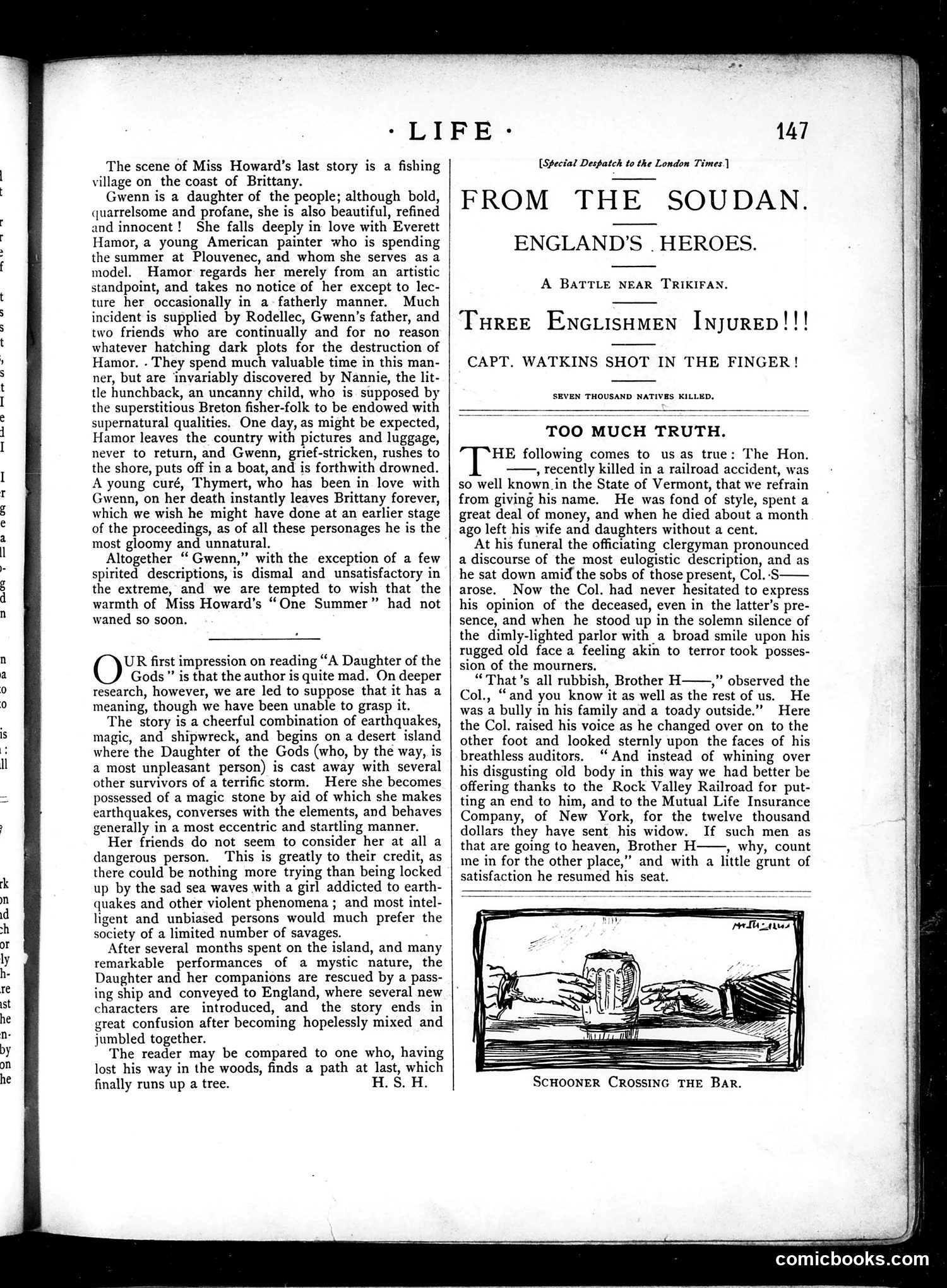
This page contains two distinct sections: **Left column:** A literary review of Miss Howard's story "A Daughter of the Gods," which the critic finds confusing and somewhat absurd. The plot involves earthquakes, magic, and rescue by steamship—elements the reviewer finds incoherent. **Right column:** News dispatches from Sudan titled "From the Soudan: England's Heroes," reporting on a battle near Trikifan with three injured Englishmen, including Captain Watkins shot in the finger. Below that is an anecdote titled "Too Much Truth" about a Vermont railroad accident and a colonel's blunt eulogy. **The woodcut illustration** shows a schooner crossing a sandbar, accompanying the Sudan dispatch. The page mixes literary criticism with contemporary military/news reporting—typical of Life's format as a general-interest satirical weekly.
📄 Transcribed text from this page (OCR, searchable)
Machine-transcribed from the original scan — historical spelling and the odd misread are preserved.
* LIFE - The scene of Miss Howard’s last story is a fishing village on the coast of Brittany. Gwenn is a daughter of the people; although bold, quarrelsome and profane, she is also beautiful, refined and innocent! She falls deeply in love with Everett Hamor, a young American painter who is spending the summer at Plouvenec, and whom she serves as a model. Hamor regards her merely from an artistic standpoint, and takes no notice of her except to lec- ture her occasionally in a-fatherly manner. Much incident is supplied by Rodellec, Gwenn’s father, and two friends who are continually and for no reason whatever hatching dark plots for the destruction of Hamor. - They spend much valuable time in this man- ner, but are invariably discovered by Nannie, the lit- tle hunchback, an uncanny child, who is supposed by the superstitious Breton fisher-folk to be endowed with supernatural qualities. One day, as might be expected, Hamor leaves the country with pictures and luggage, never to return, and Gwenn, grief-stricken, rushes to the shore, puts off in a boat, and is forthwith drowned. A young curé, Thymert, who has been in love with Gwenn, on her death instantly leaves Brittany forever, which we wish he might have done at an earlier stage of the proceedings, as of all these personages he is the most gloomy and unnatural. Altogether “ Gwenn,” with the exception of a few spirited descriptions, is dismal and unsatisfactory in the extreme, and we are tempted to wish that the warmth of Miss Howard’s “One Summer” had not waned so soon. UR first impression on reading “A Daughter of the Gods” is that the author is quite mad. On deeper research, however, we are led to suppose that it has a meaning, though we have been unable to grasp it. The story is a cheerful combination of earthquakes, magic, and shipwreck, and begins on a desert island where the Daughter of the Gods (who, by the way, is a most unpleasant person) is cast away with several other survivors of a terrific storm. Here she becomes possessed of a magic stone by aid of which she makes earthquakes, converses with the elements, and behaves generally in a most eccentric and startling manner. Her friends do not seem to consider her at all a dangerous person. This is greatly to their credit, as there could be nothing more trying than being locked up by the sad sea waves with a girl addicted to earth- quakes and other violent phenomena ; and most intel- ligent and unbiased persons would much prefer the society of a limited number of savages. After several months spent on the island, and many remarkable performances of a mystic nature, the Daughter and her companions are rescued by a pass- ing ship and conveyed to England, where several new characters are introduced, and the story ends in great confusion after becoming hopelessly mixed and jumbled together. The reader may be compared to one who, having lost his way in the woods, finds a path at last, which finally runs up a tree. H. S. H. [Special Despatch to the London Times FROM THE SOUDAN. ENGLAND'S . HEROES. A BATTLE NEAR TRIKIFAN. Turee Encuisumen Inyurep!!! CAPT. WATKINS SHOT IN THE FINGER! SEVEN THOUSAND NATIVES KILLED. TOO MUCH TRUTH. HE following comes to us as true: The Hon. ——,, recently killed in a railroad accident, was so well known.in the State of Vermont, that we refrain from giving his name. He was fond of style, spent a great deal of money, and when he died about a month ago left his wife and daughters without a cent. At his funeral the officiating clergyman pronounced a discourse of the most eulogistic description, and as he sat down amid the sobs of those present, Col.-S—— arose. Now the Col. had never hesitated to express his opinion of the deceased, even in the latter’s pre- sence, and when he stood up in the solemn silence of the dimly-lighted parlor with a broad smile upon his rugged old face a feeling akin to terror took posses- sion of the mourners. “That’s all rubbish, Brother H——,” observed the Col., “and you know it as well as the rest of us. He was a bully in his family and a toady outside.” Here the Col. raised his voice as he changed over on to the other foot and looked sternly upon the faces of his breathless auditors. “And instead of whining over his disgusting old body in this way we had better be offering thanks to the Rock Valley Railroad for put- ting an end to him, and to the Mutual Life Insurance Company, of New York, for the twelve thousand dollars they have sent his widow. If such men as that are going to heaven, Brother H: , why, count me in for the other place,” and with a little grunt of satisfaction he resumed his seat. SCHOONER CROSSING THE Bar. comicbooks.com