
Life, 1884-03-13 · page 6 of 16
Life — March 13, 1884 — page 6: what you’re looking at
What you’re looking at
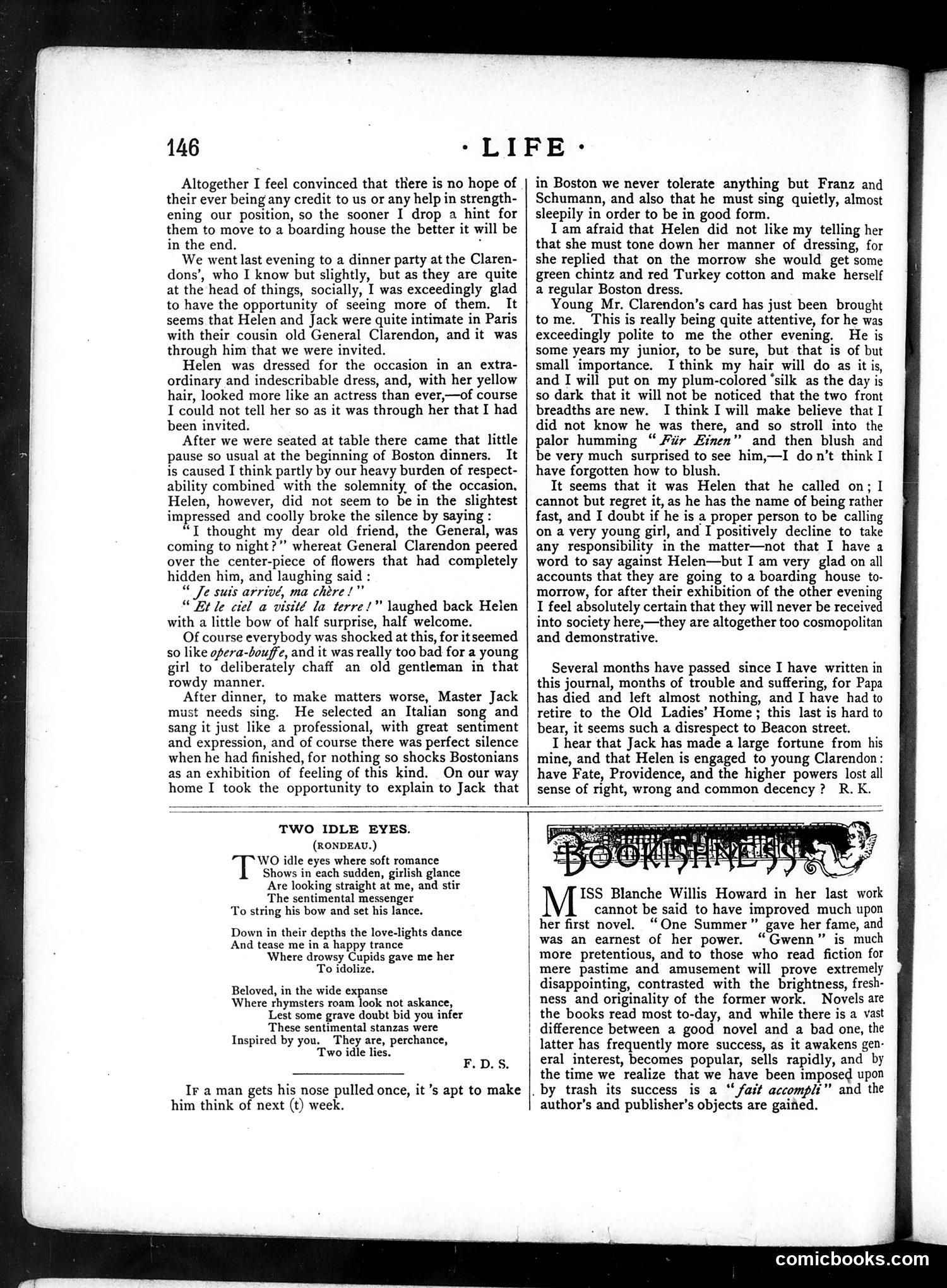
This page contains primarily literary content rather than political cartoons. The main item is a journal entry discussing Boston society and a dinner party attended by the writer and someone named Helen. The entry includes gossip about Helen's appearance, a General Clarendon, and commentary on Boston's social expectations. Below that is a poem titled "Two Idle Eyes" by Rondeau, which appears to be romantic verse about courtship and love. The only illustrated element is a small advertisement or header for "Boothby & Bunker" (appearing as a decorative business logo/seal). The page reflects *Life's* role as a magazine of literary and social commentary rather than political satire on this particular issue.
📄 Transcribed text from this page (OCR, searchable)
Machine-transcribed from the original scan — historical spelling and the odd misread are preserved.
146 Altogether I feel convinced that there is no hope of their ever being any credit to us or any help in strength- ening our position, so the sooner I drop a hint for them to move to a boarding house the better it will be in the end. . We went last evening to a dinner party at the Claren- dons’, who I know but slightly, but as they are quite at the head of things, socially, I was exceedingly glad to have the opportunity of seeing more of them. It seems that Helen and Jack were quite intimate in Paris with their cousin old General Clarendon, and it was through him that we were invited. Helen was dressed for the occasion in an extra- ordinary and indescribable dress, and, with her yellow hair, looked more like an actress than ever,—of course I could not tell her so as it was through her that I had been invited. After we were seated at table there came that little pause so usual at the beginning of Boston dinners. It is caused I think partly by our heavy burden of respect- ability combined with the solemnity, of the occasion, Helen, however, did not seem to be in the slightest impressed and coolly broke the silence by saying : “T thought my dear old friend, the General, was coming to night?” whereat General Clarendon peered over the center-piece of flowers that had completely hidden him, and laughing said : “ Te suis arrivé, ma chere!” “Et le ciel a visité la terre!” laughed back Helen with a little bow of half surprise, half welcome. Of course everybody was shocked at this, for itseemed so like opera-bouffe, and it was really too bad for a young girl to deliberately chaff an old gentleman in that rowdy manner. After dinner, to make matters worse, Master Jack must needs sing. He selected an Italian song and sang it just like a professional, with great sentiment and expression, and of course there was perfect silence when he had finished, for nothing so shocks Bostonians as an exhibition of feeling of this kind. On our way home I took the opportunity to explain to Jack that * LIFE: in Boston we never tolerate anything but Franz and Schumann, and also that he must sing quietly, almost sleepily in order to be in good form. I am afraid that Helen did not like my telling her that she must tone down her manner of dressing, for she replied that on the morrow she would get some green chintz and red Turkey cotton and make herself a regular Boston dress. Young Mr. Clarendon’s card has just been brought tome. This is really being quite attentive, for he was exceedingly polite to me the other evening. He is some years my junior, to be sure, but that is of but small importance. I think my hair will do as it is, and I will put on my plum-colored ‘silk as the day is so dark that it will not be noticed that the two front breadths are new. I think I will make believe that I did not know he was there, and so stroll into the palor humming “ Far Einen” and then blush and be very much surprised to see him,—I don’t think I have forgotten how to blush. It seems that it was Helen that he called on; I cannot but regret it, as he has the name of being rather fast, and I doubt if he is a proper person to be calling on a very young girl, and I positively decline to take any responsibility in the matter—not that I have a word to say against Helen—but I am very glad on all accounts that they are going to a boarding house to- morrow, for after their exhibition of the other evening I feel absolutely certain that they will never be received into society here,—they are altogether too cosmopolitan and demonstrative. Several months have passed since I have written in this journal, months of trouble and suffering, for Papa has died and left almost nothing, and I have had to retire to the Old Ladies’ Home; this last is hard to bear, it seems such a disrespect to Beacon street. I hear that Jack has made a large fortune from his mine, and that Helen is engaged to young Clarendon: have Fate, Providence, and the higher powers lost all sense of right, wrong and common decency? R.K. TWO IDLE EYES. (RONDEAU.) WO idle eyes where soft romance Shows in each sudden, girlish glance Are looking straight at me, and stir The sentimental messenger To string his bow and set his lance. Down in their depths the love-lights dance And tease me in a happy trance Where drowsy Cupids gave me her To idolize. Beloved, in the wide expanse Where rhymsters roam look not askance, Lest some grave doubt bid you infer These sentimental stanzas were Inspired by you. They are, perchance, Two idle lies. F.D.S. Ir a man gets his nose pulled once, it’s apt to make her first novel. | was an earnest of her power. him think of next (t) week. cea “q 3 ISS Blanche Willis Howard in her last work cannot be said to have improved much upon “One Summer” gave her fame, and “Gwenn” is much more pretentious, and to those who read fiction for mere pastime and amusement will prove extremely disappointing, contrasted with the brightness, fresh- ness and originality of the former work. Novels are | the books read most to-day, and while there is a vast difference between a good novel and a bad one, the | latter has frequently more success, as it awakens gen- eral interest, becomes popular, sells rapidly, and by the time we realize that we have been imposed upon . by trash its success is a “fait accompli” and the author’s and publisher’s objects are gaified. comicbooks.com