
Life, 1884-03-13 · page 2 of 16
Life — March 13, 1884 — page 2: what you’re looking at
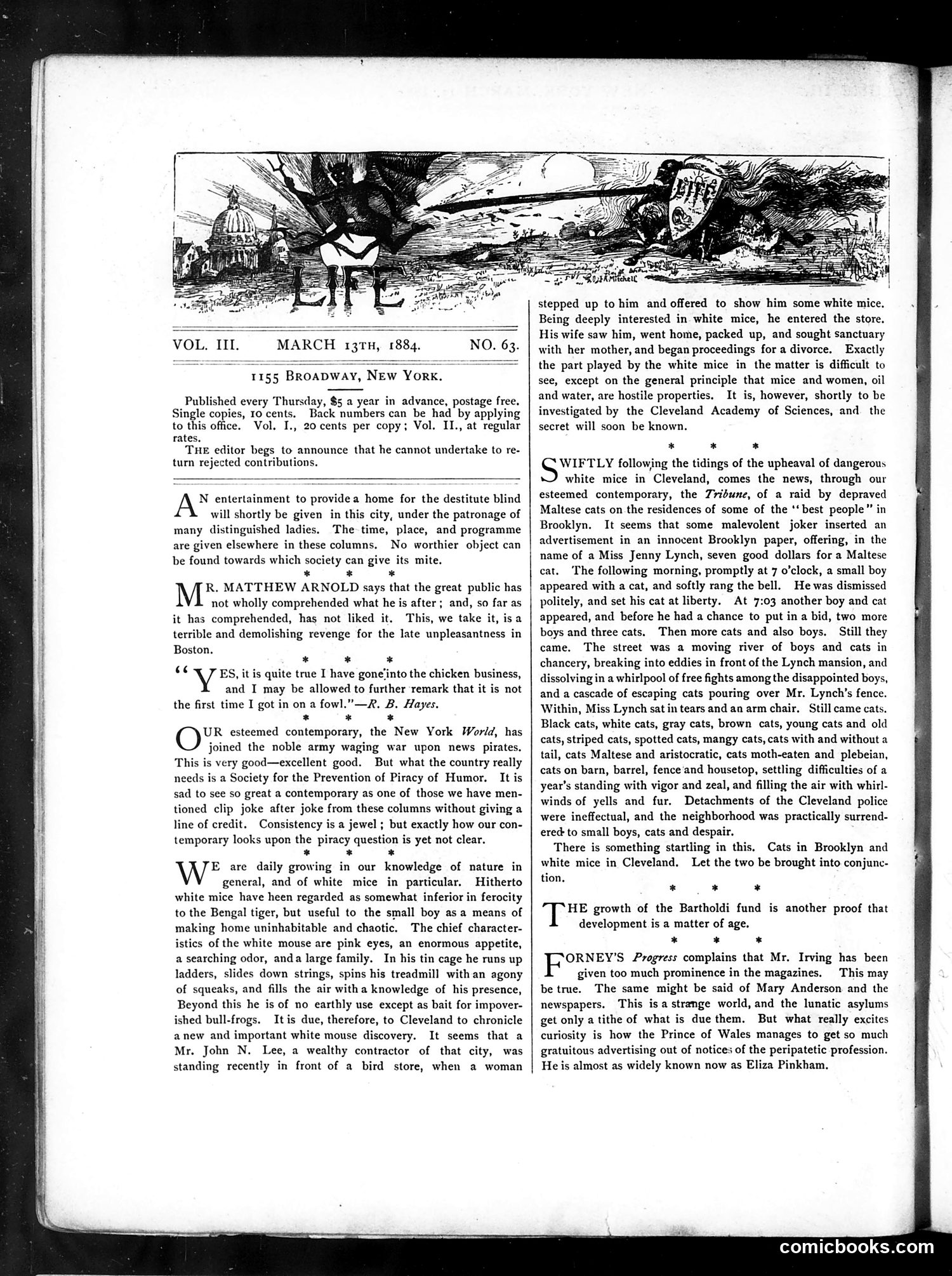
What you’re looking at
The masthead illustration depicts "LIFE" personified as a classical female figure overlooking a landscape with a cathedral and cityscape—standard allegorical imagery for the publication. The page content consists entirely of **editorial commentary and opinion pieces**, not political cartoons. The articles discuss: - A planned entertainment for blind residents - Matthew Arnold's observations on American life - Commentary on the New York *World* newspaper's coverage of piracy - A lengthy satirical piece about white mice becoming fashionable in Cleveland and Brooklyn, including a humorous account of cats disrupting a Brooklyn neighborhood in response - Brief notes on charitable fundraising and public figures There are **no political cartoons or caricatures** on this page. The white mice story appears to be satirical social commentary about upper-class fads, but the focus is primarily editorial content rather than visual satire.
📄 Transcribed text from this page (OCR, searchable)
Machine-transcribed from the original scan — historical spelling and the odd misread are preserved.
VOL. IIL. MARCH 131TH, 1884. 1155 Broapway, NEw York. Published every Thursday, $5 a year in advance, postage free. Single copies, ro cents. Back numbers can be had by applying to this office. Vol. I., 20 cents per copy; Vol. II., at regular rates, THE editor begs to announce that he cannot undertake to re- turn rejected contributions. N entertainment to provide a home for the destitute blind will shortly be given in this city, under the patronage of many distinguished ladies. The time, place, and programme are given elsewhere in these columns, No worthier object can be found towards which society can give its mite. * * * R. MATTHEW ARNOLD says that the great public has not wholly comprehended what he is after; and, so far as it has comprehended, has not liked it, This, we take it, isa terrible and demolishing revenge for the late unpleasantness in Boston. “cc * * * ES, it is quite true I have gone‘into the chicken business, and I may be allowed to further remark that it is not the first time I got in on a fowl.”—R. B. Hayes. ® * * UR esteemed contemporary, the New York World, has joined the noble army waging war upon news pirates. This is very good—excellent good. But what the country really needs is a Society for the Prevention of Piracy of Humor. It is sad to see so great a contemporary as one of those we have men- tioned clip joke after joke from these columns without giving a line of credit. Consistency is a jewel ; but exactly how our con- temporary looks upon the piracy question is yet not clear. * * * E are daily growing in our knowledge of nature in general, and of white mice in particular. Hitherto white mice have heen regarded as somewhat inferior in ferocity to the Bengal tiger, but useful to the small boy asa means of making home uninhabitable and chaotic. The chief character- istics of the white mouse are pink eyes, an enormous appetite, a searching odor, anda large family. In his tin cage he runs up ladders, slides down strings, spins his treadmill with an agony of squeaks, and fills the air witha knowledge of his presence, Beyond this he is of no earthly use except as bait for impover- ished bull-frogs. It is due, therefore, to Cleveland to chronicle anew and important white mouse discovery. It seems that a Mr. John N. Lee, a wealthy contractor of that city, was standing recently in front of a bird store, when a woman stepped up to him and offered to show him some white mice. Being deeply interested in white mice, he entered the store. His wife saw him, went home, packed up, and sought sanctuary with her mother, and began proceedings for a divorce. Exactly the part played by the white mice in the matter is difficult to see, except on the general principle that mice and women, oil and water, are hostile properties. It is, however, shortly to be investigated by the Cleveland Academy of Sciences, and the secret will soon be known. * * * WIFTLY following the tidings of the upheaval of dangerous white mice in Cleveland, comes the news, through our esteemed contemporary, the Tribune, of a raid by depraved Maltese cats on the residences of some of the ‘‘best people” in Brooklyn. It seems that some malevolent joker inserted an advertisement in an innocent Brooklyn paper, offering, in the | name of a Miss Jenny Lynch, seven good dollars for a Maltese cat. ‘The following morning, promptly at 7 o'clock, a small boy appeared with a cat, and softly rang the bell. He was dismissed politely, and set his cat at liberty. At 7:03 another boy and cat appeared, and before he had a chance to put in a bid, two more boys and three cats, Then more cats and also boys. Still they came. The street was a moving river of boys and cats in chancery, breaking into eddies in front of the Lynch mansion, and dissolving in a whirlpool of free fights among the disappointed boys, and a cascade of escaping cats pouring over Mr. Lynch’s fence. Within, Miss Lynch sat in tears and an arm chair. Still came cats, Black cats, white cats, gray cats, brown cats, young cats and old cats, striped cats, spotted cats, mangy cats, cats with and without a tail, cats Maltese and aristocratic, cats moth-eaten and plebeian, cats on barn, barrel, fence'and housetop, settling difficulties of a year’s standing with vigor and zeal, and filling the air with whirl- winds of yells and fur. Detachments of the Cleveland police were ineffectual, and the neighborhood was practically surrend- ered to small boys, cats and despair. There is something startling in this. Cats in Brooklyn and white mice in Cleveland. Let the two be brought into conjunc- tion, * * * HE growth of the Bartholdi fund is another proof that development is a matter of age. * * * ORNEY’S Progress complains that Mr. Irving has been given too much prominence in the magazines. This may be true. The same might be said of Mary Anderson and the newspapers. This isa strange world, and the lunatic asylums get only a tithe of what is due them. But what really excites curiosity is how the Prince of Wales manages to get so much gratuitous advertising out of notices of the peripatetic profession. He is almost as widely known now as Eliza Pinkham. comicbooks.com