
Life, 1884-03-13 · page 12 of 16
Life — March 13, 1884 — page 12: what you’re looking at
What you’re looking at
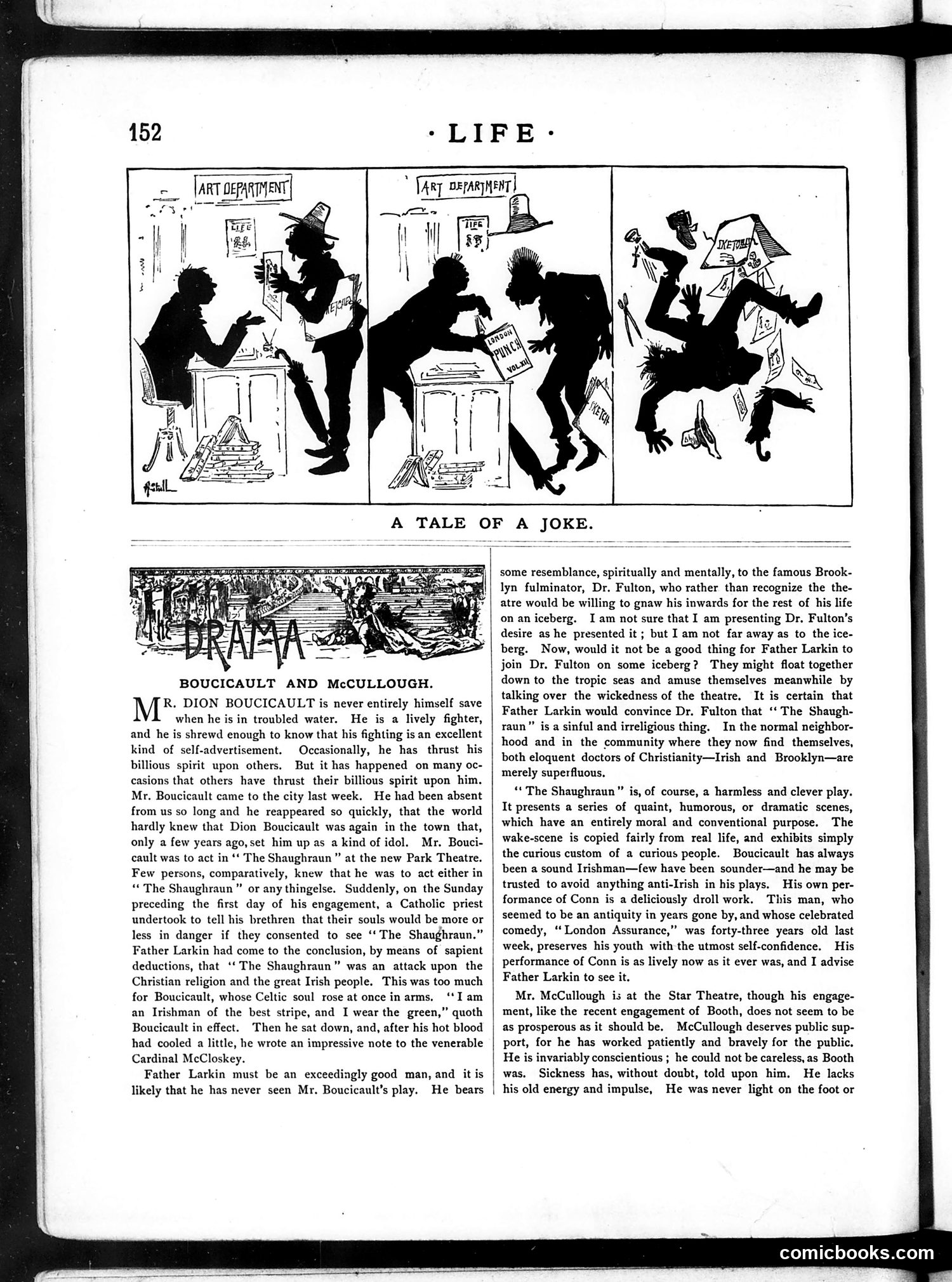
This page satirizes a religious controversy over Irish playwright Dion Boucicault's play *The Shaughraun*. Father Larkin, a Catholic priest, publicly warned his congregation that the play attacked Christian religion and Irish people, urging them not to attend. The comic strip (top) depicts the escalating joke/conflict in the Art Department, showing the absurd chaos that ensues from this pronouncement. The article defends Boucicault and mocks Father Larkin, comparing him unfavorably to Brooklyn's Dr. Fulton—both religious figures whom the author sarcastically suggests should float together on an iceberg. The satire argues *The Shaughraun* is harmless entertainment with moral purpose, and that Boucicault—a legitimate Irishman—wouldn't create anti-Irish content. The piece also briefly reviews actor McCullough's performance at the Star Theatre. The overall tone ridicules clerical censorship of theater as sanctimonious and unnecessary.
📄 Transcribed text from this page (OCR, searchable)
Machine-transcribed from the original scan — historical spelling and the odd misread are preserved.
A TALE OF A JOKE. BOUCICAULT AND McCULLOUGH. R. DION BOUCICAULT is never entirely himself save when he is in troubled water. He is a lively fighter, and he is shrewd enough to know that his fighting is an excellent kind of self-advertisement. Occasionally, he has thrust his billious spirit upon others. But it has happened on many oc- casions that others have thrust their billious spirit upon him. Mr. Boucicault came to the city last week. He had been absent from us so long and he reappeared so quickly, that the world hardly knew that Dion Boucicault was again in the town that, only a few years ago, set him up as a kind of idol. Mr. Bouci- cault was to act in ‘‘ The Shaughraun” at the new Park Theatre. Few persons, comparatively, knew that he was to act either in “The Shaughraun” or any thingelse. Suddenly, on the Sunday preceding the first day of his engagement, a Catholic priest undertook to tell his brethren that their souls would be more or less in danger if they consented to see ‘‘The Shaughraun.” Father Larkin had come to the conclusion, by means of sapient deductions, that ‘‘ The Shaughraun” was an attack upon the Christian religion and the great Irish people. This was too much for Boucicault, whose Celtic soul rose at once in arms, ‘‘I am an Irishman of the best stripe, and I wear the green,” quoth Boucicault in effect. Then he sat down, and, after his hot blood had cooled a little, he wrote an impressive note to the venerable Cardinal McCloskey. Father Larkin must be an exceedingly good man, and it is some resemblance, spiritually and mentally, to the famous Brook- lyn fulminator, Dr. Fulton, who rather than recognize the the- atre would be willing to gnaw his inwards for the rest of his life on an iceberg. I am not sure that I am presenting Dr. Fulton’s desire as he presented it ; but I am not far away as to the ice- berg. Now, would it not be a good thing for Father Larkin to join Dr. Fulton on some iceberg? They might float together down to the tropic seas and amuse themselves meanwhile by talking over the wickedness of the theatre. It is certain that Father Larkin would convince Dr. Fulton that ‘‘ The Shaugh- raun” is a sinful and irreligious thing. In the normal neighbor- hood and in the community where they now find themselves, both eloquent doctors of Christianity—Irish and Brooklyn—are merely superfluous, “* The Shaughraun” is, of course, a harmless and clever play. It presents a series of quaint, humorous, or dramatic scenes, which have an entirely moral and conventional purpose. The wake-scene is copied fairly from real life, and exhibits simply the curious custom of a curious people. Boucicault has always been a sound Irishman—few have been sounder—and he may be trusted to avoid anything anti-Irish in his plays. His own per- formance of Conn is a deliciously droll work. This man, who seemed to be an antiquity in years gone by, and whose celebrated comedy, “London Assurance,” was forty-three years old last week, preserves his youth with the utmost self-confidence. His performance of Conn is as lively now as it ever was, and I advise Father Larkin to see it. Mr. McCullough is at the Star Theatre, though his engage- ment, like the recent engagement of Booth, does not seem to be as prosperous as it should be. McCullough deserves public sup- port, for he has worked patiently and bravely for the public. He is invariably conscientious ; he could not be careless, as Booth was, Sickness has, without doubt, told upon him. He lacks likely that he has never seen Mr. Boucicault’s play. He bears | his old energy and impulse, He was never light on the foot or comicbooks.com