
Life, 1884-03-13 · page 11 of 16
Life — March 13, 1884 — page 11: what you’re looking at
What you’re looking at
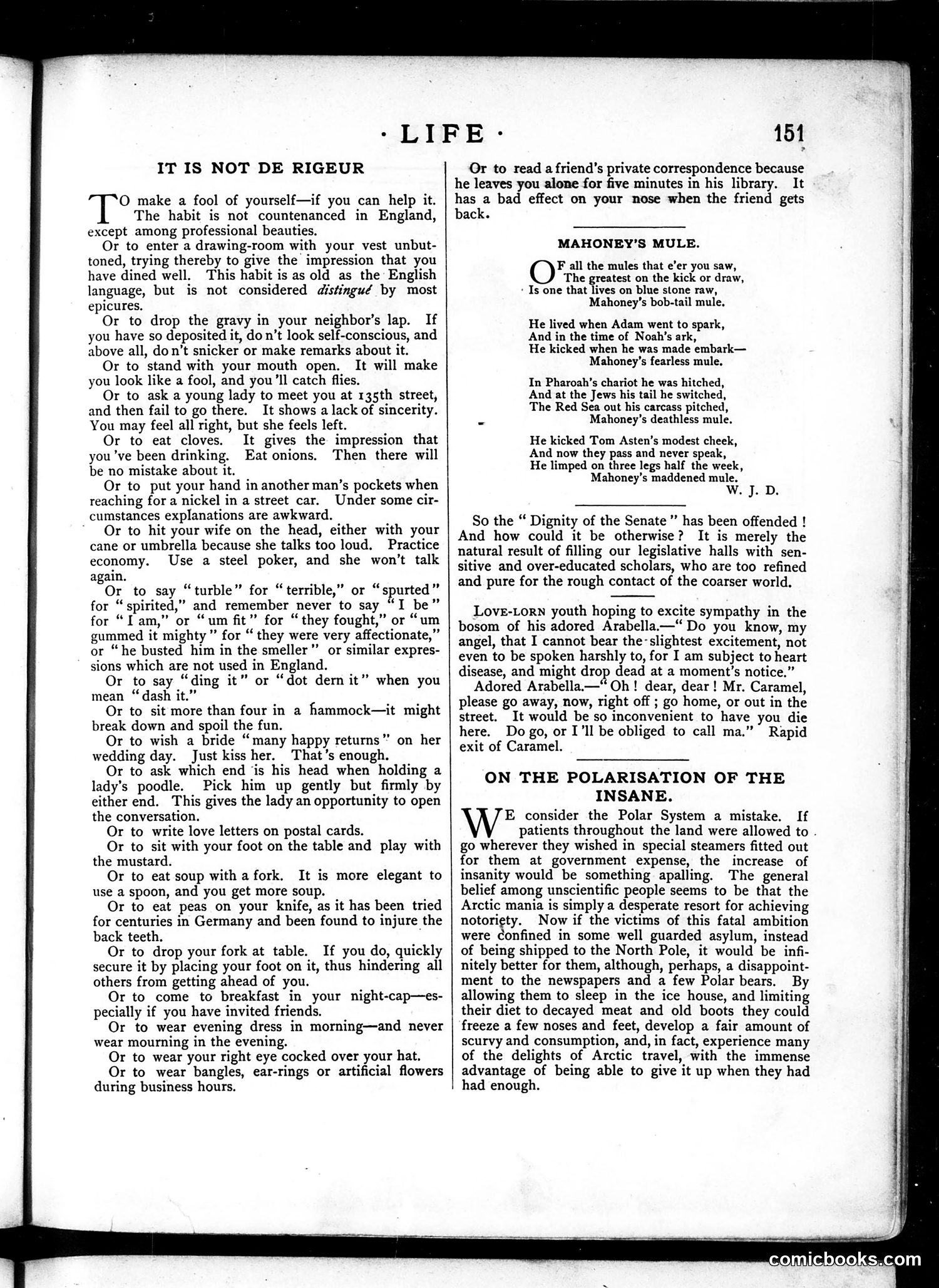
This page is a satirical etiquette column mocking Victorian-era social pretensions and English manners. The left column lists absurd "rules" of polite behavior with deadpan humor—including domestic violence ("hit your wife on the head...with a steel poker"), class anxiety about pronunciation, and trivial social mishaps like dropping gravy or sitting four in a hammock. The satire targets the obsessive refinement of the English upper classes and American aspirants imitating them. Items like asking a lady to meet at "135th street" (suggesting lower-class New York locations) mock the pretense that proper English speakers would never frequent such places. The piece ridicules both genuine etiquette concerns (fork usage) and invented anxieties, suggesting the entire enterprise of obsessing over "distingué" behavior is absurd. The poisoned-poker joke about wives hints at darker domestic realities beneath polite society's facade. The accompanying poem "Mahoney's Mule" appears unrelated humor.
📄 Transcribed text from this page (OCR, searchable)
Machine-transcribed from the original scan — historical spelling and the odd misread are preserved.
- LIFE: IT IS NOT DE RIGEUR O make a fool of yourself—if you can help it. The habit is not countenanced in England, except among professional beauties. Or to enter a drawing-room with your vest unbut- toned, trying thereby to give the impression that you have dined well. This habit is as old as the English language, but is not considered distingué by most epicures. Or to drop the gravy in your neighbor’s lap. If you have so deposited it, don’t look self-conscious, and above all, don’t snicker or make remarks about it. Or to stand with your mouth open. It will make you look like a fool, and youll catch flies. Or to ask a young lady to meet you at 135th street, and then fail to go there. It shows a lack of sincerity. You may feel all right, but she feels left. Or to eat cloves. It gives the impression that you ’ve been drinking. Eat onions. Then there will be no mistake about it. Or to put your hand in another man’s pockets when reaching for a nickel in a street car. Under some cir- cumstances explanations are awkward. Or to hit your wife on the head, either with your cane or umbrella because she talks too loud. Practice economy. Use a steel poker, and she won’t talk again. Or to say “turble” for “terrible,” or “ spurted 2 for “spirited,” and remember never to say “I be” for “Iam,” or “um fit” for “they fought,” or “um gummed it mighty” for “ they were very affectionate,” or “he busted him in the smeller” or similar expres- sions which are not used in England. Or to say “ding it” or “dot dern it” when you mean “dash it.” Or to sit more than four in a hammock—it might break down and spoil the fun. Or to wish a bride “many happy returns” on her wedding day. Just kiss her. That’s enough. Or to ask which end is his head when holding a lady's poodle. Pick him up gently but firmly by either end. This gives the lady an opportunity to open the conversation. Or to write love letters on postal cards. Or to sit with your foot on the table and play with the mustard. Or to eat soup with a fork. It is more elegant to use a spoon, and you get more soup. Or to eat peas on your knife, as it has been tried for centuries in Germany and been found to injure the back teeth. Or to drop your fork at table. If you do, quickly secure it by placing your foot on it, thus hindering all others from getting ahead of you. Or to come to breakfast in your night-cap—es- pecially if you have invited friends. Or to wear evening dress in morning—and never wear mourning in the evening. Or to wear your right eye cocked over your hat. Or to wear bangles, ear-rings or artificial flowers during business hours. 151 Or to read a friend’s private correspondence because he leaves you alone for five minutes in his library. It has a bad effect on your nose when the friend gets back. MAHONEY’S MULE. F all the mules that e’er you saw, The greatest on the kick or draw, « Is one that lives on blue stone raw, Mahoney's bob-tail mule. He lived when Adam went to spark, And in the time of Noah’s ark, He kicked when he was made embark— Mahoney's fearless mule. In Pharoah’s chariot he was hitched, And at the Jews his tail he switched, The Red Sea out his carcass pitched, Mahoney’s deathless mule. He kicked Tom Asten’s modest cheek, And now they pass and never speak, He limped on three legs half the week, Mahoney’s maddened mule. W. J. D. So the “ Dignity of the Senate” has been offended ! And how could it be otherwise? It is merely the natural result of filling our legislative halls with sen- sitive and over-educated scholars, who are too refined and pure for the rough contact of the coarser world. Love-Lorn youth hoping to excite sympathy in the bosom of his adored Arabella.—“ Do you know, my angel, that I cannot bear the-slightest excitement, not even to be spoken harshly to, for I am subject to heart disease, and might drop dead at a moment's notice.” Adored Arabella.—“ Oh! dear, dear! Mr. Caramel, please go away, now, right off ; go home, or out in the street. It would be so inconvenient to have you die here. Do go, or I'll be obliged to call ma.” Rapid exit of Caramel. ON THE POLARISATION OF THE INSANE. E consider the Polar System a mistake. If patients throughout the land were allowed to . go wherever they wished in special steamers fitted out for them at government expense, the increase of insanity would be something apalling. The general belief among unscientific people seems to be that the Arctic mania is simply a desperate resort for achieving notoriety. Now if the victims of this fatal ambition were Confined in some well guarded asylum, instead of being shipped to the North Pole, it would be infi- nitely better for them, although, perhaps, a disappoint- ment to the newspapers and a few Polar bears. By allowing them to sleep in the ice house, and limiting their diet to decayed meat and old boots they could freeze a few noses and feet, develop a fair amount of scurvy and consumption, and, in fact, experience many of the delights of Arctic travel, with the immense advantage of being able to give it up when they had had enough.