
Judge, 1928-02-04 · page 15 of 36
Judge — February 4, 1928 — page 15: what you’re looking at
What you’re looking at
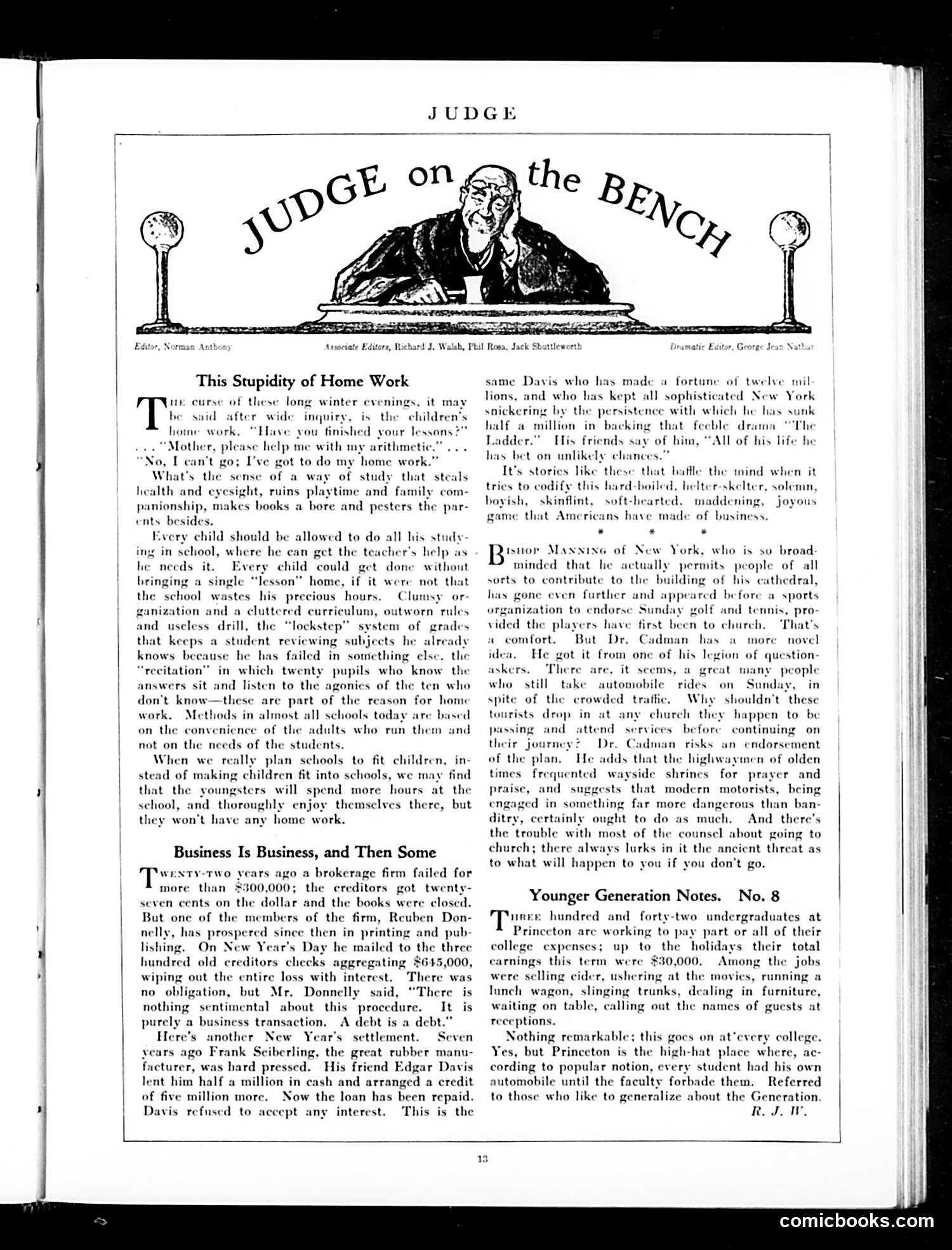
This page contains three distinct opinion pieces from Judge magazine, a satirical weekly: **"This Stupidity of Home Work"** critiques American schools for inefficient organization that forces students to complete assignments at home. The author argues that with better school design, all work could be completed during school hours, eliminating homework's burden on families and children's health. **"Business Is Business, and Then Some"** celebrates two wealthy businessmen—Reuben Donnelly and Edgar Davis—for voluntarily repaying old debts with interest decades later, despite no legal obligation. The piece uses these examples to satirize American business culture as simultaneously ruthless and unpredictably sentimental. **"Younger Generation Notes"** (brief item) observes that Princeton undergraduates work various jobs during holidays rather than assuming automatic privilege. The page represents Judge's characteristic blend of progressive social criticism and celebration of individual moral character. No specific political figures are caricatured; instead, the magazine critiques institutional systems while praising exceptional personal integrity.
📄 Transcribed text from this page (OCR, searchable)
Machine-transcribed from the original scan — historical spelling and the odd misread are preserved.
rd J. Walsh, Phil Rova, Jack Shuttleworth This Stupidity of Home Work ne curse of these long winter evenings, after wide home work. “Have you finished your lessons?” .. Mother, please help me with my arithmetic.” “No, I can't go; I've got to do my home work.” What's the sense of a way of study that. steals health and eyesight, ruins playtime and family com- panionship, makes books a bore and pesters the par- ents besides. Every child should be it may be said inquiry, iy the children’s allowed to do all his study- ing in school, where he can get the teacher's help he needs it. Every child could get done without bringing a single “lesson” home, if it were not that the school wastes his precious hours. Clumsy or- ganization and a cluttered curriculum, outworn rules and useless drill, the “lockstep’” system of grades that keeps a student reviewing sul knows beeause he has failed in something else. the itation” in which twenty pupils who know. the answers sit and listen to the agonies of the ten who don't know—these are part of the reason for home work. Methods in almost all schools toda on the convenience of the adults who run them and not on the needs of the students. When we really plan schools to fit children, in- d of making children fit into schools, we may find at the youngsters will spend more hours at the school, and thoroughly enjoy themselves there, but they won't have any home work. ects he already “ee y are based Business Is Business, and Then Some The NTY-TWO rs ago a brokerage firm failed for more than $300,000; the creditors got twenty- seven cents on the dollar and the books were closed. But one of the members of the firm, Reuben Don- nelly, has prospered since then in printing and pub- lishing. On New Year's Day he mailed to the three hundred old creditors checks aggregating $645,000, wiping out the entire loss with interest. There was no obligation, but Mr. Donnelly said, “There is nothing sentimental about this procedure. It is purely a business transaction. A debt is a debt.” Tere’s another New Year's settlement. Seven years ago Frank Seiberling, the great rubber manu- acturer, was hard pressed. His friend Edgar Davis lent him half a million in cash and arranged a credit of five million more. Now the loan has been repaid. Davis refused to accept any interest. This is the same Davis who has made a fortune of twelve mil lions, and who has kept all sophisticated New York snickering by the persistence with which he has sunk half a million in backing that feeble drama ‘The Ladder.” His friends say of him, “All of his life he has bet on unlikely chances.” It’s stories like these that battle the inind when it tries to codify this hard-boiled, helter-skelter, solemn, boyish, skinflint, soft-hearted, maddening, joyous game that Americans have made of business. * * . Bue Mansine of New York, who is so broad minded that he actually permits people of all sorts to contribute to the building of his cathedral, one even further and appeared befor ion to endorse Sunday golf and tennis, pro- 1 the players have first been to church. ‘That's « comfort. But Dr. Cadman has a novel idea, He got it from one of his legion of question- askers. There are, it seems, a great many peopl who still take automobile rides on Sunday, in spite of the crowded traffic. Why shouldn't these tourists drop in at any church they happen to be passing and continuing on their journey? Dr. Cadman risks an endorsement of the plan. He addy that the highwaymen of olden times frequented wayside shrines for prayer and praise, and su ts that modern motorists, being engaged in something far more dangerous than ban- ditry, certainly ought to do as much. And there's the trouble with most of the counsel about going to church; there always lurks in it the ancient threat as to what will happen to you if you don’t go. 1 sports more attend services before Younger Generation Notes. No. 8 Ture hundred and forty-two undergraduates at Princeton are working to pay part or all of their college expenses; up to the holid: their total rnings this term were $30,000. Among the jobs were selling cider, ushering at the movies, running a lunch wagon, slinging trunks, dealing in furniture, waiting on table, calling out the names of guests at receptions. Nothing remarkable; this goes on at*every college. Yes, but Princeton is the high-hat plo cording to popular notion, every student had his own automobile until the faculty forbade them. Referred to those who like to generalize about the Generation. R.J.W, where, ac- comicbooks.com | =I