
Judge, 1922-05-13 · page 16 of 36
Judge — May 13, 1922 — page 16: what you’re looking at
What you’re looking at
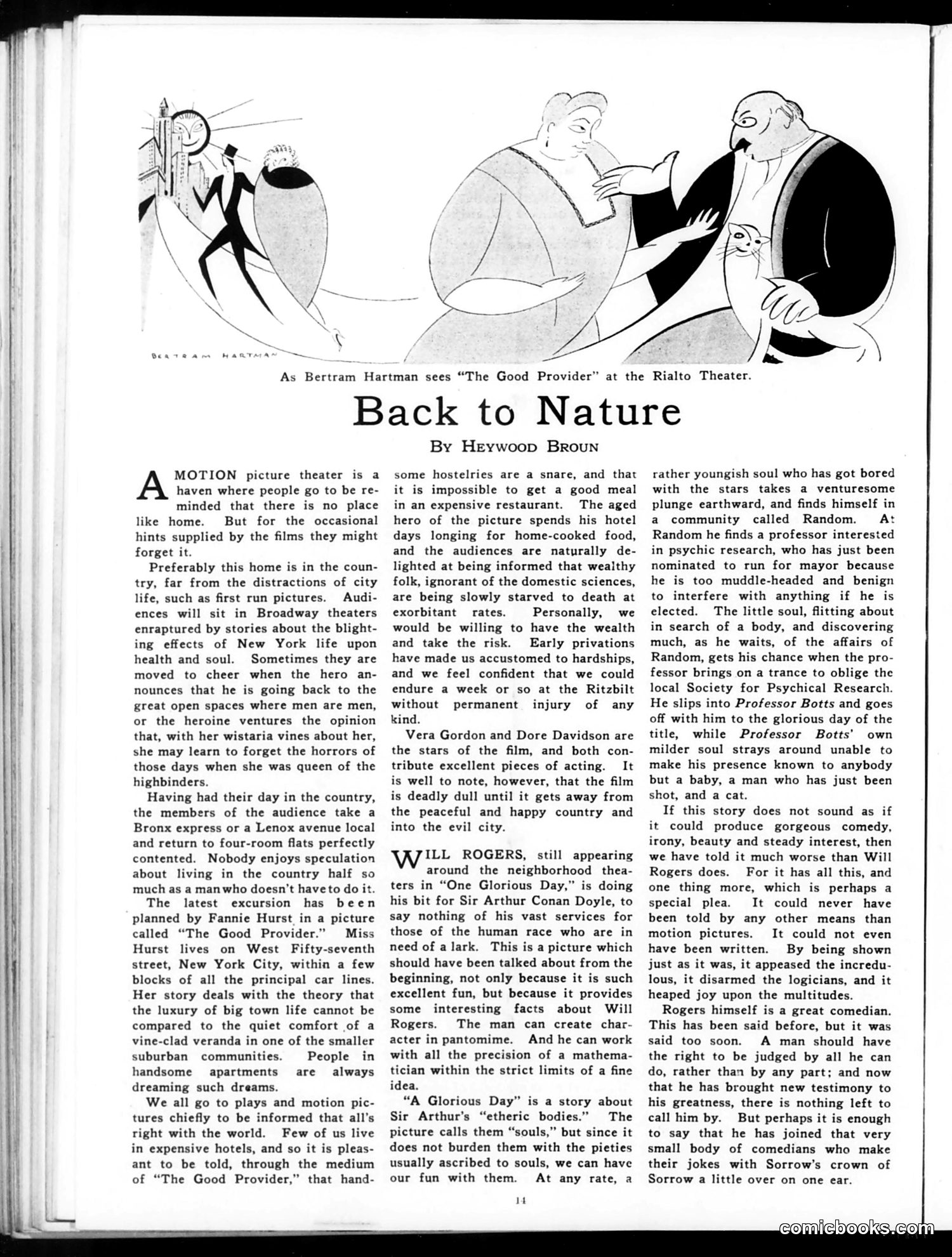
This page contains a satirical film review by Heywood Broun critiquing the common Hollywood trope of extolling rural simplicity to urban audiences. The cartoon (top left) shows a man being pulled back toward nature/the country while two well-fed men observe. Broun mocks the hypocrisy: audiences in Broadway theaters cheer films condemning city life and praising country living, then immediately return to their apartments. He reviews "The Good Provider" (starring Vera Gordon and Dore Davidson), a film claiming wealthy hotel living cannot compare to home cooking—a message Broun finds amusing since he'd gladly trade places with the rich. The page also praises Will Rogers' pantomime acting in "A Glorious Day," adapted from Arthur Conan Doyle's spiritualist concept of "etheric bodies" or souls visiting Earth. The satire targets both filmmakers exploiting nostalgia and audiences who enjoy escapist fantasies they have no intention of living.
📄 Transcribed text from this page (OCR, searchable)
Machine-transcribed from the original scan — historical spelling and the odd misread are preserved.
) As Bertram Hartman sees “The Good Provider” at the Rialto Theater. Back to Nature MOTION picture theater is a haven where people go to be re- minded that there is no place like home. But for the occasional hints supplied by the films they might forget it. Preferably this home is in the coun- try, far from the distractions of city life, such as first run pictures. Audi- ences will sit in Broadway theaters enraptured by stories about the blight- ing effects of New York life upon health and soul. Sometimes they are moved to cheer when the hero an- nounces that he is going back to the great open spaces where men are men, or the heroine ventures the opinion that, with her wistaria vines about her, she may learn to forget the horrors of those days when she was queen of the highbinders. Having had their day in the country, the members of the audience take a Bronx express or a Lenox avenue local and return to four-room flats perfectly contented. Nobody enjoys speculation about living in the country half so much as a manwho doesn't have to do it. The latest excursion has been planned by Fannie Hurst in a picture called “The Good Provider.” Miss Hurst lives on West Fifty-seventh street, New York City, within a few blocks of all the principal car lines. Her story deals with the theory that the luxury of big town life cannot be compared to the quiet comfort of a vine-clad veranda in one of the smaller suburban communities. People in handsome apartments are always dreaming such dreams. We all go to plays and motion pic- tures chiefly to be informed that all's right with the world. Few of us live in expensive hotels, and so it is pleas- ant to be told, through the medium of “The Good Provider,” that hand- By Heywoop Broun some hostelries are a snare, and that it is impossible to get a good meal in an expensive restaurant. The aged hero of the picture spends his hotel days longing for home-cooked food, and the audiences are naturally de- lighted at being informed that wealthy folk, ignorant of the domestic sciences, are being slowly starved to death at exorbitant rates. Personally, we would be willing to have the wealth and take the risk. Early privations have made us accustomed to hardships, and we feel confident that we could endure a week or so at the Ritzbilt without permanent injury of any kind. Vera Gordon and Dore Davidson are the stars of the film, and both con- tribute excellent pieces of acting. It is well to note, however, that the film is deadly dull until it gets away from the peaceful and happy country and into the evil city. ILL ROGERS, still appearing around the neighborhood thea- ters in “One Glorious Day,” is doing his bit for Sir Arthur Conan Doyle, to say nothing of his vast services for those of the human race who are in need of a lark. This is a picture which should have been talked about from the beginning, not only because it is such excellent fun, but because it provides some interesting facts about Will Rogers. The man can create char- acter in pantomime. And he can work with all the precision of a mathema- tician within the strict limits of a fine idea. “A Glorious Day” is a story about Sir Arthur's “etheric bodies.” The picture calls them “souls,” but since it does not burden them with the pieties usually ascribed to souls, we can have our fun with them. At any rate, a M4 rather youngish soul who has got bored with the stars takes a venturesome plunge earthward, and finds himself in a community called Random. At Random he finds a professor interested in psychic research, who has just been nominated to run for mayor because he is too muddle-headed and benign to interfere with anything if he is elected. The little soul, flitting about in search of a body, and discovering much, as he waits, of the affairs of Random, gets his chance when the pro- fessor brings on a trance to oblige the local Society for Psychical Research. He slips into Professor Botts and goes off with him to the glorious day of the title, while Professor Botts’ own milder soul strays around unable to make his presence known to anybody but a baby, a man who has just been shot, and a cat. If this story does not sound as if it could produce gorgeous comedy, irony, beauty and steady interest, then we have told it much worse than Will Rogers does. For it has all this, and one thing more, which is perhaps a special plea. It could never have been told by any other means than motion pictures. It could not even have been written. By being shown just as it was, it appeased the incredu- lous, it disarmed the logicians, and it heaped joy upon the multitudes. Rogers himself is a great comedian. This has been said before, but it was said too soon. A man should have the right to be judged by all he can do, rather than by any part; and now that he has brought new testimony to his greatness, there is nothing left to call him by. But perhaps it is enough to say that he has joined that very small body of comedians who make their jokes with Sorrow’s crown of Sorrow a little over on one ear.