
Judge, 1922-05-13 · page 10 of 36
Judge — May 13, 1922 — page 10: what you’re looking at
What you’re looking at
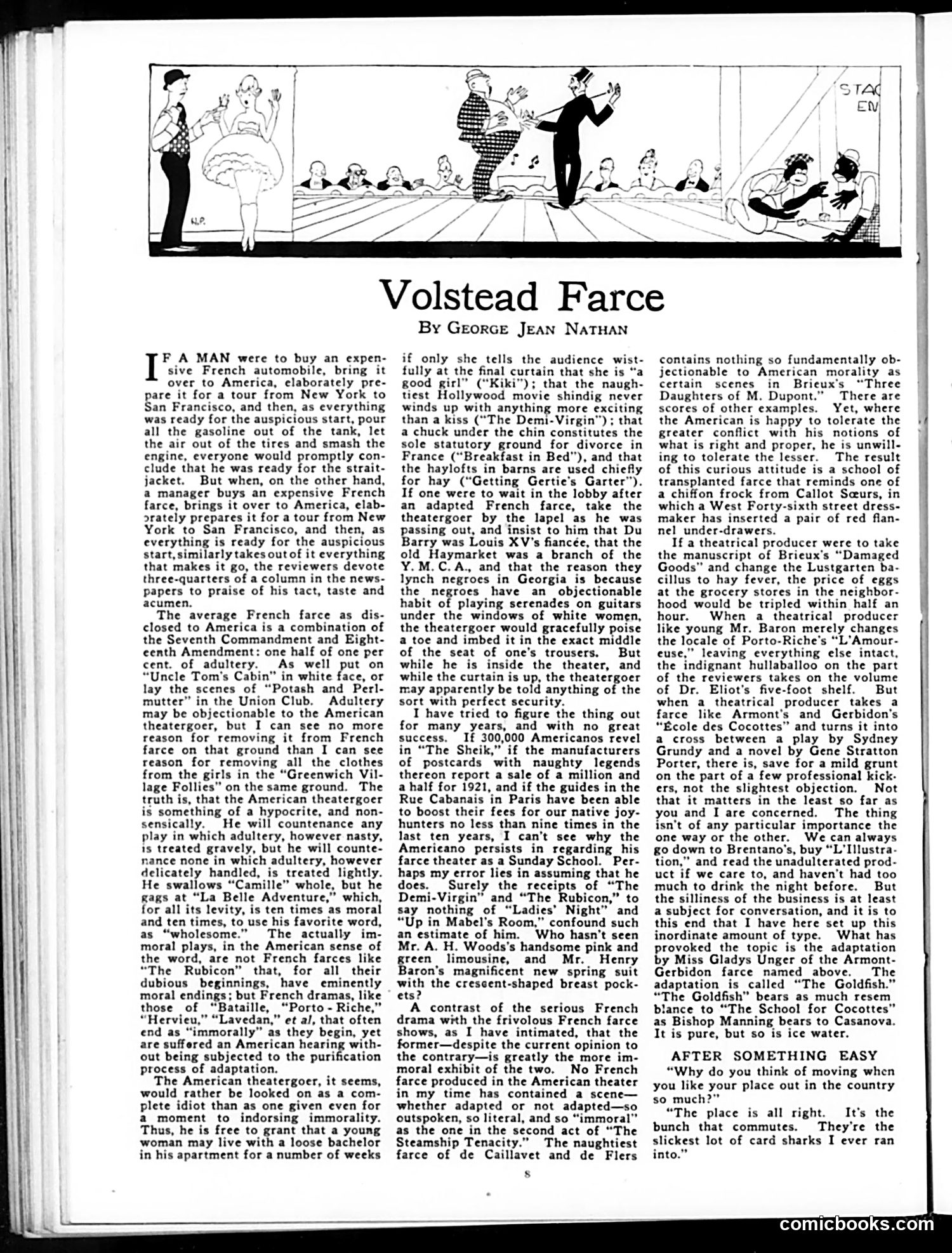
This article by George Jean Nathan critiques American audiences' hypocrisy regarding French farces adapted for American theaters. **The Satire:** Nathan argues that American theatergoers tolerate serious moral transgressions (adultery, loose living) in dramatic plays but demand that comedic French farces be "sanitized" of their adult content—removing the very elements that make them work. He uses the metaphor of buying an expensive car, then destroying its engine before the trip. **The "Volstead" Reference:** The title invokes the Volstead Act (Prohibition), suggesting Americans similarly gut imported culture of its essential character to fit moral standards, much as they prohibited alcohol. **The Point:** Nathan exposes the audience's contradiction—they'll accept immorality if treated seriously but reject identical behavior if presented lightly or comically. He cites specific plays: "Kiki," "The Demi-Virgin," "Breakfast in Bed," and "Getting Gertie's Garter," arguing these adaptations became absurdly sanitized while genuinely immoral French dramas escaped censure. The satire targets American prudishness and the illogic of theatrical censorship practices.
📄 Transcribed text from this page (OCR, searchable)
Machine-transcribed from the original scan — historical spelling and the odd misread are preserved.
Volstead Farce F A MAN were to buy an expen- sive French automobile, bring it over to America, elaborately pre- pare it for a tour from New York to San Francisco, and then, as everything was ready for the auspicious start, pour all the gasoline out of the tank, let the air out of the tires and smash the engine, everyone would promptly con- clude that he was ready for the strait- jacket. But when, on the other hand, a manager buys an expensive French farce, brings it over to America, elab- orately prepares it for a tour from New York to San Francisco, and then, as everything is ready for the auspicious start, similarly takes out of it everything that makes it go, the reviewers devote three-quarters of a column in the news- papers to praise of his tact, taste and acumen. The average French farce as dis- closed to America is a combination of the Seventh Commandment and Eight- eenth Amendment: one half of one per cent. of adultery. As well put on “Uncle Tom's Cabin” in white face, or lay the scenes of “Potash and Perl- mutter” in the Union Club. Adultery may be objectionable to the American theatergoer, but I can see no more reason for removing it from French farce on that ground than I can see reason for removing all the clothes from the girls in the “Greenwich Vil- lage Follies” on the same ground. The truth is, that the American theatergoer is something of a hypocrite, and non- sensically. He will countenance any play in which adultery, however nasty, 1s treated gravely, but he will counte- nance none in which adultery, however delicately handled, is treated lightly. He swallows “Camille” whole, but he gags at “La Belle Adventure,” which, for all its levity, is ten times as moral and ten times, to use his favorite word, as “wholesome.” The actually im- moral plays, in the American sense of the word, are not French farces like “The Rubicon” that, for all their dubious beginnings, have eminently moral endings; but French dramas, like those of “Bataille, “Porto - Riche,” “Hervieu,” “Lavedan,” et a/, that often end as “immorally” as they begin, yet are suffered an American hearing with- out being subjected to the purification process of adaptation. The American theatergoer, it seems, would rather be looked on as a com- plete idiot than as one given even for a moment to indorsing immorality. Thus, he is free to grant that a young woman may live with a loose bachelor in his apartment for a number of weeks By Georce Jean NaTHAN if only she tells the audience wist- fully at the final curtain that she is “a good girl” (“Kiki”); that the naugh- tiest Hollywood movie shindig never winds up with anything more exciting than a kiss (“The Demi- Virgin”); that a chuck under the chin constitutes the sole statutory ground for divorce in France (“Breakfast in Bed"), and that the haylofts in barns are used chiefly for hay (“Getting Gertie’s Garter”). If one were to wait in the lobby after an adapted French farce, take the theatergoer by the lapel as he was assing out, and insist to him that Du arry was Louis XV's fiancée, that the oe Haymarket was a branch of the .M.C.A., and that the reason they lynch negroes in Georgia is because the negroes have an objectionable habit of playing serenades on guitars under the windows of white women, the theatergoer would gracefully poise a toe and imbed it in the exact middle of the seat of one’s trousers. But while he is inside the theater, and while the curtain is up, the theatergoer may apparently be told anything of the sort with perfect security. I have tried to figure the thing out for many years, and with no great success, If 300,000 Americanos revel in “The Sheik,” if the manufacturers of postcards with naughty legends thereon report a sale of a million and a half for 1921, and if the guides in the Rue Cabanais in Paris have been able to boost their fees for our native joy- hunters no less than nine times in the last ten years, I can’t see why the Americano persists in regarding his farce theater as a Sunday School. Per- haps my error lies in assuming that he does. Surely the receipts of “The Demi-Virgin” and “The Rubicon,” to say nothing of “Ladies’ Night” and “Up in Mabel's Room,” confound such an estimate of him. Who hasn't seen Mr. A. H. Woods's handsome pink and reen limousine, and Mr. Henry ‘aron’s magnificent new spring suit with the crescent-shaped breast pock- ets? A contrast of the serious French drama with the frivolous French farce shows, as I have intimated, that the former—despite the current opinion to the contrary—is greatly the more im- moral exhibit of the two. No French farce produced in the American theater in my time has contained a scene— whether adapted or not adapted—so outspoken, so literal, and so “immoral” as the one in the second act of “The Steamship Tenacity.” The naughtiest farce of de Caillavet and de Flers contains nothing so fundamentally ob- jectionable to American morality as certain scenes in Brieux’s “Three Daughters of M. Dupont.” There are scores of other examples. Yet, where the American is happy to tolerate the greater conflict with his notions of what is right and proper, he is unwill- ing to tolerate the lesser. The result of this curious attitude is a school of transplanted farce that reminds one of a chiffon frock from Callot Sceurs, in which a West Forty-sixth street dress- maker has inserted a pair of red flan- nel _under-drawers. If a theatrical producer were to take the manuscript of Brieux’s “Damaged Goods” and change the Lustgarten ba- cillus to hay fever, the price of eggs at the grocery stores in the neighbor- hood would be tripled within half an hour. When a theatrical producer like young Mr. Baron merely changes the locale of Porto-Riche’s “L'’Amour- euse,” leaving everything else intact, the indignant hullaballoo on the part of the reviewers takes on the volume of Dr. Eliot's five-foot shelf. But when a theatrical producer takes a farce like Armont’s and Gerbidon’s “Ecole des Cocottes” and turns it into a cross between a play by Sydney Grundy and a novel by Gene Stratton Porter, there is, save for a mild grunt on the part of a few professional kick- ers, not the slightest objection. Not that it matters in the least so far as you and I are concerned. The thing isn't of any particular importance the one way or the other. We can always go down to Brentano's, buy “L'Illustra- tion,” and read the unadulterated prod- uct if we care to, and haven't had too much to drink the night before. But the silliness of the business is at least a subject for conversation, and it is to this end that I have here set up this inordinate amount of type. What has provoked the topic is the adaptation by Miss Gladys Unger of the Armont- Gerbidon farce named above. The adaptation is called “The Goldfish.” “The Goldfish” bears as much resem blance to “The School for Cocottes” as Bishop Manning bears to Casanova. It is pure, but so is ice water. AFTER SOMETHING EASY “Why do you think of moving when you like your place out in the country so much?” “The place is all right. It's the bunch that commutes. They're the slickest lot of card sharks I ever ran comicbooks.com