
Judge, 1919-03-22 · page 18 of 32
Judge — March 22, 1919 — page 18: what you’re looking at
What you’re looking at
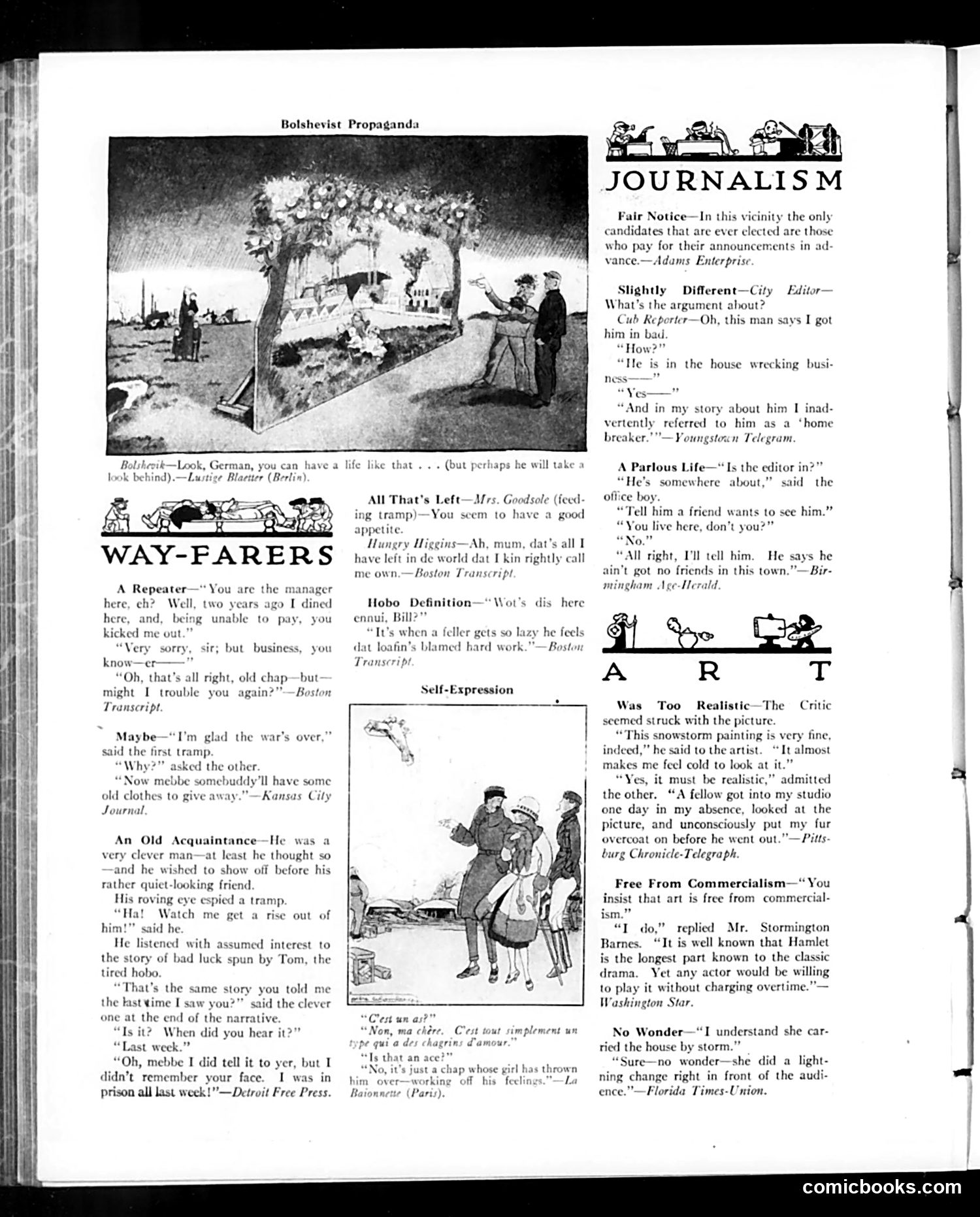
The top image shows a German soldier being tempted by idyllic pastoral scenery, with the caption suggesting Bolsheviks are using propaganda to recruit Germans with promises of a better life—"but perhaps he will take a look behind," implying the reality is darker. This references post-WWI communist propaganda efforts to destabilize Germany and recruit soldiers disillusioned by war. The "Way-Farers" section contains unrelated humorous anecdotes about vagrants and social mishaps, typical of Judge magazine's filler content. The "Art" cartoon features three disconnected jokes about critics, artists, and theater—mocking pretentious art criticism and actors' commercial motivations. **Historical context**: This appears from the Red Scare era (likely 1920s), when American publications warned readers about Bolshevik recruitment tactics among war-weary Europeans. The juxtaposition of serious political commentary with trivial humor was standard for Judge's satirical format.
📄 Transcribed text from this page (OCR, searchable)
Machine-transcribed from the original scan — historical spelling and the odd misread are preserved.
Bolshevist Propaganda —Look, German, you can have a life like that . . . (but perhaps he will take a ige Blactter (Berlin). S ras WAY-FARERS A Repeater—* You are the manager here, ch? Well, two years ago I dined here, and, being unable to pay, you kicked me out.” Very sorry, sir; but business, you know—er——" “Oh, that’s all right, old chap—but might I trouble you again?”—Boston Transcript. Maybe—“I'm glad the war's over,” said the first tramp. “Why?” asked the other. Now mebbe somebuddy’ll have some old clothes to give away.”—Kansas City Journal. An Old Acquaintance—He was a very clever man—at least he thought so and he wished to show off before his rather quict-looking friend. His roving eye espied a tramp “Ha! Watch me get a rise out of him!” said he. He listened with assumed interest to the story of bad luck spun by Tom, the tired hobo. “That's the same story you told me the kasttime I saw you?” said the clever one at the end of the narrative. s it? When did you hear it?” st week.” “Oh, mebbe I did tell it to yer, but I didn’t remember your face. I was in prison alll last week!""—Detroit Free Press. All That's Left—AMrs. Goodsole (feed- ing tramp)—You scem to have a good appetite. Hungry Higgins—Ah, mum, dat’s all I have left in de world dat I kin rightly call me own.—Boston Transcript Hobo Definition Wot's dis here ennui, Bill?” “It’s when a feller gets so lazy he feels dat loafin’s blamed hard work.""—Boston Transcript. Self-Expression “Is that an ace Fair Notice—In this vicinity the only candidates that are ever elected are those who pay for their announcements in ad- vance.—Adams Enterprise Slightly Different—City What's the argument about? Cub Reperter—Oh, this man says I got him in bad. “How?” “He is in the house wrecking busi- Editor— ness- And in my story about him I inad- vertently referred to him as a ‘home breaker. Youngstown Telegram. A Parlous Life—* Is the editor in?” “He's somewhere about,” said the office boy. “Tell him a friend wants to see him.” “You live here, don’t you?” No.” All right, U'll tell him. He says he ain't got no friends in this town.””—Bir- mingham Age-Herald. Gi Wo fe AR T Was Too Realistic—The Critic seemed struck with the picture. “This snowstorm painting is very fine, indeed,” he said to the artist. makes me feel cold to look at Yes, it must be re the other. “A fellow got into my studio one day in my absence, looked at the picture, and unconsciously put my fur overcoat on before he went out.” —Pitts- burg Chronicle-Telegraph. Free From Commercialism—“ You insist that art is free from commercial- ism.” “IT do,” replied Mr. Stormington Barnes. “It is well known that Hamlet is the longest part known to the i drama. Yet any actor would be wil to play it without charging overtime. Washington Star. No Wonder—“I understand she car- ried the house by storm.”” “Sure—no wonder—she did a light- ning change right in front of the audi- ence.”"—Florida Times-Union. comicbooks.com