
Judge, 1916-12-30 · page 18 of 29
Judge — December 30, 1916 — page 18: what you’re looking at
What you’re looking at
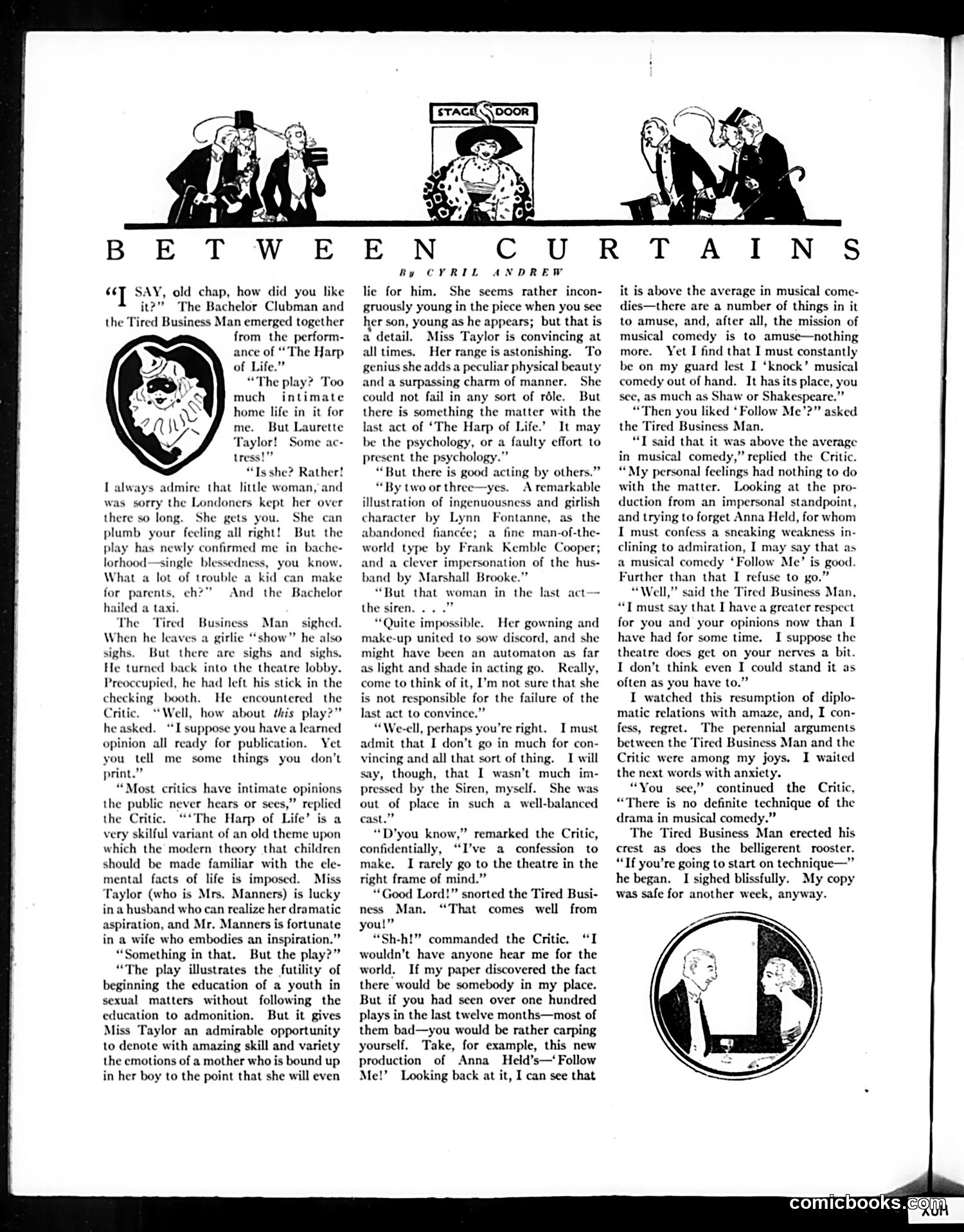
This is a theatrical review column disguised as dialogue between two characters—a Bachelor Clubman and a Tired Business Man—discussing a play called "The Harp of Life" starring Laurette Taylor. The satire targets **theatrical criticism itself**. The Critic admits he rarely attends theater "in the right frame of mind" and confesses he'd lose his job if his newspaper knew he sees plays while mentally exhausted. This exposes professional critics as jaded, overworked observers rather than authentic judges of art. The column also celebrates **Laurette Taylor's acting talent** while gently mocking the play's dated moral framework about sexual education. The dialogue format allows the author (Cyril Andrew) to present nuanced opinions—praising individual performances while critiquing the script's psychology. The illustrations show well-dressed gentlemen in top hats, reflecting Judge's upper-class audience and the era's formal theater culture.
📄 Transcribed text from this page (OCR, searchable)
Machine-transcribed from the original scan — historical spelling and the odd misread are preserved.
667] SAY, old chap, how did you like it?” The Bachelor Clubman and the Tired Business Man emerged together from the perform- ance of “The Harp of Life.” “The play? Too much intimate home life in it for me. But Laurette Taylor! Some ac- tress!” “Is she? Rather! IT always admire that little woman, and was sorry the Londoners kept her over there so long. She gets you. She can plumb your feeling all right! But the play has newly confirmed me in bache- lorhood—single blessedness, you know. What a lot of trouble a kid can make for parents, ch?” And the Bachelor hailed a i. The Tired Busine: Man sighed. When he leaves a girlie “show” he also sighs. But there are sighs and sighs. He turned back into the theatre lobby. Preoccupied, he had left his stick in the checking booth. He encountered the Critic. “Well, how about tis play?” heasked. “I suppose you have a learned opinion all ready for publication. Yet you tell me some things you don’t print.” “Most critics have intimate opinions the public never hears or sees,” replied the Critic. “*The Harp of Life’ is a very skilful variant of an old theme upon which the modern theory that children should be made familiar with the cle- mental facts of life is imposed. Mi: Taylor (who is Mrs. Manners) is lucky in a husband who can realize her dramatic aspiration, and Mr. Manners is fortunate in a wife who embodies an inspiration.” “Something in that. But the play?” “The play illustrates the futility of beginning the education of a youth in sexual matters without following the education to admonition. But it gives Miss Taylor an admirable opportunity to denote with amazing skill and variety the emotions of a mother who is bound up in her boy to the point that she will even C UR TAIN § By CYRIL ANDREW lie for him. She seems rather incon- gruously young in the piece when you see her son, young as he appears; but that is a detail. Miss Taylor is convincing at all times. Her range is astonishing. To genius she adds a peculiar physical beauty and a surpassing charm of manner. She could not fail in any sort of réle. But there is something the matter with the last act of ‘The Harp of Life.” It may be the psychology, or a faulty effort to present the psychology.” “But there is good acting by others.” “By two or three—yes. A remarkable illustration of ingenuousness and girlish character by Lynn Fontanne, as the abandoned fiancée; a fine man-of-the- world type by Frank Kemble Cooper; and a clever impersonation of the hus- band by Marshall Brooke.” “But that woman in the last act— the siren... .” “Quite impossible. Her gowning and make-up united to sow discord, and she might have been an automaton as far as light and shade in acting go. Really, come to think of it, I’m not sure that she is not responsible for the failure of the last act to convince.” “We-ell, perhaps you’re right. I must admit that I don’t go in much for con- vincing and all that sort of thing. I will say, though, that I wasn’t much im- pressed by the Siren, myself. She was out of place in such a well-balanced cast.” “D’you know,” remarked the Critic, confidentially, “I’ve a confession to make. I rarely go to the theatre in the right frame of mind.” “Good Lord!” snorted the Tired Busi- ness Man. “That comes well from you!” “Sh-h!” commanded the Critic. “I wouldn’t have anyone hear me for the world. If my paper discovered the fact there would be somebody in my place. But if you had seen over one hundred plays in the last twelve months—most of them bad—you would be rather carping yourself. Take, for example, this new production of Anna Held’s—‘ Follow Me!’ Looking back at it, I can see that it is above the average in musical come- dies—there are a number of things in it to amuse, and, after all, the mission of musical comedy is to amuse—nothing more. Yet I find that I must constantly be on my guard lest I ‘knock’ musical comedy out of hand. It has its place, you see, as much as Shaw or Shakespeare. “Then you liked ‘Follow Me’?” asked the Tired Business Man. “T said that it was above the average in musical comedy,” replied the Critic. “ My personal feelings had nothing to do with the matter. Looking at the pro- duction from an impersonal standpoint, and trying to forget Anna Held, for whom I must confess a sneaking weakness in- clining to admiration, I may say that as a musical comedy ‘Follow Me’ is good. Further than that I refuse to yo.” “Well,” said the Tired Business Man, “T must say that I have a greater respect for you and your opinions now than I have had for some time. I suppose the theatre docs get on your nerves a bit. I don’t think even I could stand it as often as you have to.” I watched this resumption of diplo- matic relations with amaze, and, I con- fess, regret. The perennial arguments between the Tired Business Man and the Critic were among my joys. I waited the next words with anxiety. “You see,” continued the Critic, “There is no definite technique of the drama in musical comedy.” The Tired Business Man erected his crest as does the belligerent rooster. “If you're going to start on technique—” he began. I sighed blissfully. My copy was safe for another week, anyway. comicbooks.