
Judge, 1916-12-30 · page 16 of 29
Judge — December 30, 1916 — page 16: what you’re looking at
What you’re looking at
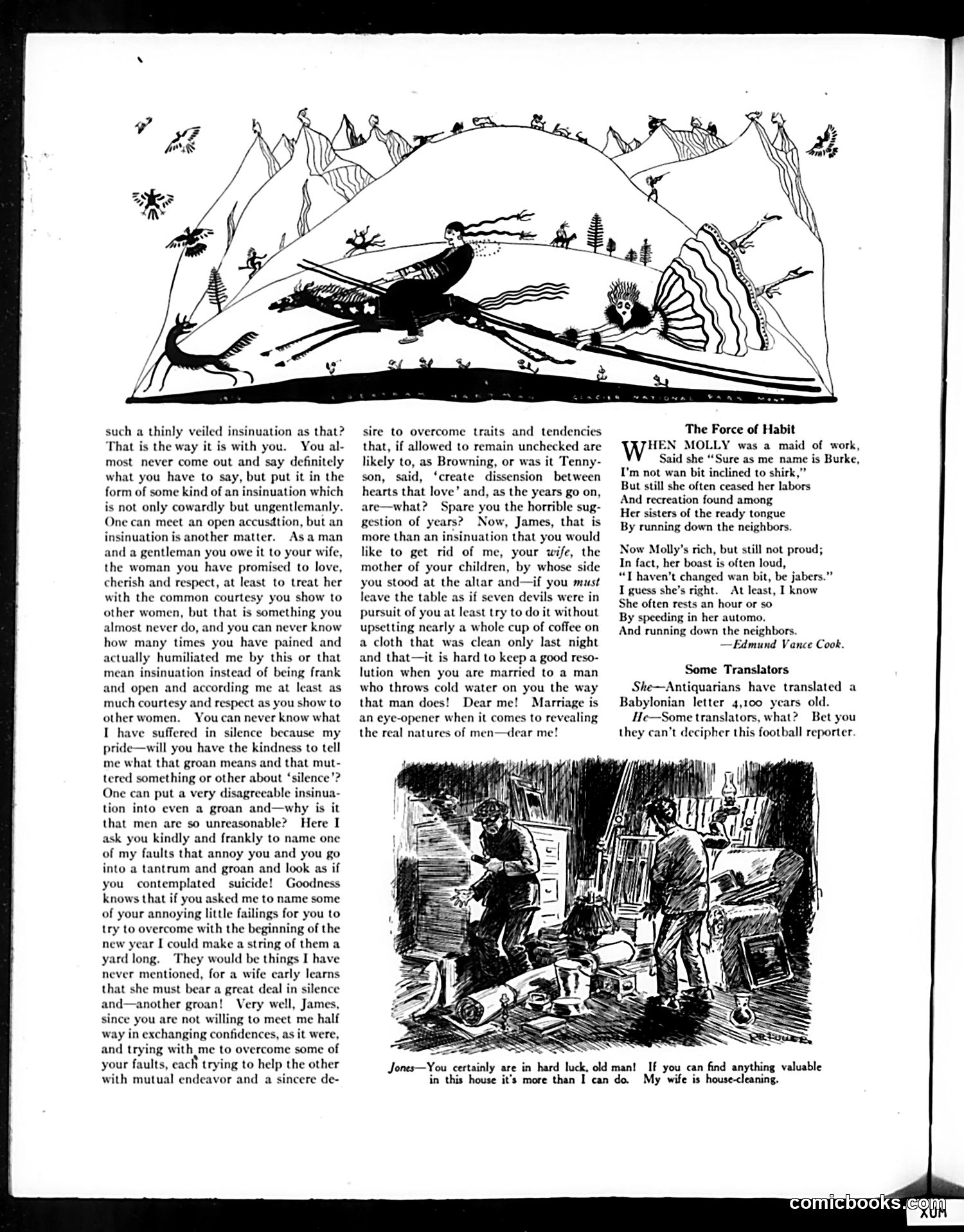
The page contains two distinct pieces of social satire: **Main Text (Left):** A lengthy marital complaint, apparently from a wife to her husband "James," criticizing his use of insinuation rather than direct communication. She catalogs his failings—his groans of disapproval, his cold demeanor, his inability to meet her halfway in marriage. The satire targets Victorian-era marital dynamics: the wife's expectation of emotional reciprocity clashing against the husband's withdrawn, passive-aggressive behavior. It's a critique of both parties—her endless monologuing and his silent resistance. **"The Force of Habit" (Poem):** A humorous commentary on social mobility. Molly, once a working maid who gossiped about neighbors, is now wealthy but hasn't changed her nature—she still gossips, now while speeding in her automobile. The joke: money can't alter fundamental character traits, particularly unflattering ones. **Bottom Cartoon:** Shows a man searching a messy house; the caption jokes that finding anything valuable is impossible when his wife is house-cleaning—domestic chaos as comedy. All three pieces satirize early 20th-century social behavior and marital tension.
📄 Transcribed text from this page (OCR, searchable)
Machine-transcribed from the original scan — historical spelling and the odd misread are preserved.
such a thinly veiled insinuation as that? That is the way it is with you. You al- most never come out and say definitely what you have to say, but put it in the form of some kind of an insinuation which is not only cowardly but ungentlemanly. One can meet an open accusation, but an insinuation is another matter. Asaman and a gentleman you owe it to your wife, the woman you have promised to love, cherish and respect, at least to treat her with the common courtesy you show to other women, but that is something you almost never do, and you can never know how many times you have pained and actually humiliated me by this or that mean insinuation instead of being frank and open and according me at least as much courtesy and respect as you show to other women. You can never know what I have suffered in silence because my pride—will you have the kindness to tell me what that groan means and that mut- tered something or other about ‘silence’? One can put a very disagreeable insinua- tion into even a groan and—why is it that men are so unreasonable? Here I ask you kindly and frankly to name one of my faults that annoy you and you go into a tantrum and groan and look as if you contemplated suicide! Goodness knows that if you asked me to name some of your annoying little failings for you to try to overcome with the beginning of the new year I could make a string of them a yard long. They would be things I have never mentioned, for a wife early learns that she must bear a great deal in silence and—another groan! Very well, James, since you are not willing to meet me half way in exchanging confidences, as it were, and trying with me to overcome some of your faults, each trying to help the other with mutual endeavor and a sincere de- sire to overcome traits and tendencies that, if allowed to remain unchecked are likely to, as Browning, or was it Tenny- son, said, ‘create dissension between hearts that love’ and, as the years go on, are—what? Spare you the horrible sug- gestion of years? Now, James, that is more than an insinuation that you would like to get rid of me, your wife, the mother of your children, by whose side you stood at the altar and—if you must leave the table as if seven devils were in pursuit of you at least try to do it without upsetting nearly a whole cup of coffee on a cloth that was clean only last night and that—it is hard to keep a good reso- lution when you are married to a man who throws cold water on you the way that man does! Dear me! Marriage is an eye-opener when it comes to revealing the real natures of men—dear me! Jones—You certainly in this house it’s more than I can do. My wife is house-cleaning. The Force of Habit HEN MOLLY was a maid of work, Said she “Sure as me name is Burke, I'm not wan bit inclined to shirk,” But still she often ceased her labors And recreation found among Her sisters of the ready tongue By running down the neighbors. Now Molly’s rich, but still not proud; In fact, her boast is often loud, “LT haven't changed wan bit, be jabers.” I guess she’s right. At least, I know She often rests an hour or so By speeding in her automo, And running down the neighbors. —Edmund Vance Cook. Some Translators She—Antiquarians have translated a Babylonian letter 4,100 years old. He—Some translators, what? Bet you they can’t decipher this football reporter. in hard luck, old man! If you can find anything valuable