
Judge, 1914-12-26 · page 16 of 25
Judge — December 26, 1914 — page 16: what you’re looking at
What you’re looking at
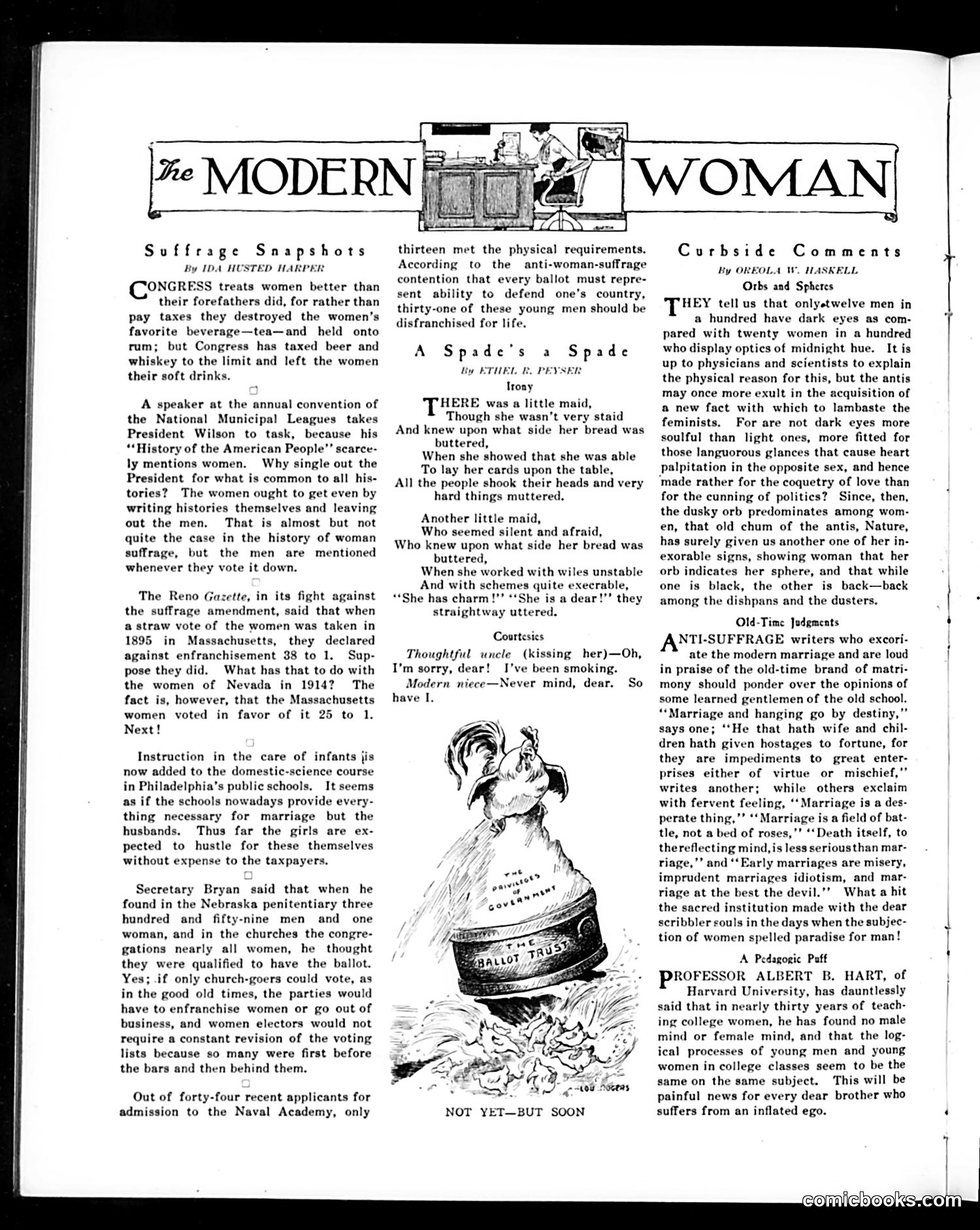
This page from Judge satirizes anti-suffrage arguments through multiple pieces. The main text columns attack opponents of women's voting rights by exposing logical fallacies and hypocrisies in their positions. **"Suffrage Snapshots"** by Ida Husted Harper uses ironic examples: Congress taxed beer and whiskey but not women's soft drinks (implying women lack political power); anti-suffragists cite an 1895 Massachusetts straw vote against suffrage while ignoring that same state later voted 25-to-1 *for* it; and she notes that if only churchgoers could vote, women would dominate the electorate. **"A Spade's a Spade"** contrasts two young women—one honest, one manipulative—to mock society's reward of feminine deception over directness. The **cartoon** (captioned "NOT YET—BUT SOON") depicts a woman labeled "BALLOT TIED" in chains, symbolizing women's denied voting rights and the anticipated future enfranchisement. **"Orbs and Spheres"** sarcastically addresses anti-feminist claims that women's darker eyes suit them for romance rather than politics—mocking the argument that biological differences disqualify women from civic participation.
📄 Transcribed text from this page (OCR, searchable)
Machine-transcribed from the original scan — historical spelling and the odd misread are preserved.
#* MODER Suffrage Snapshots By IDA HUSTED HARPER CONGRESS treats women better than their forefathers did, for rather than pay taxes they destroyed the women’s favorite beverage—tea—and held onto rum; but Congress has taxed beer and whiskey to the limit and left the women their soft drinks. A speaker at the annual convention of the National Municipal Leagues takes President Wilson to task, because his “History of the American People’’ scarce- ly mentions women. Why single out the President for what is common to all his- tories? The women ought to get even by writing histories themselves and leaving out the men, That is almost but not quite the case in the history of woman suffrage, but the men are mentioned whenever they vote it down. The Reno Gazette, in its fight against the suffrage amendment, said that when a straw vote of the women was taken in 1895 in Massachusetts, they declared against enfranchisement 38 to 1. Sup- pose they did. What has that to do with the women of Nevada in 1914? The fact is, however, that the Massachusetts women voted in favor of it 25 to 1. Next! Instruction in the care of infants jis now added to the domestic-science course in Philadelphia's public schools, It seems if the schools nowadays provide every- thing necessary for marriage but the husbands. Thus far the girls are ex- pected to hustle for these themselves without expense to the taxpayers. Secretary Bryan said that when he found in the Nebraska penitentiary three hundred and fifty-nine men and one woman, and in the churches the congre- gations nearly all women, he thought they were qualified to have the ballot. Yes; .if only church-goers could vote, as in the good old times, the parties would have to enfranchise women or go out of business, and women electors would not require a constant revision of the voting lists because so many were first before the bars and then behind them. Out of forty-four recent applicants for admission to the Naval Academy, only thirteen met the physical requirements. According to the anti-woman-suffrage contention that every ballot must repre- sent ability to defend one’s country, thirty-one of these young men should be disfranchised for life. A Spade’s a Spade By ETHEL PEYSER lrony HERE was a little maid, Though she wasn’t very staid And knew upon what side her bread was buttered, When she showed that she was able To lay her cards upon the table, All the people shook their heads and very hard things muttered. Another little maid, Who seemed silent and afraid, Who knew upon what side her bread was buttered, When she worked with wiles unstable And with schemes quite execrable, “She has charm!’’ *‘She is a dear!’’ they straightway uttered. Courtesies Thoughtful uncle (kissing her)—Oh, I'm sorry, dear! I've been smoking. Modern niece er mind, dear. So have I. NOT YET—BUT SOON Comments LL Curbside By OREOLA W. HAS Orbs and Spheres HEY tell us that onlyetwelve men in a hundred have dark eyes as com- pared with twenty women in a hundred who display optics of midnight hue. It is up to physicians and scientists to explain the physical reason for this, but the antis may once more exult in the acquisition of a new fact with which to lambaste the feminists. For are not dark eyes more soulful than light ones, more fitted for those languorous glances that cause heart palpitation in the opposite sex, and hence ‘made rather for the coquetry of love than for the cunning of politics? Since, then, the dusky orb predominates among wom- en, that old chum of the antis, Nature, has surely given us another one of her in- exorable signs, showing woman that her orb indicates her sphere, and that while one is black, the other is back—back among the dishpans and the dusters. Old-Time Judgments ANTI-SUFFRAGE writers who excori- ate the modern marriage and are loud in praise of the old-time brand of matri- mony should ponder over the opinions of some learned gentlemen of the old school. “Marriage and hanging go by destiny,” says one; ‘‘He that hath wife and chil- dren hath given hostages to fortune, for they are impediments to great enter- prises either of virtue or mischief,"’ writes another; while others exclaim with fervent feeling, ‘‘Marriage is a des- perate thing,’’ ‘‘ Marriage is a field of bat- tle, not a bed of roses,’’ ‘Death itself, to thereflecting mind, is less serious than mar- riage,’’ and ‘Early marriages are misery, imprudent marriages idiotism, and mar- riage at the best the devil.’’. What a hit the sacred institution made with the dear scribbler souls in the days when the subjec- tion of women spelled paradise for man! A Pedagogic Puff PROFESSOR ALBERT B. HART, of Harvard University, has dauntlessly said that in nearly thirty years of teach- ing college women, he has found no male mind or female mind, and that the log- ical processes of young men and young women in college classes seem to be the same on the same subject. This will be painful news for every dear brother who suffers from an inflated ego. -—t—