
Judge, 1914-12-26 · page 10 of 25
Judge — December 26, 1914 — page 10: what you’re looking at
What you’re looking at
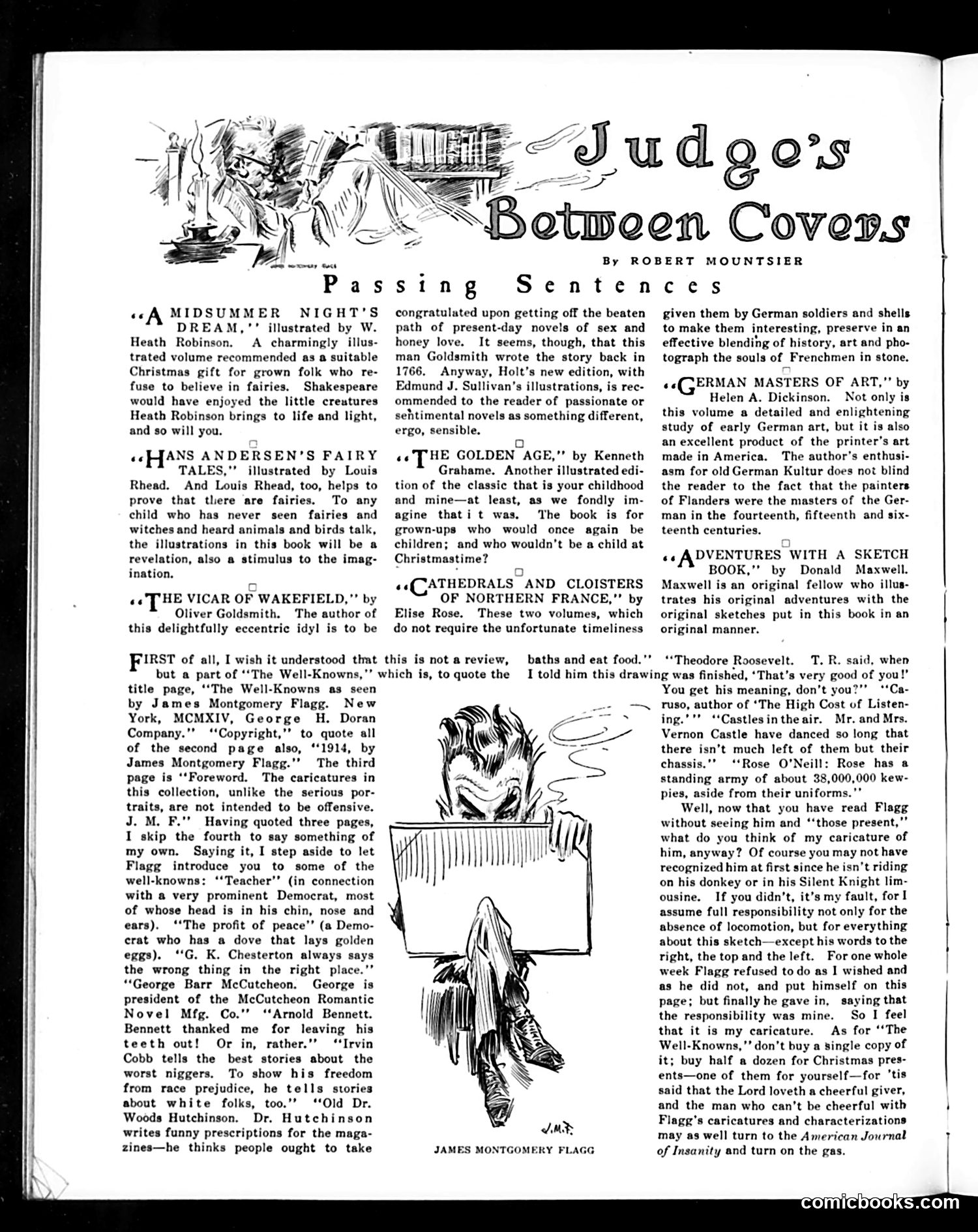
This is primarily a book review column by Robert Mountsier recommending illustrated Christmas gifts. The main illustration depicts caricatures by James Montgomery Flagg from his 1914 collection "The Well-Knowns." The text includes satirical character sketches of contemporary figures: a prominent Democrat with an exaggerated chin/nose, author G.K. Chesterton ("always says the wrong thing in the right place"), novelist George Barr McCutcheon, author Arnold Bennett (joked about his missing teeth), humorist Irvin Cobb (mocked for his dialect humor about race), and Dr. Woods Hutchinson (criticized for writing medical advice for magazines). The reviews themselves recommend classic literature: Shakespeare's *Midsummer Night's Dream*, Andersen's *Fairy Tales*, and Goldsmith's *Vicar of Wakefield*, alongside contemporary works. A notable review of "Cathedrals and Cloisters of Northern France" references damage "given them by German soldiers and shells"—indicating this was published during or shortly after WWI, when France was actively at war with Germany.
📄 Transcribed text from this page (OCR, searchable)
Machine-transcribed from the original scan — historical spelling and the odd misread are preserved.
Passing «A MIDSUMMER NIGHT'S DREAM,"’ illustrated by W. Heath Robinson. A charmingly illus- trated volume recommended as a suitable Christmas gift for grown folk who re- fuse to believe in fairies. Shakespeare would have enjoyed the little creutures Heath Robinson brings to life and light, and so will you. «« HANS ANDERSEN'S FAIRY TALES,”’ illustrated by Louis Rhead. And Louis Rhead, too, helps to prove that tlere are fairies. To any child who has never seen fairies and witches and heard animals and birds talk, the illustrations in this book will be a revelation, also a stimulus to the imag- ination, se THE VICAR OF WAKEFIELD,” by Oliver Goldsmith. The author of this delightfully eccentric idyl is to be First of all, I wish it understood that but a part of ‘‘The Well-Knowns,"’ which is, to quote the title page, ‘‘The Well-Knowns as seen by James Montgomery Flagg. New York, MCMXIV, George H. Doran Company.'’ ‘‘Copyright,’’ to quote all of the second page also, ‘1914, by James Montgomery Flagg.'’ The third page is ‘‘Foreword. The caricatures in this collection, unlike the serious por- traits, are not intended to be offensive. J. M. F."" Having quoted three pages, I skip the fourth to say something of my own. Saying it, I step aside to let Flagg introduce you to some of the well-knowns: ‘‘Teacher’’ (in connection with a very prominent Democrat, most of whose head is in his chin, nose and ears). ‘‘The profit of peace’’ (a Demo- crat who has a dove that lays golden eggs). ‘‘G. K. Chesterton always says the wrong thing in the right place.’’ “George Barr McCutcheon. George is president of the McCutcheon Romantic Novel Mfg. Co."’ ‘Arnold Bennett. Bennett thanked me for leaving his teeth out! Or in, rather.” “Irvin Cobb tells the best stories about the worst niggers. To show his freedom from race prejudice, he tells stories about white folks, too.’’ ‘Old Dr. Woods Hutchinson. Dr. Hutchinson writes funny prescriptions for the maga- zines—he thinks people ought to take Ee congratulated upon getting off the beaten path of present-day novels of sex and honey love. It seems, though, that this man Goldsmith wrote the story back in 1766. Anyway, Holt’s new edition, with Edmund J. Sullivan's illustrations, is rec- ommended to the reader of passionate or sehtimental novels as something different, ergo, sensible, Oo ee THE GOLDEN AGE," by Kenneth Grahame. Another illustrated edi- tion of the classic that is your childhood and mine—at least, as we fondly im- agine thatit was. The book is for grown-ups who would once again be children; and who wouldn't be a child at Christmastime? fs) «(CATHEDRALS AND CLOISTERS OF NORTHERN FRANCE,” by Elise Rose. These two volumes, which do not require the unfortunate timeliness this is not areview, baths and eat foo¢ Hil | W\Il AM JAMES MONTGOMERY FLAGG Judgos etmeen Covon.s By ROBERT MOUNTSIER Sentences given them by German soldiers and shells. to make them interesting, preserve in an effective blending of history, art and pho- tograph the souls of Frenchmen in stone. «eGERMAN MASTERS OF ART," by Helen A. Dickinson. Not only is this volume a detailed and enlightening study of early German art, but it is also an excellent product of the printer's art made in America. The author’s enthusi- asm for oldGerman Kultur does not blind the reader to the fact that the painters of Flanders were the masters of the Ger- man in the fourteenth, fifteenth and six- teenth centuries. «« ADVENTURES WITH A SKETCH BOOK,” by Donald Maxwell. Maxwell is an original fellow who illus- trates his original adventures with the original sketches put in this book in an original manner. “Theodore Roosevelt. T. R. said, when I told him this drawing was finished, ‘That's very good of you!” You get his meaning, don’t you?"’ ‘*Ca- ruso, author of ‘The High Cost of Listen- ing.’’’ ‘*Castlesintheair. Mr. and Mrs. Vernon Castle have danced so long that there isn’t much left of them but their chassis.’ ‘Rose O'Neill: Rose has a standing army of about 38,000,000 kew- pies, aside from their uniforms."* Well, now that you have read Flagg without seeing him and ‘those present,” what do you think of my caricature of him, anyway? Of course you may not have recognized him at first since he isn't riding on his donkey or in his Silent Knight lim- ousine. If you didn’t, it’s my fault, for I assume full responsibility not only for the absence of locomotion, but for everything about this sketch—except his words to the right, the top and the left. For one whole week Flagg refused to do as I wished and as he did not, and put himself on this page; but finally he gave in, saying that the responsibility was mine. So I feel that it is my caricature. As for ‘‘The Well-Knowns,’’ don’t buy a single copy of it; buy half a dozen for Christmas pres- ents—one of them for yourself—for ‘tis said that the Lord loveth a cheerful giver, and the man who can’t be cheerful with Flagg’s caricatures and characterizations may as well turn to the American Journal of Insanity and turn on the gas.