
Judge, 1912-07-20 · page 5 of 26
Judge — July 20, 1912 — page 5: what you’re looking at
What you’re looking at
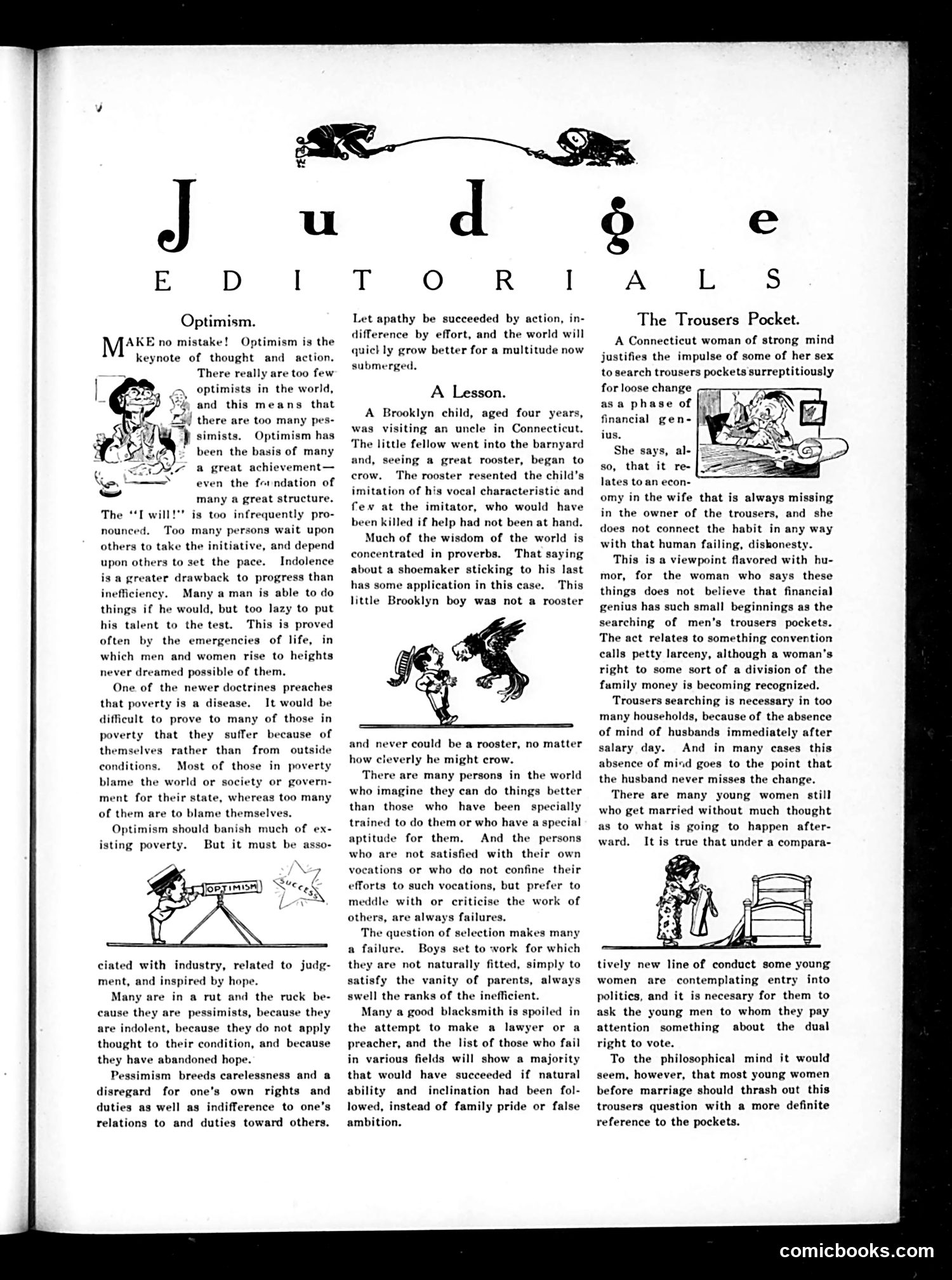
This page contains three editorial pieces rather than political cartoons: 1. **"Optimism"** (left): A brief essay arguing optimism enables achievement, contrasting it with pessimism's paralysis. The small illustration shows someone looking through a telescope labeled "OPTIMISM." 2. **"A Lesson"** (center): A parable about a Brooklyn boy who imitates a rooster, learning that natural ability matters more than imitation. The moral critiques those who attempt work they're unsuited for. 3. **"The Trousers Pocket"** (right): Defends women searching their husbands' trouser pockets for money, arguing financial transparency in marriage is reasonable. It advocates for women's economic awareness before marriage. These pieces reflect early 20th-century concerns about personal virtue, gender roles, and marital finances rather than specific political events or figures.
📄 Transcribed text from this page (OCR, searchable)
Machine-transcribed from the original scan — historical spelling and the odd misread are preserved.
Optimism. <E no mistake! Optimism is the keynote of thought and action. There really are too few “ optimists in the world, by and this means that £/ there are too many pes- simists. Optimism has been the basis of many {7 a great achievement— Yoa-—— even the forndation of inal many a great structure. The ‘I will!’ is too infrequently pro- nounced. Too many persons wait upon others to take the initiative, and depend upon others to set the pace. Indolence is a greater drawback to progress than inefficiency. Many aman is able to do things if he would, but too lazy to put his talent to the test. This is proved often by the emergencies of life, in which men and women rise to heights never dreamed possible of them. One of the newer doctrines preaches that poverty is a disease, It would be difficult to prove to many of those in poverty that they suffer because of themselves rather than from outside conditions. Most of those in poverty blame the world or society or govern- ment for their state, whereas too many of them are to blame themselves. Optimism should banish much of ex- isting poverty. But it must be asso- 3 ciated with industry, related to judg- ment, and inspired by hope. Many are in a rut and the ruck be- cause they are pessimists, because they are indolent, because they do not apply thought to their condition, and because they have abandoned hope. Pessimism breeds carelessness and a disregard for one’s own rights and duties as well as indifference to one’s relations to and duties toward others. T R Let apathy be succeeded by action, in- difference by effort, and the world will quict ly grow better for a multitude now submerged. A Lesson. A Brooklyn child, aged four years, was visiting an uncle in Connecticut. The little fellow went into the barnyard and, seeing a great rooster, began to crow. The rooster resented the child’s imitation of his vocal characteristic and few at the imitator, who would have been killed if help had not been at hand. Much of the wisdom of the world is concentrated in proverbs. That saying about a shoemaker sticking to his last has some application in this case. This little Brooklyn boy was not a rooster PA and never could be a rooster, no matter how cleverly he might crow. There are many persons in the world who imagine they can do things better than those who have been specially trained to do them or who have a special aptitude for them. And the persons who are not satisfied with their own vocations or who do not confine their efforts to such vocations, but prefer to meddle with or criticise the work of others, are always failures. The question of selection makes many a failure. Boys set to work for which they are not naturally fitted, simply to satisfy the vanity of parents, always swell the ranks of the inefficient. Many a good blacksmith is spoiled in the attempt to make a lawyer or a preacher, and the list of those who fail in various fields will show a majority that would have succeeded if natural ability and inclination had been fol- lowed, instead of family pride or false ambition. L § The Trousers Pocket. A Connecticut woman of strong mind justifies the impulse of some of her sex to search trousers pockets surreptitiously for loose change asa phase of financial gen- ius. She says, al- so, that it re- lates to an econ- omy in the wife that is always missing in the owner of the trousers, and she does not connect the habit in any way with that human failing, dishonesty. This is a viewpoint flavored with hu- mor, for the woman who says these things does not believe that financial genius has such small beginnings as the searching of men’s trousers pockets. The act relates to something convention calls petty larceny, although a woman's right to some sort of a division of the family money is becoming recognized. Trousers searching is necessary in too many households, because of the absence of mind of husbands immediately after salary day. And in many cases this absence of mind goes to the point that the husband never misses the change. There are many young women still who get married without much thought as to what is going to happen after- ward. It is true that under a compara- tively new line of conduct some young women are contemplating entry into politics, and it is necesary for them to ask the young men to whom they pay attention something about the dual right to vote. To the philosophical mind it would seem, however, that most young women before marriage should thrash out this trousers question with a more definite reference to the pockets. comicbooks.com