
Judge, 1912-07-20 · page 12 of 26
Judge — July 20, 1912 — page 12: what you’re looking at
What you’re looking at
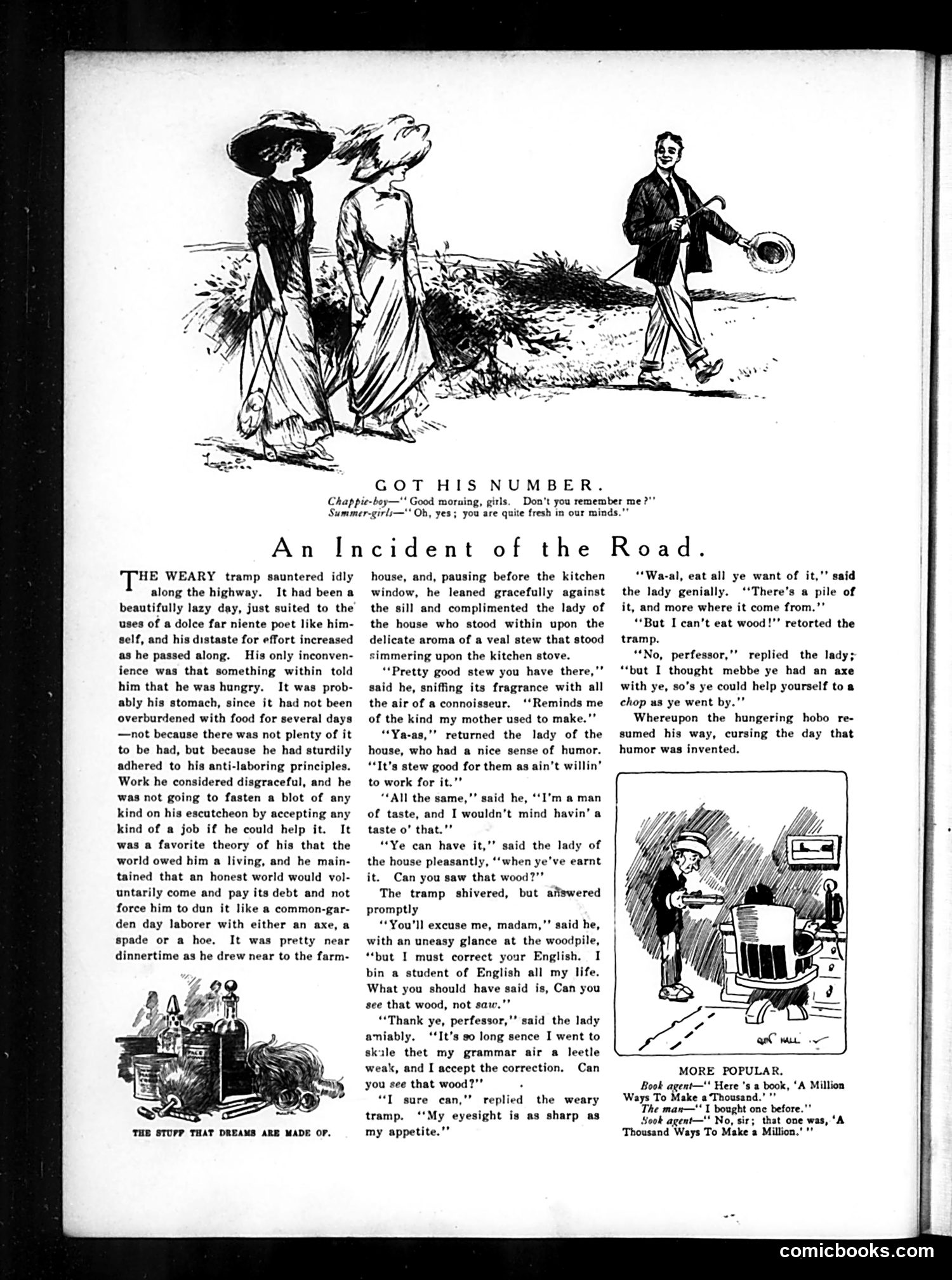
This story satirizes a lazy vagrant's entitlement and his comeuppance through wit. The tramp, who refuses work on principle (believing "the world owed him a living"), attempts to charm a farmwoman into feeding him by flattering her stew. When she offers food in exchange for sawing wood, he pedantically corrects her grammar—"see" versus "saw"—rather than accept the work. The farmwoman cleverly turns his own pretension against him: she "corrects" herself and asks if he can "see that wood," making clear he must chop it to eat. The tramp leaves hungry and frustrated. The satire targets both idleness and false gentility. The vagrant uses affected language ("connoisseur," grammatical pedantry) to mask his unwillingness to labor, but the sharp farmwoman exposes his hypocrisy. The joke's sting: cleverness cannot substitute for honest work, and those who refuse labor deserve their hunger.
📄 Transcribed text from this page (OCR, searchable)
Machine-transcribed from the original scan — historical spelling and the odd misread are preserved.
Chap pie-boy—' Good morning, girls. GOT HIS NUMBER. Don't you remember me ?"’ Summer-girli—" Ob, yes ; you are quite fresh in our minds."” An Incident of THE WEARY tramp sauntered idly along the highway. It had beena beautifully lazy day, just suited to the uses of a dolce far niente poet like him- self, and his distaste for effort increased as he passed along. His only inconven- ience was that something within told him that he was hungry. It was prob- ably his stomach, since it had not been overburdened with food for several days —not because there was not plenty of it to be had, but because he had sturdily adhered to his anti-laboring principles. Work he considered disgraceful, and he was not going to fasten a blot of any kind on his escutcheon by accepting any kind of a job if he could help it. It was a favorite theory of his that the world owed him a living, and he main- tained that an honest world would vol- untarily come and pay its debt and not force him to dun it like a common-gar- den day laborer with either an axe, a spade or a hoe. It was pretty near dinnertime as he drew near to the farm- THE STUPP THAT DREAMS ARE MADE OP. house, and, pausing before the kitchen window, he leaned gracefully against the sill and complimented the lady of the house who stood within upon the delicate aroma of a veal stew that stood simmering upon the kitchen stove. “Pretty good stew you have there,’’ said he, sniffing its fragrance with all the air of a connoisseur. ‘‘Reminds me of the kind my mother used to make."’ “*Ya-as,'’ returned the lady of the house, who had a nice sense of humor. “It's stew good for them as ain’t willin’ to work for it."” “*All the same,"’ said he, ‘‘I’m a man of taste, and I wouldn't mind havin’ a taste o' that.’’ “Ye can have it,’ said the lady of the house pleasantly, ‘‘when ye've earnt it. Can you saw that wood?” The tramp shivered, but ailswered promptly “*You'll excuse me, madam,”’ said he, with an uneasy glance at the woodpile, “‘but I must correct your English. bin a student of English all my life. What you should have said is, Can you see that wood, not saw."’ “Thank ye, perfessor,"’ said the lady amniably. ‘‘It’s 90 long sence I went to skale thet my grammar air a leetle weak, and I accept the correction. Can you see that wood?”’ . “I sure can,"? replied the weary tramp. ‘My eyesight is as sharp as my appetite.’” the Road. “‘Wa-al, eat all ye want of it,’’ said the lady genially. ‘‘There’s a pile of it, and more where it come from.’’ “But I can’t eat wood!"’ retorted the tramp. “No, perfessor,’’ replied the lady; “‘but I thought mebbe ye had an axe with ye, so’s ye could help yourself toa chop us ye went by.” Whereupon the hungering hobo re- sumed his way, cursing the day that humor was invented. MORE POPULAR. Book agent—'‘ Here ‘s 2 book, ‘A Million Ways To Make a Thousand.’ The man—'* 1 bought one before."” Sook agent—* No, sir; that one was, ‘A Thousand Ways To Make a Million.’ "" comicbooks.com