
Judge, 1907-05-11 · page 3 of 16
Judge — May 11, 1907 — page 3: what you’re looking at
What you’re looking at
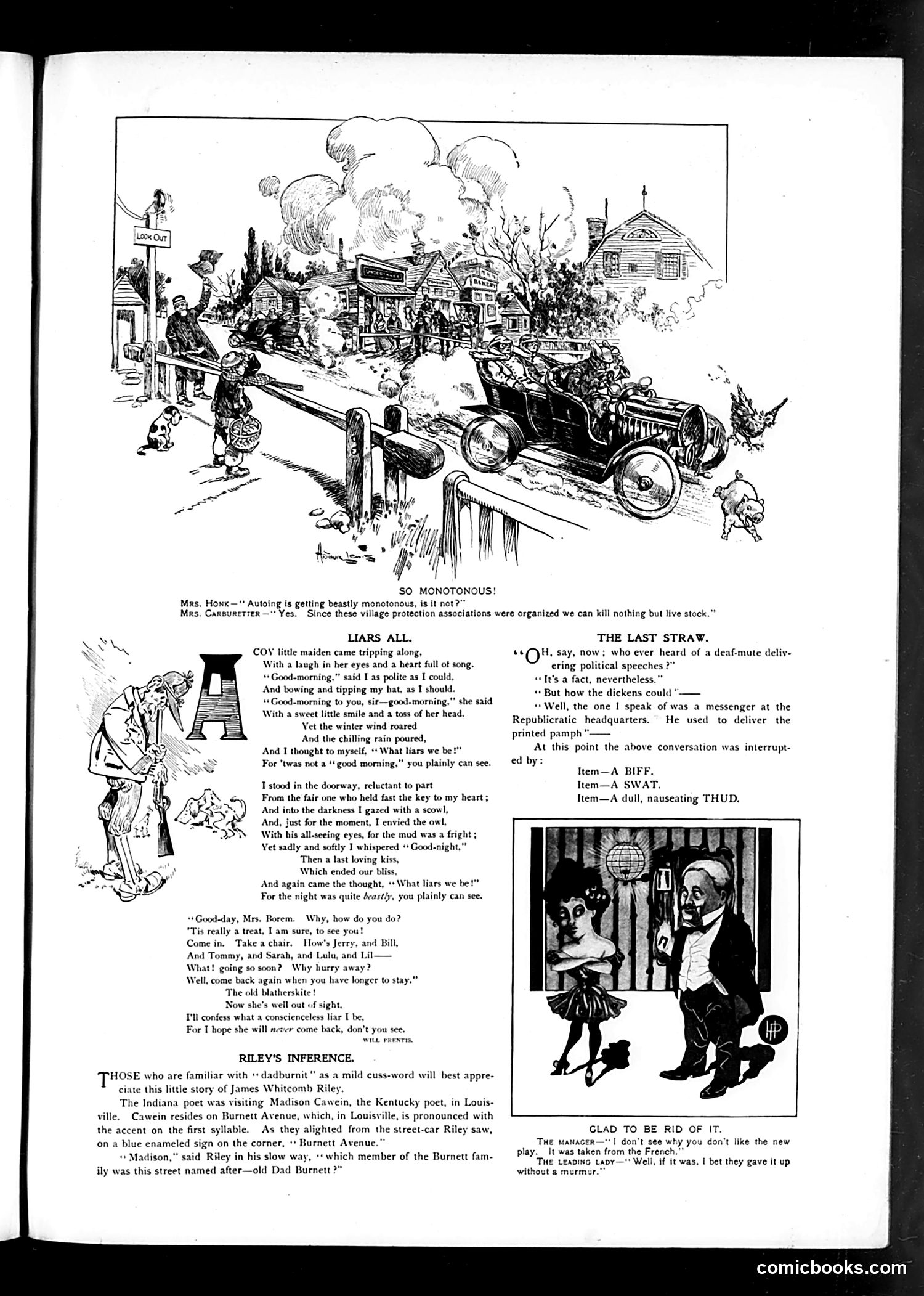
The top cartoon, "SO MONOTONOUS!" depicts a speeding automobile rushing through a village, with the caption suggesting village residents have organized "protection associations" to combat reckless drivers. The joke satirizes the ineffectiveness of these early auto-safety groups—they can't stop dangerous driving, only "like stock" (complain). Below are literary pieces: "Liars All" (a poem about a cow maiden), and "Riley's Inference," discussing James Whitcomb Riley's visit to Madison, Wisconsin. The text notes the poet observed "Burnett Avenue" on a street sign and humorously inferred the street must be named after writer James Burnett. The lower right shows what appears to be a theatrical or social scene titled "Glad to Be Rid of It," referencing a French play. This reflects early 1900s concerns about automobile safety and contemporary literary culture.
📄 Transcribed text from this page (OCR, searchable)
Machine-transcribed from the original scan — historical spelling and the odd misread are preserved.
SO MONOTONOUS! Mrs. Honx—"' Autoing is getting beastly monotonous, is it not?" Mrs. Carsuretrer—"Yes. Since these village protection associations were organized we can kill nothing but live stock.” LIARS ALL, COY little maiden came tripping along, With a laugh in her eyes and a heart full of song. “+ Good-morning,” said I as polite as I could, And bowing and tipping my hat, as I’ should. “Good-morning to you, sir—good-morning,” she said With a sweet little smile and a toss of her head. Yet the winter wind roared And the chilling rain poured, And I thought to myself, “ What liars we be!” For ‘twas not a “good morning," you plainly can see. I stood in the doorway, reluctant to part From the fair onie who held fast the key to my heart; And into the darkness I gazed with a scowl, And, just for the moment, I envied the owl, With his all-seeing eyes, for the mud was a fright ; Yet sadly and softly I whispered Good-night,” Then a last loving kiss, Which ended our bliss, ‘And again came the thought, “+ What liars we be!" For the night was quite deast/y, you plainly can see. “Good-day, Mrs. Borem. Why, how do you do? ‘Tis really a treat, Iam sure, to see you! Come in. Take a chair. How's Jerry, and Bill And Tommy, and Sarah, and Lulu, and What! going so soon? Why hurry awa: Well, come back again when you have longer to stay.” The old blatherskite! Now she’s well out of sight, T'll confess what a conscienceless liar I be, For I hope she will never come back, don't you see. RILEY'S INFERENCE. HOSE who are familiar with “dadburnit” as a mild cuss-word will best appre- ciate this little story of James Whitcomb Riley. The Indiana poet was visiting Madison Cawein, the Kentucky poet, in Louis- ville. Cawein resides on Burnett Avenue, which, in Louisville, is pronounced with the accent on the first syllable. As they alighted from the street-car Riley saw, on a blue enameled sign on the corner, « Burnett Avenue.” + Madison," said Riley in his slow way, + which member of the Burnett fam- ily was this street named after—old Dad Burnett >” THE LAST STRAW. $4 )H, say, now: who ever heard of a deaf-mute deliv. ering political speeches ?” It's a fact, nevertheless. “+ But how the dickens could "— “Well, the one I speak of was a messenger at the Republicratic headquarters. He used to deliver the printed pamph "— At this point the above conversation was interrupt- ed by: Item—A BIFF. Item—A SWAT. Item—A dull, nauseating THUD. GLAD TO BE RID OF IT. Tue uanacer—'! don't see why you don't like the new play. It was taken from the French.”* Tue Leapina Lapy—'* Well, if it was, I bet they gave it up without a murmur.” comicbooks.com