
Judge, 1907-05-11 · page 10 of 16
Judge — May 11, 1907 — page 10: what you’re looking at
What you’re looking at
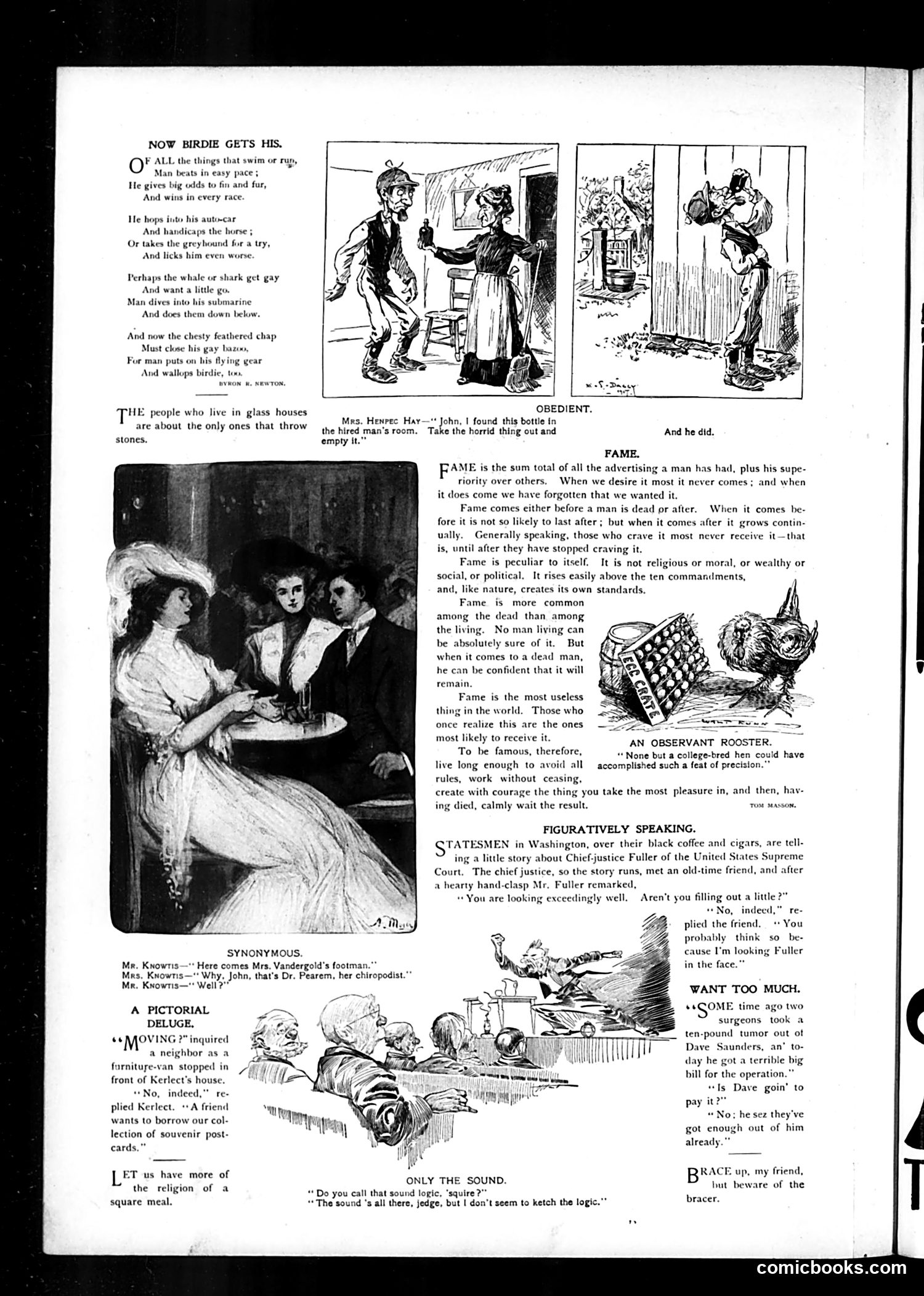
This page contains several humorous vignettes typical of early 20th-century American satirical humor: **"Now Birdie Gets His"** (top): A poem celebrating human dominance over animals—man outpaces all creatures, from whales to birds. The accompanying cartoons show a man triumphantly confronting nature, reflecting era-specific pride in industrial/technological progress. **"Obedient"**: A domestic scene where a hired man removes a bottle from his room—likely alcohol—depicting servant compliance and middle-class anxiety about lower-class moral behavior. **"Fame"**: A philosophical essay noting fame is useless, more common among the dead, and unpredictable—ironic commentary on society's obsession with reputation. **Other sketches** mock class pretensions ("Synonymous"—confusing a doctor with a footman), marital dynamics, and working-class humor about medical bills and surgical procedures. The page reflects Gilded Age preoccupations: technological superiority, class distinctions, servant management, and aspirational social climbing—all delivered through the magazine's trademark blend of text and satirical illustrations.
📄 Transcribed text from this page (OCR, searchable)
Machine-transcribed from the original scan — historical spelling and the odd misread are preserved.
NOW BIRDIE GETS HIS. OF ALL the things that swim or rup, Man beats in easy pace ; He gives big odds te nd fur, And wins in every race He hops inte his auto-car And handicaps the horse 5 Or takes the greyhound for a try, And licks him even worse. Perhaps the whale or shark get gay And want a little Man dives into his submarine And does them down be And now the chesty feathered chap Must close his bazoo, For man puts on his flying gear And wallops birdie, too HE people who live in glass houses sien Sicivis 6S ln and a OBEDIENT. . ins. Henrec Har—"' John, | found this bottle in are about the only ones that throw ihe hired man’s room. Take the horrid thing out and And he did. stones. empty it.” FAME. AME is the sum total of all the advertising a man has had, plus his supe- riority over others. When we desire it most it never comes ; and when it does come we have forgotten that we wanted it. Fame comes either before a man is dead pr after. When it comes be- fore it is not so likely to last after; but when it comes after it grows contin- ually, Generally speaking, those who crave it most never receive it—that is, until after they have stopped craving it, Fame is peculiar to itself. It is not religious or moral, or wealthy or social, or political. It rises easily above the ten commandments, and, like nature, creates its own standards, Fame is more common among the dead than among the living. No man living can be absolutely sure of it. But when it comes toa dead man, he can be confident that it will remain. Fame is the most useless thing in the world. Those who once realize this are the ones 5 most likely to receive it. AN OBSERVANT ROOSTER. To be famous, therefore, “None but a college-bred hen could have live long enough to avoid all accomplished such a feat of precision.” rules, work without ceasing, create with courage the thing you take the most pleasure in, and then, hav- ing died, calmly wait the result. Tost MASSom. FIGURATIVELY SPEAKING. STATESMEN in Washington, over their black coffee and cigars, are tell ing a little story about Chief-justice Fuller of the United States Supreme Court. The chief justice, so the story runs, met an old-time friend, and after a hearty hand-clasp Mr, Fuller remarked, ++ You are looking exceedingly well. Aren't you filling out a little?” “No, indeed,” re- plied the friend. You probably think so be- SYNONYMOUS. t. Z cause I'm looking Fuller Mr. Knownis—** Here comes Mrs. Vandergold’s footman."” SA in the face.” Mrs. Kuownis—"' Why, John, that's Dr. Pearem, her chiropodist.” Mr. Kwowris— Well ?” WANT TOO MUCH. S#SOME time ago two DELUGE, surgeons took a ++ MOVING ?* inquired . = = ten-pound tumor out o /, f y i BHT | TI Dave Saunders, an’ to- a neighbor as a (i HIG WUT day he got a terrible big farnit stopped arn ue van moppes bill for the operation.” front of Kerlect’s house. He “Is Dave goin’ to “No, indeed," re- says lied Kerlect. +A friend Paya? plied Kerlect. +A frien a Nouneaeningyve got enough out of him A PICTORIAL wants to borrow our col- lection of souvenir post- . alread cards. already BRACE up, my friend, but beware of the LET us have more of ONLY THE SOUND. the religion of a “Do you call that sound logic, “squire?” square meal. “The sound ‘s all there, jedge, but | don’t seem to ketch the logic."* bracer. comicbooks.com