
Judge, 1887-07-09 · page 5 of 16
Judge — July 9, 1887 — page 5: what you’re looking at
What you’re looking at
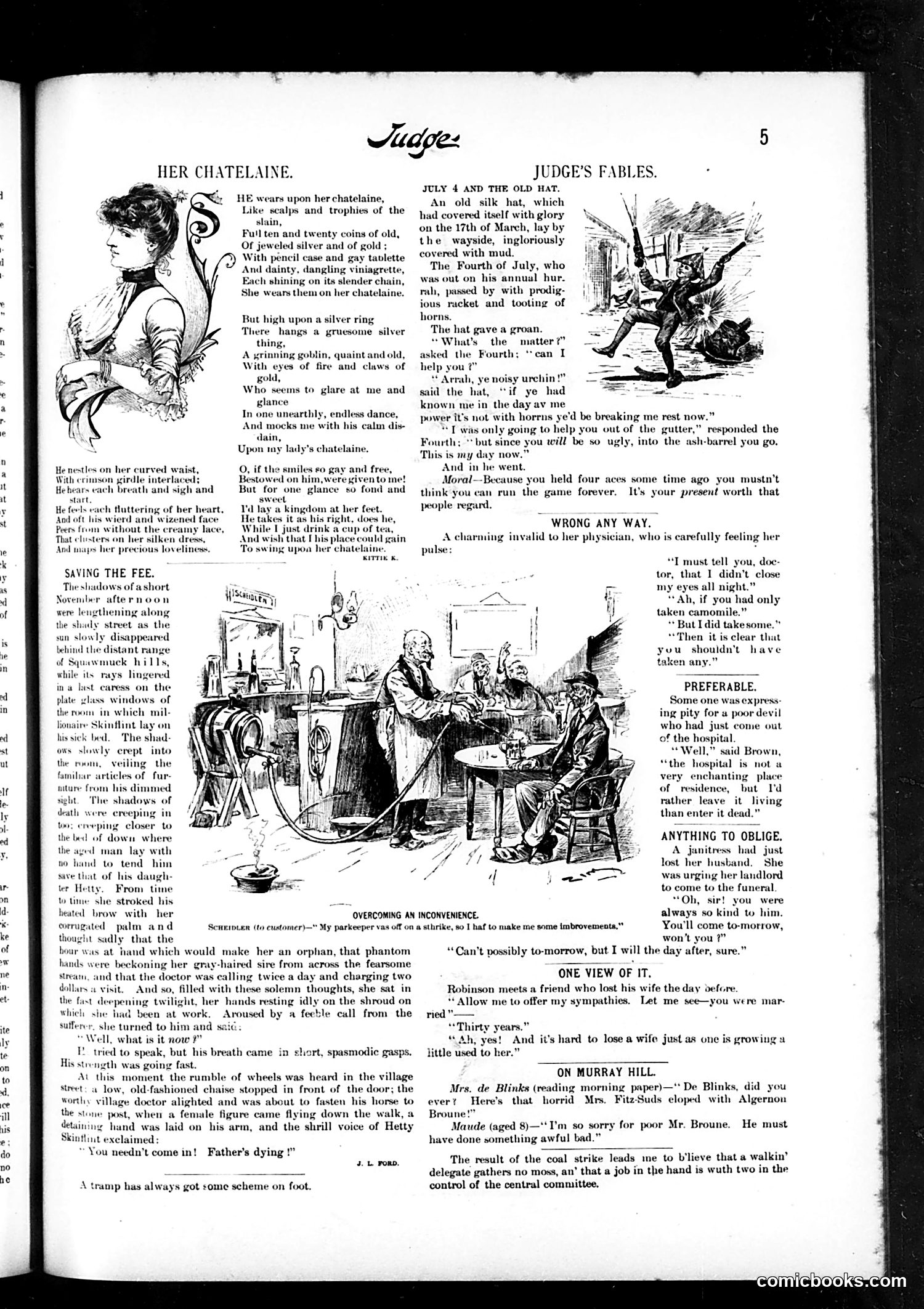
This page contains several humorous pieces typical of Judge's satirical approach: **"Her Chatelaine"** (left): A poem mocking the fashion of women wearing decorative charms and trinkets on chains attached to their waists. The satirical tone suggests this accessory trend was considered excessive or pretentious. **"Saving the Fee"** (center-left): A melodramatic story about an elderly man on his deathbed and his daughter Hetty. The satire appears to target either sentimental Victorian literature or—given the detail about a doctor "calling twice a day and charging two dollars a visit"—medical profiteering. **"July 4 and the Old Hat"** (right): A Aesop-style fable where a silk hat that was glorious on St. Patrick's Day (March 17) is now mud-covered and discarded on July 4th. The moral warns against resting on past accomplishments—a timeless satirical point about complacency. The remaining pieces are brief, humorous anecdotes about everyday situations.
📄 Transcribed text from this page (OCR, searchable)
Machine-transcribed from the original scan — historical spelling and the odd misread are preserved.
ape: HER CHATELAINE. He nestles on her curved waist, With crimson yirdle interlaced; He hears each breath and sigh and start seach tluttering of ber heart, and w but the creainy lace, That clusters on her silken dress, And maps her precious loveliness, SAVING THE FEE. The shadows of a short November afternoon hening along ly street as the sun slowly disappeared behind the distant range of Squawmuek hills, while its rays lingered ina last caress on the pla ows of the room in whieh mil- inflint lay on The sl ows slowly crept the room, veiling the familar articles of fur- ature from his dimmed t. The shadows of death were creeping in to: creeping closer to the bed of down where the aged man lay with ho 1 to tend him sive that of his daugh- wr Hetty. From time tw tine she stroked his heated brow with her corrugated palm and thought sadly that the hour was at i were le the sh lionaire > his sick bed. hands were beckoning her gre dollar it. And so, the pening tw whieh she had been at work, “Well, what is it now ?”" r His hh was going fast. HE wears upon her chatelaine, Like scalps and trophies of the slain, Full ten and twenty coins of old, Of jeweled silver and of gold ; With pencil case and tavlette i dangling viniagrette, on its slender chain, She wears them on her chatelaine. But high upon a silver ring There hangs a gruesome silver thing, A grinn With e} gold, Who seems to glare at me and glance In one unearthly, en And mocks me with hi: dain, lady's chatelaine, 3 dance, calm dis- miles 0 gay and free, ed on him, were given to me! But for one glance so fond and swe Yd lay a pm at her feet. He takes it as his right, does he, While I just drink a cup of tea, And wish that I his place could gain To swing upoa her chatelaine. OVERCOMING AN INCONVENIENCE. Scunipten (to customer)—" My parkeeper vas off on a sthrike, so I haf to make me some {mbrovementa,"* and which would make her an orphan, that phantom haired sire from across the fearsome Stream, and that the doctor was calling twice a d: i filled with these ght, her hands resting idly on the shroud on Aroused by a fecble call from the sutfi he turned to him and saic: y and charging two solemn thoughts, she sat in tried to speak, but his breath came in short, spasmodic gasps. At this moment the rumble of wheels was heard in the village streets a low. the stone post, when a fem old-fashioned chaise s doctor alighted and w: »pped in front of the door; the s about to fasten his horse to » figure came flying down the walk, a detaining hand was laid on his arm, and the shrill voice of Hetty ~ You needn’t come in! Father's dying!” \ tramp has always got some scheme on foot. JUDGE'S FABLES. JULY 4 AND THE OLD HAT. An old silk hat, which had covered itself with glory on the 17th of March, lay by the wayside, ingloriously covered with mud. The Fourth of July, who was out on his annual hur. rah, passed by with prodig- ious racket and tooting of horns. The hat gave a groan. “What's the matter?” ked the Fourth; ‘can I help you ?” “ Arrah, ye noisy urchin!” said the hat, “if ye had known me in the day av me power it's not with horrns ye'd be breaking me rest now.” “ T wits only going to help you out of the gutter,” responded the Fourth; “but since you will be so ugly, into the ash-barrel you go. This is my day now.” And in he went. Moral—Because you held four aces some time ago you mustn't think you can run the game forever. It's your present worth that people regard. WRONG ANY WAY. A charming invalid to her physician, who is carefully feeling her pulse: : “T must tell: you, doe: tor, that I didn’t close my eyes all night.” Ab, if you had only taken camomile.” But I did takesome.” hen it is clear that yuu shouldn't have taken any.” PREFERABLE, Some one was express- ing pity for a poor devil who had just come out of the hospital. “Well,” said Brown, “the hospital is not a very enchanting place of residence, but I'd rather leave it living than enter it dead.” ANYTHING TO OBLIGE. A. janitress had just lost her husband, She was urging her landlord to come to the funeral. “Oh, sir! you were always so kind to him. You'll come to-morrow, won't you ?” “Can't possibly to-morrow, but I will the day after, sure.” ONE VIEW OF IT. Robinson meets a friend who lost his wife the day before * Allow me to offer my sympathies. Let me see—you were mar- ried "—— “Thirty years.” “Ah, yes! And it’s hard to lose a wife just as one is growing a little used to her.” ON MURRAY HILL. Mrs. de Blinks (reading morning paper)—" De Blinks, did you ever? Here's that horrid Mrs. FitzSuds cloped with Algernon Broune!” Maude (aged 8)—" I’m so so have done something awful bad y for poor Mr, Broune. He must ‘The result of the coal strike leads me to b'lieve that a walkin’ delegate gathers no moss, an’ that a job in the hand is wuth two in the control of the central committee.