
Judge, 1887-07-09 · page 3 of 16
Judge — July 9, 1887 — page 3: what you’re looking at
What you’re looking at
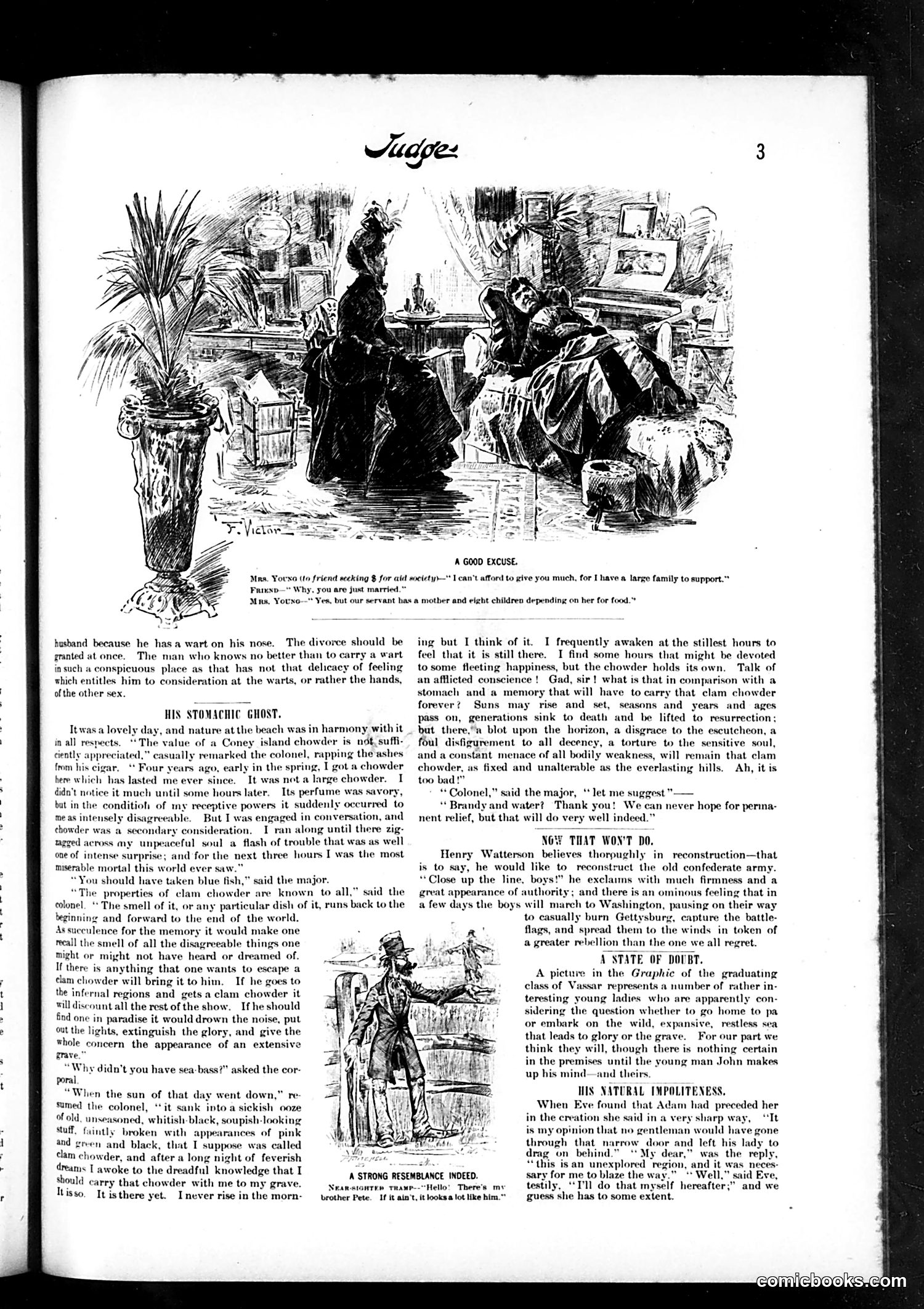
This page contains three distinct satirical pieces: **"A Good Excuse"** (top): A cartoon mocking wealthy married women's charitable excuses. A newlywed claims she cannot donate to charity because her servant's mother and eight children depend on the servant's wages—an absurdly indirect excuse that satirizes the self-serving logic of the privileged class avoiding philanthropic obligations. **"His Stomachic Ghost"** (center/bottom): A lengthy humorous monologue by a colonel describing how Coney Island clam chowder from years past haunts him permanently, causing perpetual digestive distress. It's comedic hyperbole about indigestion's lasting psychological effects—the "ghost" being an unforgettable bad meal. **"A Strong Resemblance Indeed"** (bottom right): A brief joke about mistaken identity between brothers. The page satirizes middle and upper-class foibles: charitable pretense, the perils of seaside dining, and social embarrassments. The humor relies on exaggeration and class-conscious observation typical of Judge magazine's satirical voice.
📄 Transcribed text from this page (OCR, searchable)
Machine-transcribed from the original scan — historical spelling and the odd misread are preserved.
t 1 J ‘A GOOD EXCUSE. Mas. Yorxa (to friend secking 8 for aid society) —" L can’t afford to give you much, for Ihave a large family to support.” Fanxp—" Why, you are just married.” Mns. Youxo-—* Yes, but our servant has a mother and eight children depending on her for food.”* husband because he has a wart on his nose. The divorce should be granted at once. The man who knows no better than to carry rart in such a conspicuous place as that has not that delicacy of feeling shich entitles him to consideration at the warts, or rather the hands, of the other sex. ls STONACHIC GHOST. day, and nature at the beach was in harmony with it Ttwasa lov in all respects. “The value o} Coney island chowder is not, suffi- ciently ed,” ca remarked the colonel, rapping the ashes from his. Four years ago, early in the spring, I got a chowder here wh lasted me ever since. It was no’ jarge chowder, I didn’t notice ch until some hours later. Its perfume was savory, but in the conditioh of my receptive powers it suddenly occurred to meas intensely disagreeable. But I was engaged in conversation, and chowde: a secondary consideration, I ran along until there zig- ugged across my unpeaceful soul a flash of trouble that was as well one of intense surprise; and for the next three hours I was the most miserable mortal this world ever saw.” “You should have taken blue fish,” said the major. “The properties of clam chowder are known to all,” said the colonel. ‘* The smell of it, or any particular dish of it, runs back to the ginning and forward to the end of the world. As succulence for the memory it would make one reall the smell of all the disagreeable things one might or might not have heard or dreamed of. If there is anything that one wants to escape a clam chowder will bring it to him. If he goes to the infernal regions and gets a clam chowder it will discount all the rest of the show. If he should find one in paradise it would drown the n out the lights, extinguish the glory, and give the shole concern the appearance of an extensive grave.” “Why didn't you have sea-bass?” asked the cor- poral, “When the sun of that day went down,” re- sumed the colonel, ‘it sank into a sickish ooze of old, unseasoned, whitish-black, pish-looking Stuff, faintly broken with appearances of pink and gr nd black, that I suppose was called clam chowder, and after a long night of feverish dreams I awoke to the dreadful knowledge that I should carry that chowder with me to my grave. isso. Itisthere yet. Inever rise in the morn- ‘A STRONG RESEMBLANCE INDEED. Nearstonren rhamp--Hello! There's my brother Pete. If it ain't, it looksa lot like him.” ing but I think of it. I frequently awaken at the stillest hours to feel that it is still there. I find some hours that might be devoted to some fleeting happiness, but the chowder holds its own. Talk of an afflicted conscience !_ Gad, sir! what is that in comparison with a stomach and a memory that will have to carry that clam chowder forever? Suns may rise and set, seasons and years and ages pass on, generations sink to death and be lifted to resurrection; but there,"n blot upon the horizon, a disgrace to the escutcheon, a foul disfigurement to all decency, a torture to the sensitive soul, and a constant menace of all bodily weakness, will remain that clam chowder, as fixed and unalterable as the everlasting hills. Ah, it is too bad!” “Colonel,” said the major, ‘let me suggest "—— “Brandy and water? Thank you! We can never hope for perima- nent relief, but that will do very well indeed.” NOW THAT WON'T DO. Henry Watterson believes thorpughly in reconstruction—that he exclaims with much firmness and a appearance of and there is an ominous feeling that in a few days the boys will march to Washington, pausing on their way to casually burn Gettysburg, capture the battle- flags, and spread them to the winds in token of a greater rebellion than the one we all regret. A STATE OF DOUBT. A picture in the Graphic of the graduating class of Vassar represents a number of rather in- teresting young ladies who are apparently con- sidering the question whether to go home to pa or embark on the wild, expansive, restless sea that leads to glory or the grave. For our part we think they will, though there is nothing certain in the premises until the young man John makes up his mind—and theirs. HIS NATURAL IMPOLITENESS, When Eve found that Adam had preceded her in the creation she said in sharp way, “Tt is my opinion that entleman would have gone through that narrow door d left his lady to drag on behind.” ‘ My dear,” was the reply, “this isan unexplored region, and it was neces- sary for me to blaze the "Well. d Eve, testily, “I'll do that myself hereafter;” and we guess she has to some extent.