
Judge, 1886-05-08 · page 15 of 20
Judge — May 8, 1886 — page 15: what you’re looking at
What you’re looking at
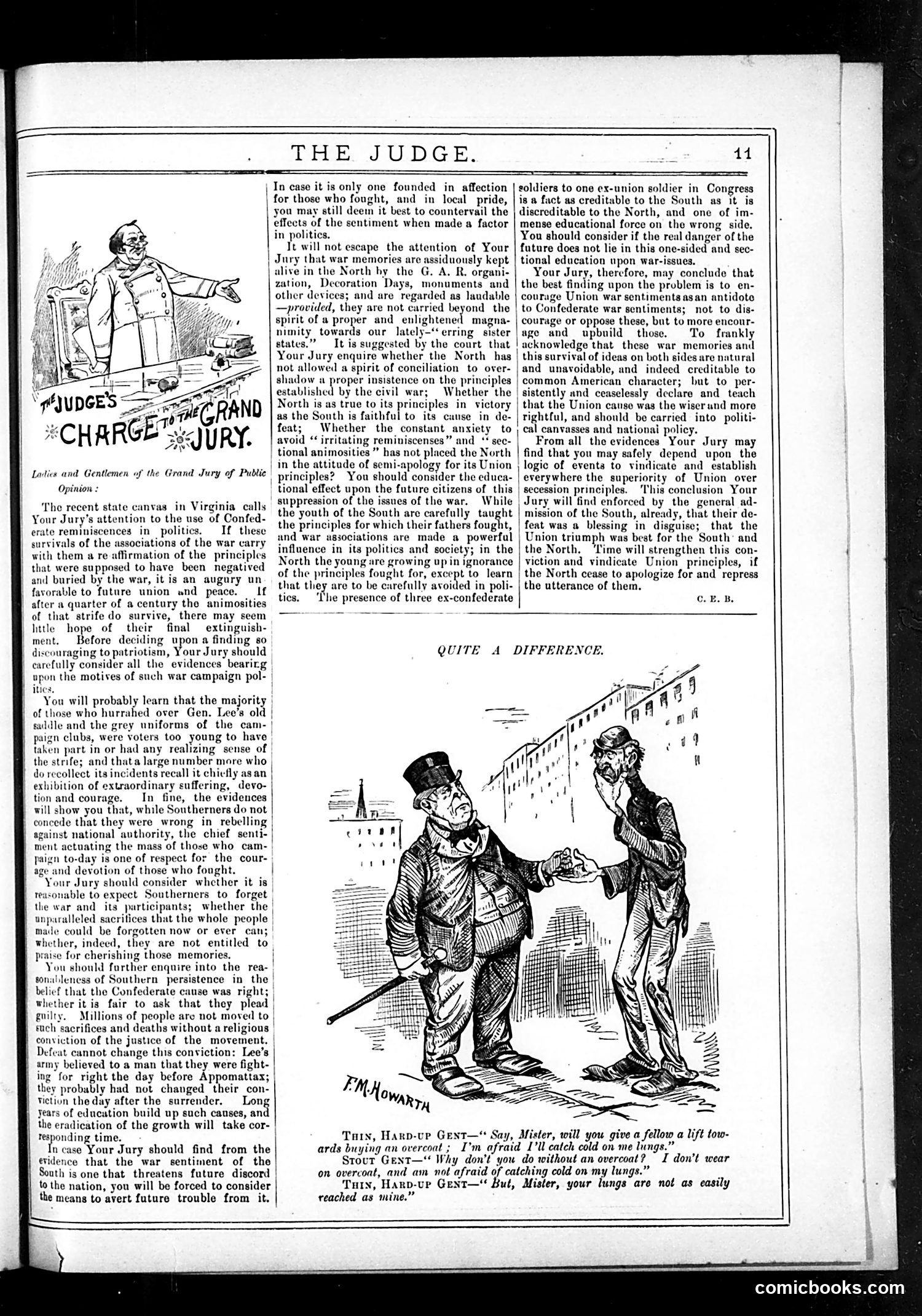
This page addresses the 1888 Virginia election, where Confederate nostalgia became a political tool. The main article ("Judge's Charge to the Grand Jury") warns against using Civil War memories to stoke sectional division, while noting that Northerners similarly preserve war memories through the G.A.R. (Grand Army of the Republic). The lower cartoon, "Quite a Difference," satirizes this hypocrisy: a thin, ragged Confederate soldier asks a well-fed Union soldier for help crossing an icy river. The Union soldier refuses, saying he won't aid someone "not a friend of catching cold on my journey." The caption's irony cuts both ways—it suggests the North claims moral superiority while refusing reconciliation. The page argues Southerners shouldn't be condemned for honoring Confederate sacrifice, since the South fought believing their cause was just. Judge suggests the real problem isn't Southern war sentiment, but Northern unwillingness to accept Southern pride while maintaining their own veteran organizations. The satire exposes post-Reconstruction hypocrisy about sectional "healing."
📄 Transcribed text from this page (OCR, searchable)
Machine-transcribed from the original scan — historical spelling and the odd misread are preserved.
THE JUDGE. 44 a Ladies and Gentlemen of the Grand Jury of Public Opinion : | ‘The recent state canvas in Virginia calls Your Jury’s attention to the use of Confed- erate reminiscences in politics. If these survivals of the associations of the war carry with them a re affirmation of the principles | that were supposed to have been negatived and buried by the war, it is an augury un favorable to future union and peace. If after a quarter of a century the animosities of that strifedo survive, there may seem little hope of their final extinguish- ment. Before deciding upon a finding so discouraging to patriotism, Your Jury should carefully consider all the evidences’ bearirg upon the motives of such war campaign pol- it | You will probably learn that the majority | of those who hurrahed over Gen. Lee’s old | saddle and the grey uniforms of the cam- paign clubs, were voters too young to have taken part in or had any realizing sense of the strife; and thata large number more who do recollect its incidents recall it chiefly as an | | exhibition of extraordinary suffering, devo- | tion and courage. In fine, the evidences will show you that, while Southerners do not | concede that they were wrong in rebelling | against national ‘authority, the chief senti- ment actuating the mass of those who cam- jay is one of respect for the cour- ge and devotion of those who fought. | Your Jury should consider whether it is reasonable to expect Southerners to forget the war and its participants; whether the | | unparalleled sacritices that the whole people made could be forgotten now or ever can; whether, indeed, they are not entitled to praise for cherishing those memories, | You should farther enquire into the rea- sonableness of Southern persistence in the } belief that the Confederate cause was right; whether it is fair to ask that they plead | guilty. Millions of people are not moved to | tuch sacrifices and deaths without a religious | conviction of the justice of the movement. Defeat cannot change this conviction: Lee’s | y believed to a man that they were fight- | ing for right the day before Appomattas; | they probably had not changed their con- Victiun the day after the surrender. Long Jears of education build up such causes, ani the eradication of the growth will take cor- responding time. | ncase Your Jury should find from the evidence that the war sentiment of the uth isone that threatens future discord | tothe nation, you will be forced to consider the means to avert future trouble from it. In case it is only one founded in affection for those who fought, and in local pride, you may still deem it best to countervail the effects of the sentiment when made a factor in politics. Tt will not escape the attention of Your Jury that war memories are assiduously kept alive in the North by the G. A. R. organi- zation, Decoration Days, monuments and other devices; and are regarded as laudable —provided, they are not carried beyond the spirit of a proper and enlightened magna- nimity towards our lately-‘ erring sister states.” It is suggested by the court that Your Jury enquire whether the North has not allowed a spirit of conciliation to over- shadow a proper insistence on the principles es ablished by the civil war; | Whether the North is as true to its principles in victory as the South is faithful to its cause in de- feat; Whether the constant anxiety to avoid “irritating reminiscenses” and ** sec- tional animosities ” has not placed the North in the attitude of semi-apology for its Union principles? You should consider the educa- tional effect upon the future citizens of this suppression of the issues of the war, While the youth of the South are carefully taught the principles for which their fathers fought, und war ugsociations are made a powerfal influence in its politics and society; in the North the young are growing up in ignorance of the principles fought for, except to learn that they are to be carefully avoided in poli- tics, ‘The presence of three ex-confederate ee soldiers to one ex-union soldier in Congress is a fact as creditable to the South as it is discreditable to the North, and one of im- mense educational force on the wrong side. You should consider if the real danger of the future does not lie in this one-sided and sec- tional education upon war-issues. Your Jury, therefore, may conclude that the best finding upon the problem is to en- courage Union war sentiments asan antidote to Confederate war sentiments; not to dis- | courage or oppose these, but to more encour- age and upbuild those. To frankly | acknowledge that these war memories and this survival of ideas on both sides are natural and unavoidable, and indeed creditable to common American character; but to per- sistently and ceaselessly declare and teach that the Union canse was the wiser und more | rightful, and should be carried into politi- j cal canvasses and national policy. From all the evidences Your Jury may | find that you may safely depend upon the logic of events to vindicate and establish | everywhere the superiority of Union over secession principles. ‘This conclusion Your Jury will find enforced by the general ad- mission of the South, already, that their de- , | feat was a blessing in disguise; that the Union triumph was best for the South: and the North. ‘'ime will strengthen this con- viction and vindicate Union’ principles, if | the North cease to apologize for and repress | the utterance of them. C.E. B. QUITE A DIFFERENCE, Tain, Harv-up Gent—“ Say, Mister, will you give a fellow a lift tow- ards buying an overcoat ; I’m afraid I'll catch cold on me lungs.” Stout Gent—“‘ Why don’t you do without an overcoat? I don’t wear on overcoat, and am not afraid of catching cold on my lungs.” Tux, Harpv-up Genxt—“ But, reached as mine.” Mister, your lungs are not as easily comicbooks.com