
Judge, 1886-05-08 · page 14 of 20
Judge — May 8, 1886 — page 14: what you’re looking at
What you’re looking at
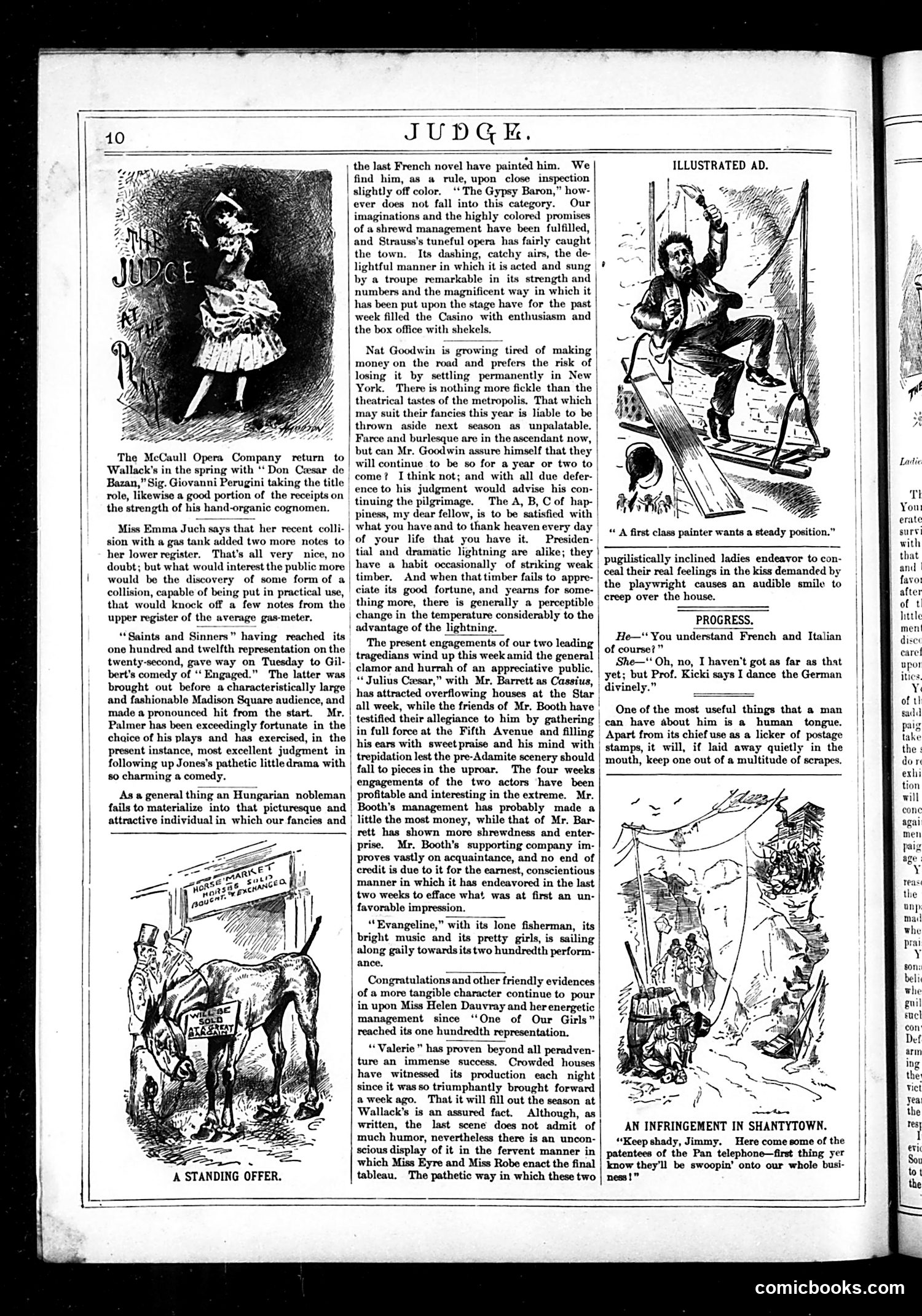
This page from *Judge* reviews New York theatrical productions circa the 1880s. The content mixes theatrical criticism with light satire on performers and opera companies. **Key references:** - The McCaull Opera Company's production of "Don Caesar de Bazan" at Wallack's Theatre - "The Gypsy Baron" (Strauss operetta) at the Casino Theatre, praised for its music and production values - Actor Nat Goodwin, criticized for considering leaving touring to settle permanently in New York—the writer warns that theatrical tastes are fickle - Two leading tragedians (likely Edwin Booth and Lawrence Barrett) performing "Julius Caesar" at competing theaters **The satire:** The opening joke about singer Emma Juch gaining lower notes from a gas tank collision, then suggesting gas meters need similar treatment to reduce high notes, mocks both the singer and noisy urban utilities. The overall tone is gossipy Broadway commentary rather than sharp political satire—typical theatrical column humor for the era.
📄 Transcribed text from this page (OCR, searchable)
Machine-transcribed from the original scan — historical spelling and the odd misread are preserved.
oe DGQK. The McCaull Opera Company return to ‘Wallack’s in the spring with "Don Cyesar de Bazan,” Sig. Giovanni Perugini taking the title role, likewise a good portion of the receipts on the strength of his hand-organic cognomen. Miss Emma Juch says that her recent colli- sion with a gas tank added two more notes to her lower register. That's all very nice, no doubt; but what would interest the public more would be the discovery of some form of a collision, capable of being put in practical use, that would knock off a few notes from the upper register of the average gas-meter. “Saints and Sinners” having reached its one hundred and twelfth representation on the twenty-second, gave way on Tuesday to Gil- bert’s comedy of “Engaged.” The latter was brought out before a characteristically large and fashionable Madison Square audience, and made a pronounced hit from the start. Mr. Palmer has been exceedingly fortunate in the chaice of his plays and has exercised, in the present instance, most excellent judgment in following up Jones's pathetic littledrama with so charming a comedy. Asa general thing an Hungarian nobleman fails to materialize into that picturesque and attractive individual in which our fancies and er CURT ARS S56 SHANG ite ise pow A STANDING OFFER. ) the last French novel have painted him. We find him, as a rule, upon close inspection slightly off color. ‘The Gypsy Baron,” how- ever does not fall into this category. Our imaginations and the highly colored promises | of a shrewd management have been fulfilled, | and Strauss’s tuneful opera has fairly caught | the town. Its dashing, catchy airs, the de- lightful manner in which it is acted and sung by a troupe remarkable in its strength and numbers and the magnificent way in which it has been put upon the stage have for the past week filled the Casino with enthusiasm and | the box office with shekels. Nat Goodwin is growing tired of making money on the road and prefers the risk of losing it by settling permanently in New York. There is nothing more fickle than the theatrical tastes of the metropolis. That which may suit their fancies this year is liable to be thrown aside next season as unpalatable. Farce and burlesque are in the ascendant now, but can Mr. Goodwin assure himself that they will continue to be so for a year or two to| come? I think not; and with all due defer- ence to his judgment would advise his con- tinuing the pilgrimage. The A, B, C of hap- piness, my dear fellow, is to be satisfied with | what you have and to thank heaven every day of your life that you have it. Presiden- tial and dramatic lightning are alike; they } have a habit occasionally of striking weak | timber. And when that timber fails to appre- | ciate its good fortune, and yearns for some- thing more, there is generally a perceptible change in the temperature considerably to the | advantage of the lightning. The present engagements of our two leading tragedians wind up this week amid the general clamor and hurrah of an appreciative public. | “Julius Cesar,” with Mr. Barrett as Cassius, has attracted overflowing houses at the Star all week, while the friends of Mr. Booth have testified their allegiance to him by gathering in full force at the Fifth Avenue and filling his ears with sweet praise and his mind with | trepidation lest the pre-Adamite scenery should fall to pieces in the uproar. The four weeks engagements of the two actors have been profitable and interesting in the extreme. Mr. Booth’s management has probably made a | little the most money, while that of Mr. Bar- rett has shown more shrewdness and enter- prise. Mr. Booth’s supporting company im- proves vastly on acquaintance, and no end of credit is due to it for the earnest, conscientious manner in which it has endeavored in the last two weeks to efface what was at first an un- favorable impression. “Evangeline,” with its lone fisherman, its bright music and its pretty girls, is sailing along gaily towards its two hundredth perform- ance. Congratulations and other friendly evidences of a more tangible character continue to pour in upon Miss Helen Dauvray and her energetic management since “One of Our Girls” reached its one hundredth representation. “Valerie” has proven beyond all peradven- ture an immense success. Crowded houses have witnessed its production each night since it wasso triumphantly brought forward a week ago. That it will fill out the season at Wallack’s is an assured fact. Although, as written, the last scene does not admit of much humor, nevertheless there is an uncon- scious display of it in the fervent manner in which Miss Eyre and Miss Robe enact the final tableau. The pathetic way in which these two ILLUSTRATED AD. 1 “A first class painter wants a steady position.” pugilistically inclined ladies endeavor to con- ceal their real feelings in the kiss demanded by the playwright causes an audible smile to creep over the house. PROGRESS. He—‘ You understand French and Italian of course?” She—‘ Oh, no, I haven't got as far as that yet; but Prof. Kicki says I dance the German divinely.” One of the most useful things that a man can have about him is a human tongue. Apart from its chief use as a licker of postage stamps, it will, if laid away quietly in the mouth, keep one out of a multitude of scrapes, AN INFRINGEMENT IN SHANTYTOWN. “Keep shady, Jimmy. Here come some of the patentees of the Pan telephone—first thing yer know they'll be swoopin’ onto our whole busi- ness!” || paig take the : dor exhi tion will | conc agai men paig age Teas W the unp mail whe prai y fon; beli whe guil sucl con Def arm 1 the Tiel yea the Tes] comicbooks.com