
Judge, 1885-07-11 · page 5 of 16
Judge — July 11, 1885 — page 5: what you’re looking at
What you’re looking at
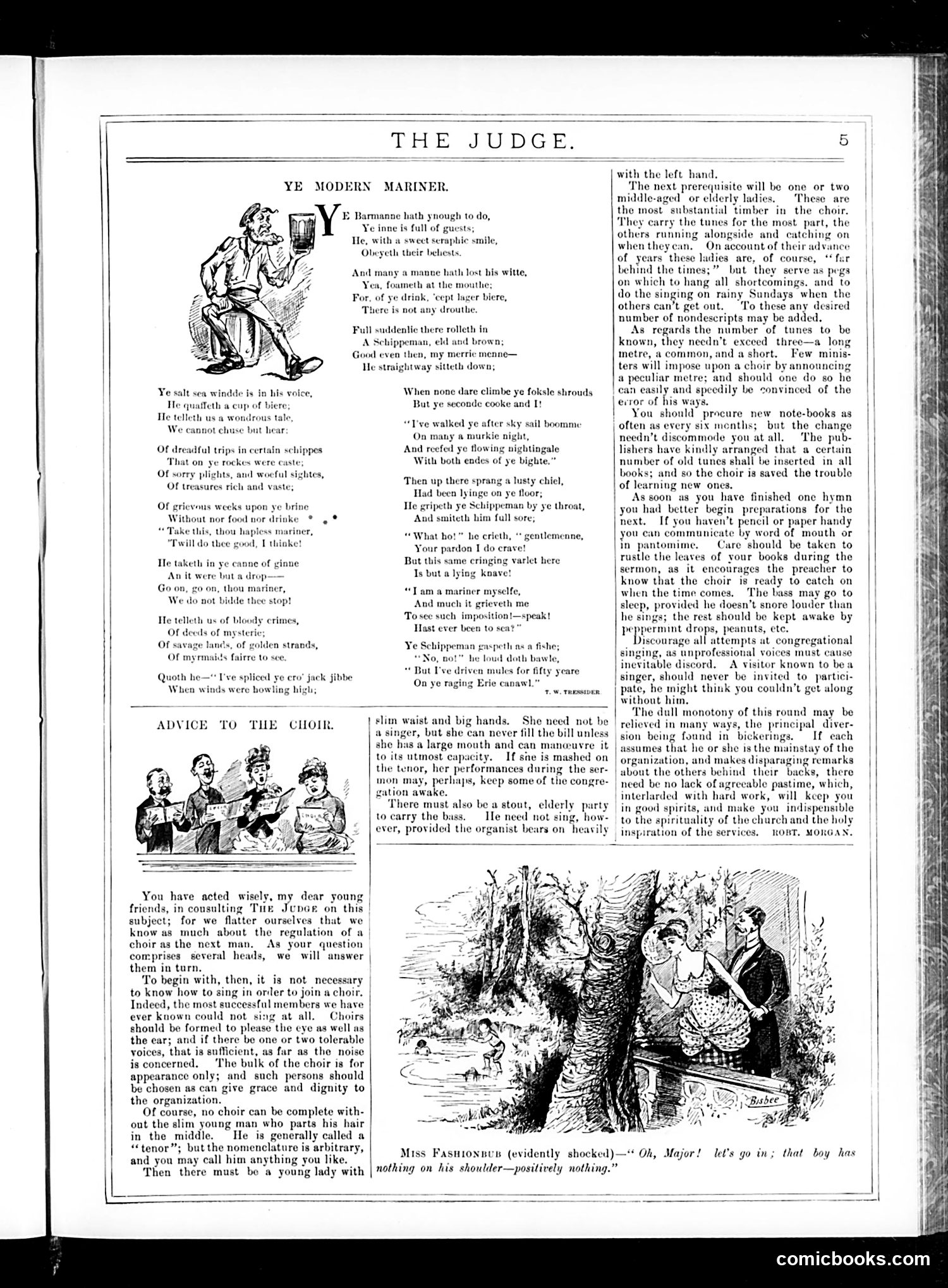
**"Ye Modern Mariner"** is a humorous poem mocking tall-tale-telling sailors. A garrulous mariner entertains inn guests with exaggerated adventures—sky sails, nightingales, shipwrecks—until another man interrupts, exposing him as a fraud: he's actually driven mules for fifty years, never been to sea. The joke targets both the boastful liar and credulous audiences who believe obvious fabrications. **"Advice to the Choir"** is satirical guidance on church choir selection. Humorously, it argues that singing ability is unnecessary; choirs exist for visual appeal. The piece ridicules actual choir practices by suggesting members are chosen for appearance (slim tenor, busty soprano, stout bass singer), romantic entanglement, and age rather than talent. It mocks both choir directors' priorities and churches' tolerance of poor musical performance, suggesting congregations accept "inevitable discord" to maintain appearances. Both pieces critique human folly—gullibility and vanity—through mock-earnest, exaggerated advice.
📄 Transcribed text from this page (OCR, searchable)
Machine-transcribed from the original scan — historical spelling and the odd misread are preserved.
iy *s He, ¥ For. A Ye salt sea windde is in his voice, He quaffeth a cup of biere; Tle telleth us a wondrous tale, We cannot chuse but hear Of dreadful trips in certain sehippes That on ye rockes we Of sorry Of tre: c caste ures rich and vaste; Of grievous weeks upon ye brine Without n ake thi will do thee g food nor dri thou hapless mariner, I thinke! Ie taketh in ye canne of ginue An it were but a drop— Go on, g We on, thou mariner, » not bidde thee stop! He telleth us of bloody crimes, Of deeds of mysteric; Of sav lands, of gold Of myrmaids fairre te Quoth he—" I've spliced ye ero’ jack jibe When winds were howling hi MODERN Obeyeth their behests. And m Full suddentie t Good even then, 1 He straightway THE JUDGE. MARINER. manne hath ynough to do, ¢ inne is full of guests; with a sweet seraphic smile, manne hath lost bis witte, ca, foameth at the mouthe of ye drink, ‘cept | re is not any drouth re rolleth in eld and brown; y merric menne— tteth down; Schippeman When none dare climbe ye foksle shrouds But ye seconde cooke and I! “T've walked ye after sky sail boomme On many a murkie night, And reefed ye flowing nightingale With both endes of ye bighte.” ‘Then up there sprang a lusty chiel, Had been lyinge on ye floor; He gripeth ye Schippeman by ye throa And smiteth him full sore; “What ho!” he erieth Your pardon I do era “ gentlemenne, But this same cringing varlet here Is but a lying knavet ma mariner myselfe, And much it grieveth me To see such imposition!—speak! Hast ever been to s¢ Ye Schippeman gaspeth as a fishe; “No, not” he loud doth bawle, | * But I've driven mules for fifty ye On ye rag’ wi." 3 Erie ADVICE TO THE CHOIR. | | You have acted wisely, my dear young friends, in consulting Turk Jupar on this | subject; for we flatter ourselves that we know as much about the regulation of a choir as the next man. As your question comprises several heads, we will answer | them in turn. To begin with, then, it is not nece: to know how to sing in order to join a choi Indeed, the most successful members we have ever known could not sing at all. Choirs shonld be formed to please the eye as well as the ear; and if there be one or two tolerable yoices, that is sufficient, as far as the noise is concerned. ‘The bulk of the choir is for appearance only; and such persons should be chosen as can give grace and dignity to the organization. Of course, no choir can be complete with- out the slim young man who parts his hair in the middle. He is generally called ‘| “tenor”; but the nomenclature is arbit and you may call him anything you like. Then there must be a young lady with | \ ecror of his w; | next. | inevitable discord. slim waist and big hands. She need not be a singer, but she can never fill the bill unless she has a large mouth and can manwuvre it to its utmost capacity. If sne is mashed on the tenor, her performances during the ser- mon may, perhaps, keep some of the congre- tion awake. There must also be a stout, elder! to carry the bass. party He need’ not sing, how- organist bears on heavily ou with the left hand. ‘The next prerequisite will be one or two middle-aged or elderly ladies, These are the most substantial timber in the choir. ‘They carry the tunes for the most part, the others ruining alongside and catching on when theycan, On account of their advane of years these ladies are, of course, ‘fx behind the times;” but they serve as pegs on which to hang all shortcomings. and to do the singing on rainy S others can’t get out. ‘To these any desired number of nondescripts may be added. As regards the number of tunes to be known, they needn’t exceed three—a lon metre, a common, and a short. Few mini ters will impose upon a choir by announcing peculiar metre; and should one do so he easily and speedily be convinced of the note-books as but the change all. The pub- You should’ procure new often as every six months needn’t discommode you lishers have kind ed that a certain number of old tun serted in all books; and so the choir is saved the trouble | of learning new ones, As soon us you have finished one hymn you had better begin preparations for the If you haven’t pencil or paper handy you can communicate by word of mouth or in pantomime. Care should be taken to rustle the le of your books during the sermon, as it encourages the preacher to know that the choir is ready to catch on when the time comes. The bass may go to sleep, provided he doesn’t snore louder than he sings; the rest should be kept awake by pe ppermint drops, peanuts, ete. . Jiscourage all attempts at congregational singing, sional voices must cause A visitor known to be singer, should never be invited to partici- s unprof | pate, he might think you couldn’t get along without him, The dull monotony of this round may be relieved in many ways, the principal diver- ion being found in bickerings. If each assumes that he or she is the mainstay of the organization, and makes disparaging remarks ubout the others behind their backs, there need be no lack of agreeable pastime, which, interlarded with hard work, will keep you in good spirits, and make you indispensible to the spirituality of the church and the holy inspiration of the services. konT, M04 Miss Fasnionnen (evidently shocke nothing on his shoulder—positi' ly nothing.” )—** Oh, Major! let's go in; that boy has comicbooks.com