
Judge, 1885-07-11 · page 10 of 16
Judge — July 11, 1885 — page 10: what you’re looking at
What you’re looking at
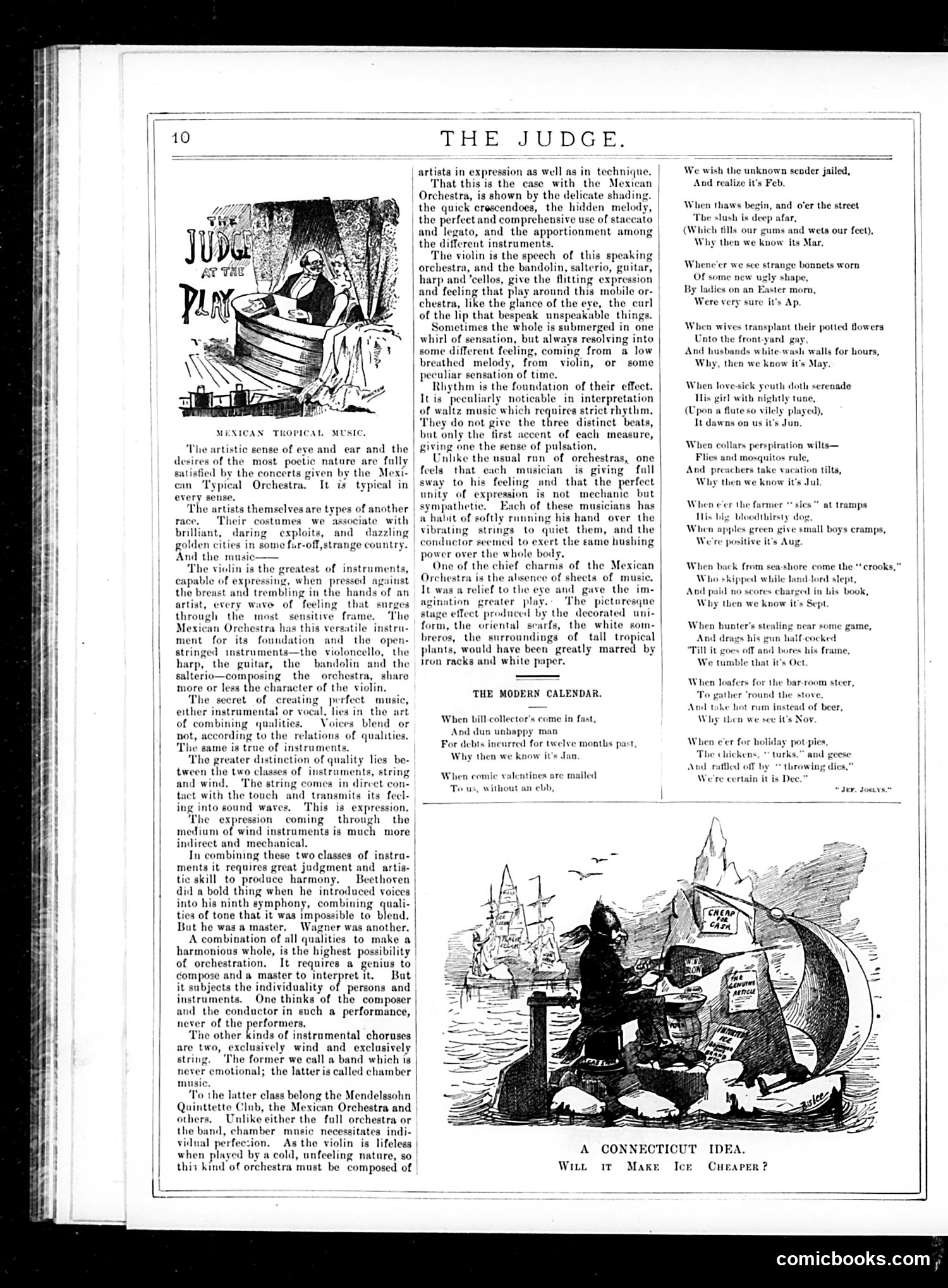
This page contains two distinct items: a lengthy article praising the Mexican Typical Orchestra's musical artistry, and a small cartoon at the bottom. The cartoon depicts a figure at a waterfront, apparently attempting to freeze water to make ice cheaply—hence "Will it Make Ice Cheaper?" The joke appears to be satirizing either an impractical invention scheme or someone's misguided attempt at cost-cutting. The figure's location (a harbor or waterfront) and casual posture suggest the idea is absurdly simple-minded or naive. Without additional context about contemporary Connecticut ice-making debates, the specific target remains unclear, but the satire mocks someone's foolish belief that nature (or improper methods) could produce a commercial product more economically.
📄 Transcribed text from this page (OCR, searchable)
Machine-transcribed from the original scan — historical spelling and the odd misread are preserved.
; | } | | MENICAN TROPICAL MUSIC, tistic sense of eve and ear and the f the most poetic nature are fully 1 by the concerts given by the Mexi- can Typical Orchestra. It is 1 in every sense. The artists themselves are types of another race. ‘Their costumes we associate with brilliant, daring exploits, and dazzlir golden cities in some far-off, strange country. And the music—— The violin is the greatest of instruments, capable of expressing, when pressed against the breast A trembling in the hands o artist, every wave of feeling that surges through the most sensitive frame. ‘The Mexican Orchestra has this versatile instra- ment for its foundation and the open- stringed instruments—the violoncello, the harp, the guitar, the bandolin and the salterio—composing the orchestra, share more or less the character of the violin. The secret of creating perfect. music, either instrumental or vocal, lies in the art of combining qualities. Voices blend or not, according to the relations of qualities. ‘The same is true of instruments, The greater distinction of quality lies be- tween the two classes of instruments, string and wind. The string comes in direct con- tact with the touch and transmits its fecl- ing into sound waves. This is expression. ‘The expression coming through the medium of wind instruments is much more indirect and mechanical, | In combining these two classes of instra- ments it requires great judgment and art tic skill to produce harmony. — Beethoven did a bold thing when he introduced voices into his ninth symphony, combining quali ties of tone that it was impossible to blend. But he was a master. Wagner was another. A combination of all qualities to make a harmonious whole, is the highest possibility of orchestration, It requires a genius to compose and a master to interpret it. But. it subjects the individuality of persons and instruments. One thinks of the composer and the conductor in such a performance, never of the performers. The other Finds of instrumental choruses are two, exclusively wind and exclusively string. ‘The former we call a band which is never emotional; the latter is called chamber he latter class belong the Mendelssohn Quinttette Club, the Mexican Orchestra and others, Unlike either the full orchestra or the band, chamber music necessitates indi- vidual perfec:ion. As the violin is lifeless when played by a cold, unfeeling nature, so this kind of orchestra must be composed of | breathed melody, from THE JUDGE. artista in expression as well as in technique. That this is the case with the Mexican Orchestra, is shown by the delicate shading. the quick crescendoes, the hidden melody, the perfeet and comprehensive use of staccato and legato, and the apportionment among the different instruments. | ‘The violin is the speech of this speaking stra, and the bandolin, guitar, harp and ‘cellos, give the flitting expression and feeling that play around this mobile or- chestra, like the glance of the eye, the curl of the lip that bespeak unspeakable things. Sometimes the whole is submerged in one whirl of sensation, but always resolving into some different feeling, coming from a low violin, or some peculiar sensation of time. Rhythm is the foundation of their effect. It is peculiarly noticable in interpretation of waltz music which requires strict rhythm. ‘They do not give the three distinct ats, but only the first accent of each measure, giving one the sense of pulsation. Unhke the usual ron of orchestras, one feels that each musician is giving’ full sway to his feeling and that the perfect unity of expression is not mechanic but sympathetic. Each of these musicians has a habit of softly running his hand over the vibrating strings to quiet them, and the ronductor seemed to exert the eame bushing power over the whole body, One of the ch arms of the Mexican of shects of music. of tothe eye and gave the im- aginat er The picturesque stage effect produced by the decorated uni- form, the oriental scarfs, the white som- breros, the surroundings of tall tropical plants, would have been greatly marred. by iron racks and white paper. THE MODERN CALENDAR. When bill collector's come in fast, And dun unbappy man For debts incurred for twelve months past Why then we know it’s Jan ¢ valentines are m n com 15, without an ebb, We wish the unknown sender jailed, And realize it’s Feb. Ww n thaws begin, and o'er the street ‘The slush is deep afar, (Which fills our gums and wets our feet), Why then we know its Mar, Whene'er we see strange bonnets worn Of some new u; By ladies on an E Were very sure it's Ap. When wives transpla Unto the frontyard And husbands whitewash walls for hours, Why, then we know it's May. t their potted flowers When love-sick youth doth serenade It dawns on us it’s Jun. ation wilts— ps rule, When collars persp Pli qui And preachers take vacation tilts, Why then we know it’s Jul nd me When eer the farmer His big blood: When We're px * at tramps irsty small boys cramps, ve it’s Aug. When back from seashore come the “crooks,” Who skipped while landlord And paid no scores charged in bis book, Why then we know it’s Sept When bunter’s stealing near some game, cocked es his frame, it's Oct We tumble th When loafers for the bar-room steer, ‘To gather ‘round the stove, ad of beer, 's Nov, And toe hot rum inst Why the When eer for holiday pot pies The chickens, “turks.” and geese And raffled off by“ throwing dies.” We're cert in it is Dec.” ger, Josuys” A CONNECTICUT IDE Witt ir Make Ick CHEAPER ? comicbooks.com