
Judge, 1885-03-14 · page 2 of 16
Judge — March 14, 1885 — page 2: what you’re looking at
What you’re looking at
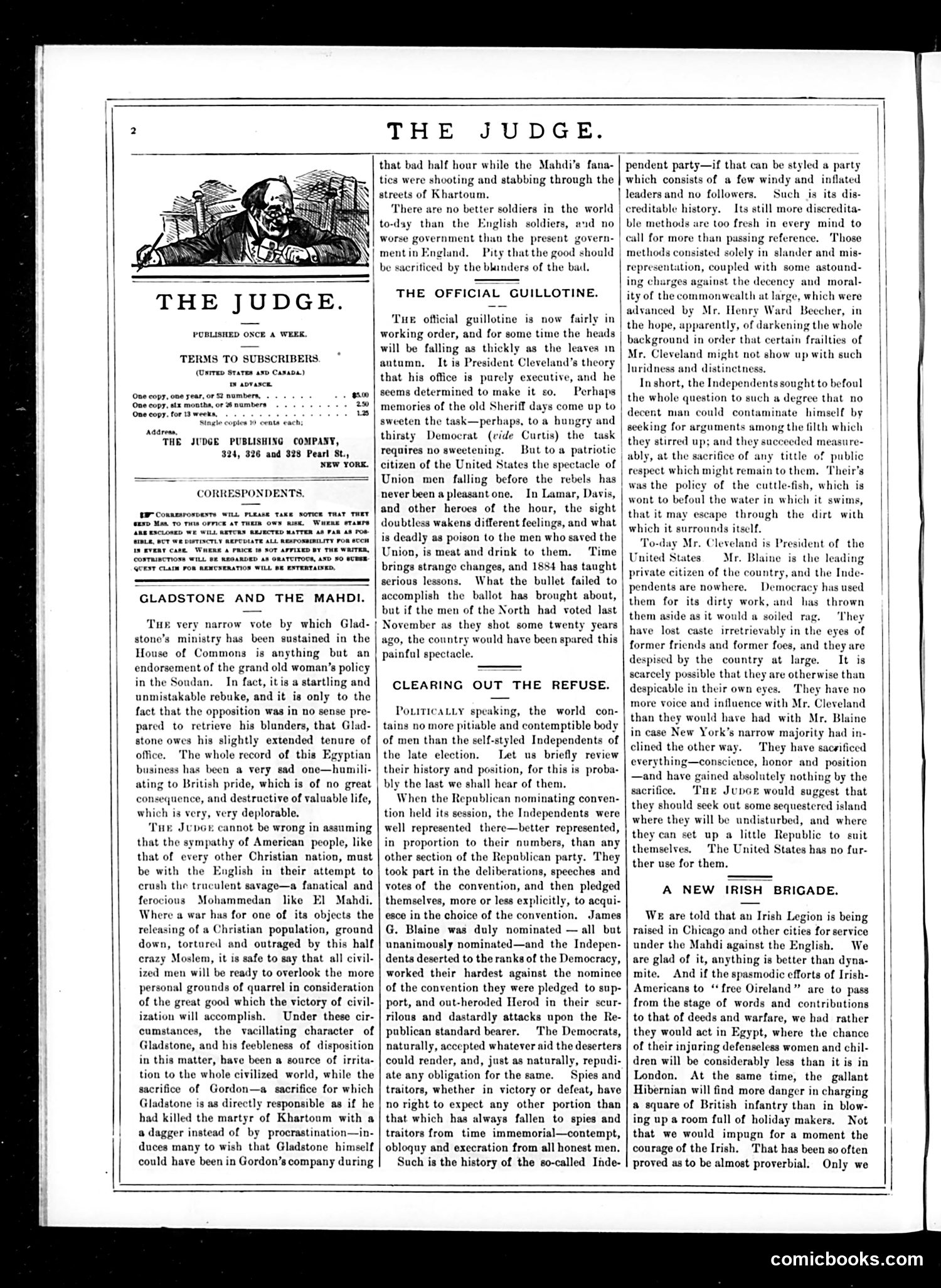
**"Gladstone and the Mahdi"**: This article criticizes British Prime Minister William Gladstone's weak handling of the Sudan conflict against the Mahdi (a religious leader). Judge defends the military campaign as justified—freeing Christians from an oppressive "fanatical" Islamic ruler—but blames Gladstone's hesitation for the death of General Gordon at Khartoum. The piece expresses frustration that capable English soldiers suffer from poor political leadership. **"The Official Guillotine"**: This section attacks President Cleveland's mass removal of Republican appointees, replacing them with Democrats. Judge frames this as betrayal: Union soldiers who saved the nation are being purged in favor of former Confederates like Lamar and Davis. The "guillotine" metaphor equates the dismissals with violent execution, condemning Cleveland's partisan revenge against Republicans who won the Civil War. Both pieces reflect Judge's conservative, Republican perspective opposing Democratic policies.
📄 Transcribed text from this page (OCR, searchable)
Machine-transcribed from the original scan — historical spelling and the odd misread are preserved.
THE JUDGE. THE JUDGE. CE A WEEK. TERMS TO SUBSCRIBERS. (Usrrep States axp Casapa) mm aprasce, One copy, one sear, or 52 numbers... One copy, stx months, or 3 numbers One copy. for 13 weeks, fenes Single copies 19 centa each; Addreas, THE JUDGE PUBLISHING COMPANY, 324, 326 and $28 Pearl St., NEW YORK. CORRESPONDEN EW ComasarorDENTe WILL PLEASE TAKE NOTICE THAT THET gasp Maa To Tris OFFICE AT THEIR OWN nuk. WHERE eTAMrs ANE ESCLOMED WE WILL RETCRS REJECTED MATTER Af FAM 48 OS: AIMLE, BUT WE DITINCTLY REPUDIATE ALL REATORAIRILITY FOR BUCH tm RVERY cate WHERE 4 PRICE # SOT AFFIXED BY THE WRITER, CONTRIRCTIONS WILL 8E REOARDED AB ORATCITODS, AND 80 SUEEE. QUEST CLAIM FOR REMCSERATION WILL BE ENTERTALSED, GLADSTONE AND THE MAHDI. Tur very narrow vote by which Glad- | stone’s ministry has been sustained in the House of Commons is anything but an endorsement of the grand old woman’s policy in the Soudan. In fact, itis a startling and unmistakable rebuke, and it is only to the fact that the opposition was in no sense pre- pared to retrieve his blunders, that Glad- stone owes his slightly extended tenure of office. The whole record of this Egyptian business has been a very sad one—humili- ating to British pride, which is of no great consequence, and destructive of valuable life, y deplorable. ‘Tur Juve cannot be wrong in assuming that the sympathy of American people, like that of every other Christian nation, must be with the English in their attempt to crush the truculent savage—a fanatical and ferocious Mohammedan like Mahdi. Where a war has for one of its objects the releasing of a Christian population, ground down, tortured and outraged by this half crazy Moslem, it is safe to say that all civil- ized men will be ready to overlook the more personal grounds of quarrel in consideration of the great good which the victory of civil- ization will accomplish. Under these cir- cumstances, the vacillating character of Gladstone, and his feebleness of disposition in this matter, have been a source of irrita- tion to the whole civilized world, while the sacrifice of Gordon—a sacrifice for which Gladstone is as directly responsible as if he had killed the martyr of Khartoum with a a dagger instead of by procrastination—in- duces many to wish that Gladstone himself could have been in Gordon’s company during that bad half hour while the Mahdi’s fana- tics were shooting and stabbing through the streets of Khartoum. ‘There are no better soldiers in the world to-day than the English soldiers, and no worse government than the present govern- mentin England. Pity thatthe good should be sacrificed by the blunders of the bad. THE OFFICIAL GUILLOTINE. ‘Tue official guillotine is now fairly in working order, and for some time the heads will be falling as thickly as the leaves in autumn, It is President Cleveland’s theory that his office is purely executive, and he seems determined to make it so. Perhaps memories of the old Sheriff days come up to sweeten the task—perhaps, to a hungry and thirsty Democrat (vide Curtis) the task requires no sweetening. But to a patriotic citizen of the United States the spectacle of Union men falling before the rebels has never been a pleasantone. In Lamar, Davis, and other heroes of the hour, the sight doubtless wakens different feelings, and what is deadly as poison to the men who saved the | Union, is meat and drink to them, Time brings strange changes, and 1884 has taught serious lessons. What the bullet failed to accomplish the ballot has brought about, but if the men of the North had voted last November as they shot some twenty years ago, the country would have been spared this painful spectacle. CLEARING OUT THE REFUSE. PouiticaLLy speaking, the world con- tains no more pitiable and contemptible body of men than the self-styled Independents of the late election. Let us briefly review their history and position, for this is proba bly the last we shall hear of them, When the Republican nominating conven- tion held its session, the Independents were well represented there—better represented, in proportion to their numbers, than any other section of the Republican party. They took part in the deliberations, speeches and votes of the convention, and then pledged themselves, more or less explicitly, to acqui- eace in the choice of the convention. James G. Blaine was duly nominated — all but unanimously nominated—and the Indepen- dents deserted to the ranks of the Democracy, worked their hardest against the nominee of the convention they were pledged to sup- port, and out-heroded Herod in their scur- rilous and dastardly attacks upon the Re- publican standard bearer. The Democrats, naturally, accepted whatever aid the deserters could render, and, just as naturally, repudi- ate any obligation for the same. Spies and traitors, whether in victory or defeat, have no right to expect any other portion than that which has always fallen to spies and traitors from time immemorial—contempt, obloquy and execration from all honest men. Such is the history of the so-called Inde- pendent party—if that can be styled a party which consists of a few windy and inflated leaders and no followers. Such is its dis- creditable history. Its still more discredita- ble methods are too fresh in every mind to call for more than passing reference. Those methods consisted solely in slander and mis- representation, coupled with some astound- es against the decency and moral- ity of the commonwealth at large, which were advanced by Mr. Henry Ward Beecher, in the hope, apparently, of darkening the whole background in order that certain frailties of Mr. Cleveland might not show up with such luridness and distinctne: In short, the Independents sought to befoul the whole question to such a degree that no decent man could contaminate himself by ing for arguments among the filth which they stirred up; and they succeeded measure- j ably, at the sacrifice of any tittle of public respect which might remain to them, Their’s was the policy of the cuttle-fish, which is wont to befoul the water in which it swims, that it may escape through the dirt with which it surrounds itself. ‘To-day Mr. Cleveland is President of the United States Mr. Blaine is the leading private citizen of the country, and the Inde- pendents are nowhere. Democracy has used them for its dirty work, and thrown them aside as it would a soiled rag. ‘They have lost caste irretrievably in the eyes of former friends and former foes, and they are despised by the country at large. It is scarcely possible that they are otherwise than despicable in their own eyes. They have no more voice and influence with Mr. Cleveland than they would have had with Mr. Blaine in case New York’s narrow majority had in- clined the other w They have sacsificed everything—conscience, honor and position —and have gained absolutely nothing by the sacrifice. Tue JupGe would suggest that they should seek out some sequestered island where they will be undisturbed, and where they can set up a little Republic to suit themselves. The United States has no fur- ther use for them, A NEW IRISH BRIGADE. We are told that an Irish Legion is being raised in Chicago and other cities for service under the Mahdi against the English. We are glad of it, anything is better than dyna- mite. And if the spasmodic efforts of Iris Americans to ‘free Oireland” are to pass from the stage of words and contributions to that of deeds and warfare, we had rather they would act in Egypt, where the chance of their injuring defenseless women and chil- dren will be considerably less than it is in London, At the same time, the gallant Hibernian will find more danger in charging a square of British infantry than in blow- ing up a room full of holiday makers. Not that we would impugn for a moment the courage of the Irish. That has been so often proved as to be almost proverbial. Only we comicbooks.com