
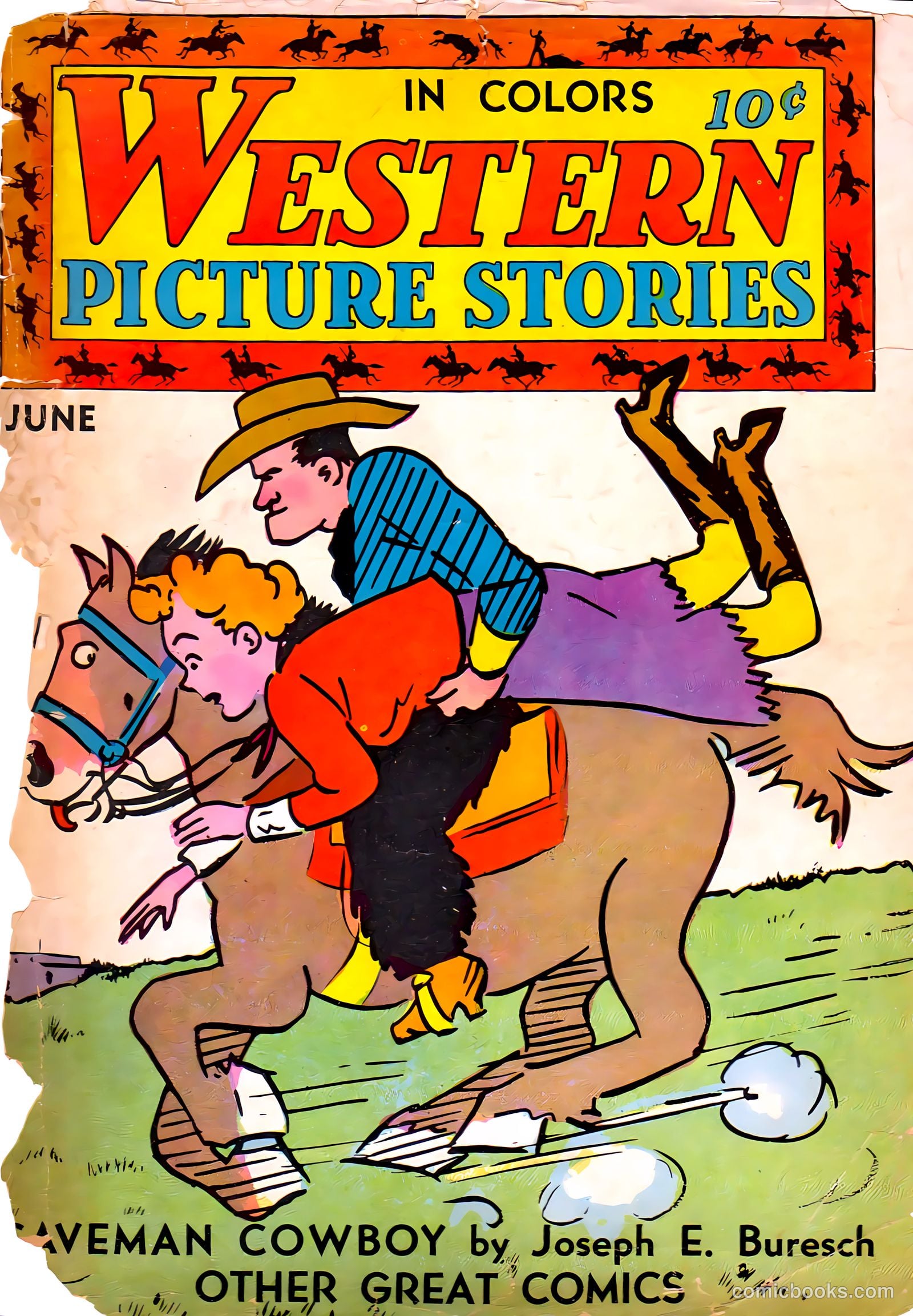
Western Picture Stories #4
☆ Be the first to review + Add to your collection — Join freeWestern Picture Stories #4 (June 1937) is the final chapter of the very first dedicated Western comic book series ever published — a title that debuted alongside Star Ranger in February 1937, together representing the medium's inaugural experiment with single-genre storytelling at a time when comic books were almost exclusively multi-genre anthologies. The series holds a foundational place in comics history because it proved that a pulp-style genre format could sustain a stand-alone comic book run, helping establish the template that would eventually generate hundreds of Western titles in the late 1940s and 1950s. Each of the four issues carried work by the young Will Eisner, making the complete run an early showcase for one of the medium's most consequential creative figures — years before The Spirit cemented his reputation. Issue #4 closes out that brief but trail-blazing run, representing both the apex and the endpoint of the very first Western comic book.
This anthology issue features "A Caveman Cowboy" by Joseph E. Buresch as the lead story. In the opening sequence, a cowboy discovers a mortally wounded man who warns him about a gentleman who brought in Clint Peters, and the cowboy resolves to find the culprit responsible. The story then shifts to a frontier narrative involving characters discussing a cattleman and a man named Cliff Sage, with references to Dr. Yates and investigations into criminal activity. A secondary story follows a young boy named Miguel whose cruel sister and brother-in-law force him into dangerous situations, including target practice and various hardships across the Mexican border, though his only solace comes from kite-flying when the scorpion isn't around. The final visible sequence depicts a cowboy discovering his prized horse has been stolen and tied to a tree, leading him to search for the thief responsible.
Sheriff Buck Bush's easygoing confidence meets its match when a determined young woman arrives at the Bar-Flier Dude Ranch seeking genuine Western romance—and she's set on winning over the one man in town who wants nothing to do with her. When desperados strike and Bush rushes to her rescue, she'll learn that actions speak louder than words, but not before a twist reveals her own hand in the chaos. A rollicking tale of stubborn hearts and frontier scheming from Western Picture Stories.
In "Chinese Cowboy," a young Chinese cook named Sung Li finds himself in over his head when he ventures into a rough frontier bar with his hard-earned money—only to be targeted by dangerous men. After a local rancher intervenes and offers him a chance at a fresh start, Sung Li soon proves his worth when the same outlaws return, this time with plans to rob the ranch.
Dan Ryder rides into town with his horse Rex, just as a cattleman lies wounded from a rustler attack. With the trail cold and danger still on the move, Dan steps in to protect the ranch and bring the outlaws to justice.
In "Lobo-Dog," a young cattleman named Tom Morgan is ambushed by rival Sheepmen after defending his land, leaving him injured and helpless. His loyal dog, Pard, sets out on a dangerous journey to find help—and then to seek justice—while Tom recovers from his wounds.
When a young boy named Miguel decides his sister's cruel husband—the notorious outlaw known as Pedro the Scorpion—has gone too far, he devises an ingenious plan using nothing but his kite and the desert wind to alert authorities across the border. As the Scorpion prepares for another cattle raid, Miguel's desperate message flies toward the very people who've been hunting the murderous rustler and the $10,000 reward on his head. Will Miguel's risky gamble save his sister from her brutal captor, or will the Scorpion discover the scheme before justice can catch up to him?
Wyatt Earp's journey from buffalo hunter to frontier lawman unfolds across the wild West, as he rises from appointed marshal of Ellsworth, Kansas to legendary peace officer of Wichita, Dodge City, and beyond. Alongside his brothers Morgan and Virgil and the gunslinger Doc Holliday, Earp faced down outlaws and brought order to lawless towns, proving himself formidable with both fists and firearms. This biographical account traces the life of one of the frontier's most storied figures, from his 1848 birth in Illinois through his final years.
Windy Parks spins a tall tale about the time he crossed paths with Billy the Kid in New Mexico—starting with a stolen sack of gold and a young troublemaker with a reputation, and escalating to a tense showdown during the Murphy-McSween cattle war. Our hero uses his legendary shooting skills to settle old debts and rewrite a bit of frontier history, all while proving that the real story is far stranger than what the history books claim.
In "Red's Newfangled Bronc," a young man with a date and no money stumbles into a surprising win when he claims a raffle prize—an automobile he barely understands. When the sheriff drops a hint about a reward for catching fleeing outlaws, Red finds himself with a wild idea: maybe this strange new machine can help him ride the frontier in a way he never expected.
ComicBooks.com Value
Show all 15 grades ▾
Find on ebay
Read it digitally
Sell my copy
Have this issue — or a whole collection? Get a fair offer from us, skip the marketplace fees and the hassle.
We Buy Collections ▸History
Western Picture Stories was launched in late 1936 (cover-dated February 1937) by the Comics Magazine Company (CMC), the same publisher whose earlier anthology experiment — polling readers about their interest in adventure, detective, and western stories — directly inspired the creation of three single-theme titles: Funny Picture Stories, Detective Picture Stories, and Western Picture Stories. These were among the first single-theme comic books in the medium, structured like pulp magazines complete with a table of contents, predating DC's Detective Comics #1. By mid-1937, CMC was sold to Ultem Publications, a company co-owned by Irving Ullman and Frank Temerson; the series concluded with issue #4 before that corporate transition was complete, and the broader CMC line eventually passed to Centaur Publications by the end of 1937.
Trivia · 8 facts
- Published June 1937 by Comics Magazine Company; issue #4 is the final and concluding issue of the four-issue run.
- The series as a whole (beginning February 1937) is recognized as one of the first two dedicated stand-alone Western comic book titles ever published, co-debuting with Star Ranger #1.
- Will Eisner contributed a story to every issue of the series; in issue #4 his story is 'Top Hand,' a tale of conflict between a sheep rancher and a cattle rancher.
- The Eisner character 'Wild Tex Martin' appeared in the series (confirmed in issue #3 as 'Wild Tex Martin: Man-Hunt'); Eisner's name appeared under his real byline in this series, whereas a pen name was used when an earlier Western Picture Stories story was later reprinted in Wonder Comics #1 (May 1939).
- Issue #4 features stories by multiple contributors including H. Mulheim ('Treachery on the Trail'), Victor Dowling ('Windy Parks' Kettle of Gold'), Arthur Pinajian ('Guns of Revenge'), Milt Wilcox ('The Lucifer Trail'), H.L. Hastings ('Tracks in the Snow'), and a text story by Tom McNamara under the pen name G.G. Lewis.
- Cover art and interior illustration for issue #4 were provided by Bill Allison (W.M. Allison), with centerfold pencils by W.M. Allison and inks by Rodney Thompson.
- The issue ran 68 pages in full color and carried a cover price of ten cents, consistent with the pulp-magazine-in-comic-book format CMC pioneered for the series.
- Funny Picture Stories, Detective Picture Stories, and Western Picture Stories together are credited as the first single-theme comic books, predating DC's Detective Comics #1 (March 1937) on the newsstand.
Full credits
Reviews
Reader reviews
No reader reviews yet.