
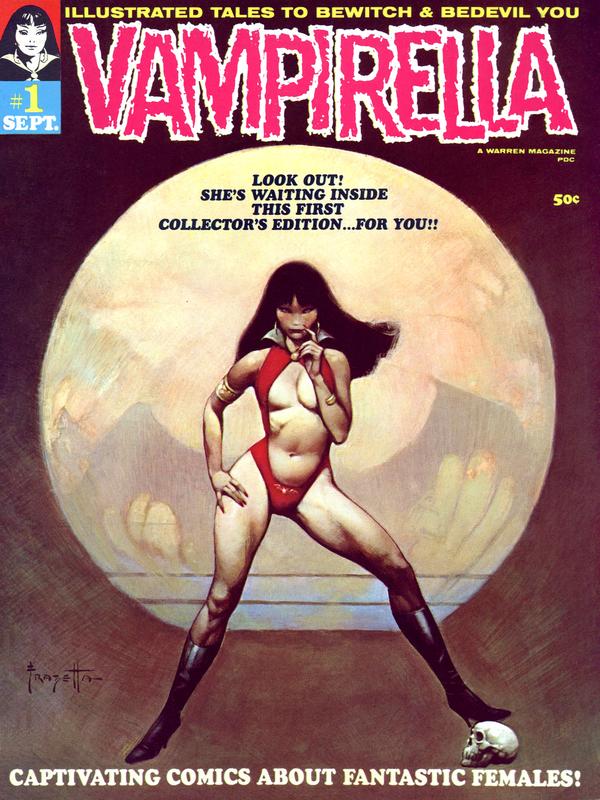
Vampirella #1
Vampirella #1 (September 1969) marks the debut of one of the first female vampires to headline her own comic magazine, distinguishing herself from the male-centric monster-host tradition Warren had established with Creepy and Eerie. Where Uncle Creepy and Cousin Eerie existed only to introduce anthology tales, Vampirella was given her own origin story in this very first issue — rooting her in science fiction as a native of the blood-river planet Drakulon — which set the stage for her eventual evolution into a full-fledged protagonist. The magazine also arrived at a cultural inflection point, consciously drawing on the pop-culture energy of the 1968 film Barbarella to present a new kind of horror heroine whose design and attitude influenced decades of comics, cosplay, and fantasy art. It launched a title that ran continuously for 112 issues through 1983 and has never fully gone out of print, making this issue the ground zero of one of comics' most persistently revived characters.
In the scorched wastelands of Draculon, Vampirella—struggling to survive the planet’s deadly drought—stumbles upon a derelict ship carrying humans whose blood holds the same life-giving consistency as the rare moisture her world craves. With her strength fading and desperation rising, she must decide whether to embrace the ship’s survivors as salvation… or as prey.
In the tense, sun-scorched silence of the open sea, a small lifeboat carries a young couple and four other men, stranded and desperate. When one of the men dies in the night and is found the next morning drained of blood, with strange marks on his throat, the survivors realize something monstrous is among them—something that feeds in the dark.
In the snow-laden woods of Canada, a young woman named Maria is attacked by a massive wolf and barely escapes with minor injuries. Her father fires at the creature, driving it off but failing to kill it—rumors among the locals whisper that the beast is no ordinary wolf, but the dreaded Loup Garou, a creature only slain by silver. That night, Maria is haunted by strange, alluring dreams that blur the line between reality and nightmare.
In "Spaced-Out Girls!", a restless night takes a wild turn when Kenny Barcroft encounters a flying saucer and its alluring alien passengers—beautiful women from a dying race desperate to preserve their species. Drawn into their mission, Kenny finds himself whisked away on a cosmic journey to their distant world, where he’s suddenly expected to become their king.
ComicBooks.com Value
Show all 22 grades ▾
This exact issue on ebay
Read it digitally
Sell my copy
Have this issue — or a whole collection? Get a fair offer from us, skip the marketplace fees and the hassle.
We Buy Collections ▸History
The character was conceived by Forrest J Ackerman — already Warren Publishing's most prominent creative voice through Famous Monsters of Filmland — with her distinctive costume and hairstyle designed by artist Trina Robbins, who described collaborating with Frank Frazetta over the phone to translate her sketch into what became the cover painting. Frazetta's cover was itself a late substitution, replacing an original cover commissioned from the European artist Aslan. The inaugural issue was edited by Bill Parente, though comics historian Richard J. Arndt has noted that Archie Goodwin may have assisted in editing; Goodwin would later return as a credited editor beginning with issue #7 and is widely credited with transforming Vampirella from a punning hostess into a serious dramatic lead. Warren was reportedly dissatisfied with Ackerman's lighthearted, pun-heavy tone from the start, and that creative tension shaped the title's early years.
Trivia · 8 facts
- First appearance and origin of Vampirella, published by Warren Publishing in September 1969 as a black-and-white magazine-format comic.
- Character created by Forrest J Ackerman (story concept/script) and Trina Robbins (costume and hair design); Tom Sutton was the first story artist for the Vampirella feature 'Vampirella of Draculon.'
- Cover painted by Frank Frazetta — a last-minute replacement for an original cover by European artist Aslan — which became one of the most referenced images in horror-comics history.
- Issue contains Vampirella's original science-fiction origin: she is a native of Drakulon, a dying planet where blood flows in rivers; its inhabitants face extinction as the blood supply dries up.
- Vampirella functions here strictly as a horror-anthology hostess, introducing and closing each story — a role she held through issue #8 before Archie Goodwin developed her into the magazine's leading character.
- The issue contains a canonical spelling inconsistency: the opening story page uses 'Draculon,' while the table of contents and second story page use 'Drakulon,' which became the accepted spelling going forward.
- Interior art roster includes Neal Adams, Reed Crandall, Billy Graham, Mike Royer, Tony Tallarico, and Ernie Colón, making the debut issue a showcase for some of the era's top genre illustrators.
- The issue has been reprinted multiple times, including a 2001 commemorative edition, a 2002 German facsimile (mg publishing), a 2010 Dynamite Archives hardcover, and a 2019 Dynamite facsimile edition that reproduced the original Warren advertising.
Cast · 1 character
Full credits
Reprints
Reprinted in Vampirella #1 (1970), Vampirella Annual #1 (1972), Vampus #12 (1972), Vampirella #19 (1972), Vampus #17 (1973), Vampirella #11 (1974), Vampirella #1/1975 (1975), Oscar Mondadori [Oscar Fumetto] #681 (1976), Dossier Negro #123 (1979), Eerie #125 (1981), HYDE-25 #0 (1995), Vampirella Faksimile Edition #1 (2002), Vampirella Archives #1 (2010), Vampirella (1969), Facsimile Edition #1 (2019), Illustrators Special Issue #14 - First Edition (2022), Vampirella: Dead Flowers #1 (2023), Vampirella: Dead Flowers #1 (2023), Vampirella #1, Vampirella #1, Vampirella #4
Key issues in Vampirella
Reviews
Reader reviews
No reader reviews yet.