
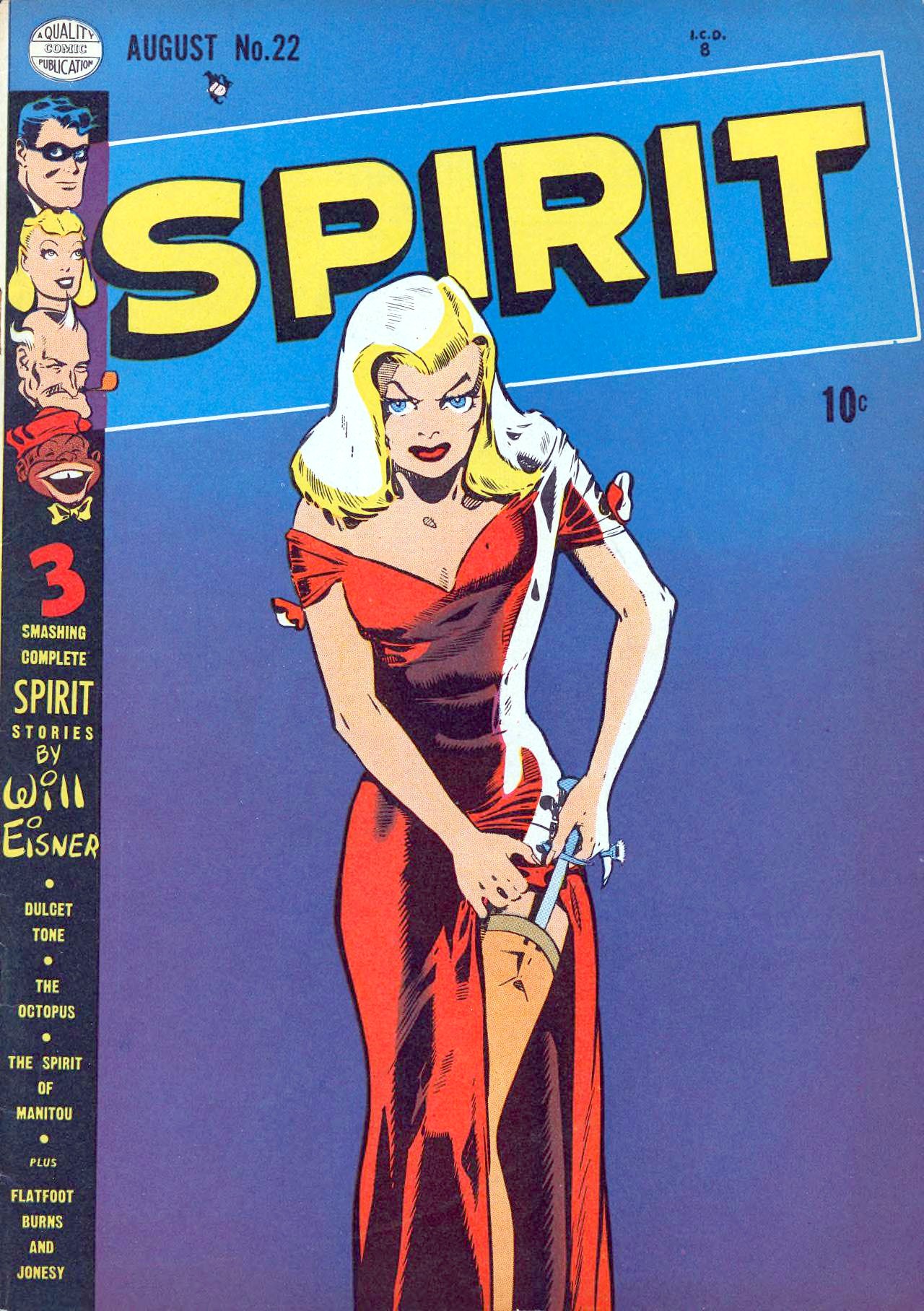
The Spirit #22
The Spirit #22 holds the distinction of being the final issue of Quality Comics' long-running Spirit series, closing out a six-year run that brought Will Eisner's newspaper-insert masterwork to standard comic-book format readers. Its cover — a dagger-brandishing femme fatale Eisner modeled on actress Lauren Bacall — became one of the most discussed images in the early 1950s comics-censorship debate, cited directly in the 1951 Report of the New York State Joint Legislative Committee to Study the Publication of Comics. That government spotlight, combined with the issue's status as a capstone to Eisner's Golden Age output for Quality, gives it a unique place at the intersection of comics artistry and the moral-panic era that would soon produce the Comics Code Authority.
This issue contains three complete Spirit stories by Will Eisner. "Dulcet Tone" features a villain emerging from the unknown who sings hypnotically and is captured by the Spirit. "Flatfoot Burns and Jonesy" follows two bumbling characters who become entangled with a criminal plot involving a surplus atom bomb and a barrel of potatoes, mistaking themselves for real operatives. The final story "The Spirit of Manitou" shows the Spirit confronting villains at police headquarters, where a female character named Dulcet Tone is being held for murder, leading to a confrontation that results in the Spirit appearing to escape while the villains' plans unravel.
A stylish criminal named Dulcet Tone sweeps into Central City with ambitious plans to corner the black market—and she's not above using charm and manipulation to bend the local rackets to her will. When her web of double-crosses and false promises tangles together her accomplices, including the conflicted Skinny Bones, the whole scheme threatens to collapse under its own weight. The Spirit finds himself caught between a riverboat trap and a criminal operation spiraling toward its own reckoning.
ComicBooks.com Value
Show all 21 grades ▾
Find on ebay
Read it digitally
Sell my copy
Have this issue — or a whole collection? Get a fair offer from us, skip the marketplace fees and the hassle.
We Buy Collections ▸History
Quality Comics publisher Everett M. Arnold produced The Spirit as a bi-monthly comic reprinting material from Eisner's tabloid-sized Sunday newspaper inserts, originally distributed through the Register and Tribune Syndicate beginning in 1940. The stories in issue #22 draw from 1946 Spirit Sections, including the 'Dulcet Tone' story (originally July 7 and July 21, 1946) scripted and drawn by Eisner, with lettering by Martin DeMuth and possible additional penciling contributions from John Spranger. The issue also features backup content by Al Stahl (Flatfoot Burns) and a humor page by Bernard Dibble, reflecting the anthology structure Quality maintained throughout the run.
Trivia · 8 facts
- Final issue of Quality Comics' The Spirit series (vol. 1, 1944–1950), published with a cover date of August 1950.
- Cover art by Will Eisner depicts the character Skinny Bones — a femme fatale Eisner explicitly modeled on actress Lauren Bacall, as confirmed in an authorized Eisner-signed print description.
- First comic-book appearances of villains Dulcet Tone and Skinny Bones, introduced in the story 'Dulcet Tone' (script and art by Will Eisner).
- The cover was reproduced and cited in the 1951 Report of the New York State Joint Legislative Committee to Study the Publication of Comics — notably classified under the committee's 'brutality, violence and crime' category rather than its sexual-content category.
- The issue's lead story, 'A Legend,' and the 'Dulcet Tone' story reprint Spirit newspaper sections originally published in July 1946; a third Spirit story features recurring villain The Octopus.
- Additional contents include two Flatfoot Burns backup stories (script and art by Al Stahl) and a Jonesy humor page by Bernard Dibble, making it a 52-page anthology.
- The 'A Legend' story was later reprinted in The Spirit #32 (Kitchen Sink Press, December 1981), helping preserve Eisner's work for a new generation of readers.
- Cover price was ten cents, consistent with the standard Golden Age comic pricing of the era.
Full credits
Reprints
↩ Reprints The Spirit #7/14/1946 (1946), The Spirit #7/21/1946 (1946), The Spirit #7/7/1946 (1946)
Reprinted in The Spirit #21 (1950), Ken Shannon #10 (1953), The Spirit #32 (1981), The Art of Will Eisner #[nn] (1982)
Reviews
Reader reviews
No reader reviews yet.