
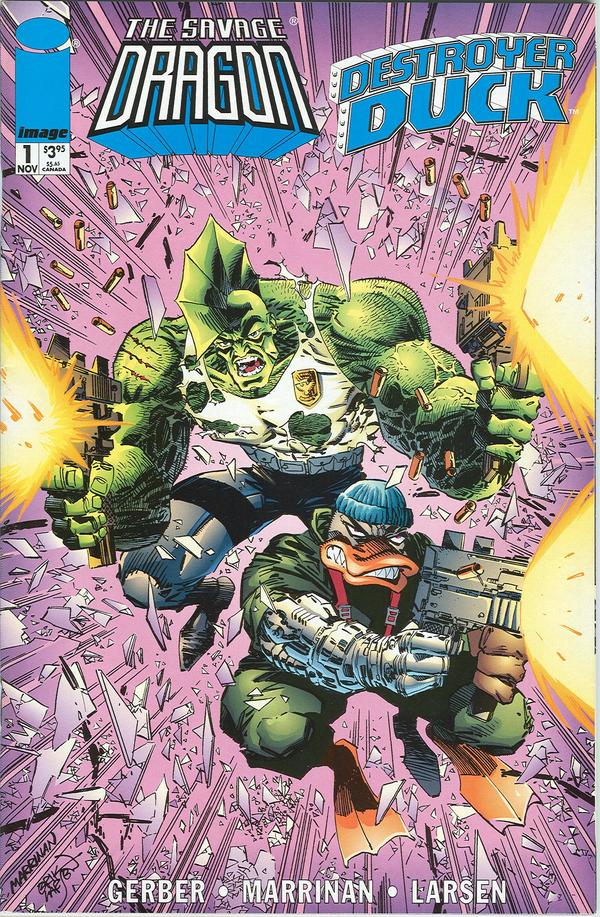
The Savage Dragon / Destroyer Duck #1
☆ Be the first to review + Add to your collection — Join freeThis 48-page one-shot is a landmark of creator-rights storytelling: Steve Gerber used it to resolve, on his own terms, the long-running dispute over Howard the Duck's ownership by engineering a parallel unofficial crossover with Marvel's Spider-Man Team-Up #5 in which the 'real' Howard and Beverly Switzler escape into the Image Universe under the new identities of Leonard the Duck and Rhonda Martini, leaving only a clone behind in Marvel continuity. The issue also pays off a two-year narrative thread by revealing that Specimen Q — first introduced in Codename: Stryke Force #14 (1995) when Marc Silvestri blocked Gerber from using Destroyer Duck outright — was Destroyer Duck all along, finally freeing the character after over a decade in story-limbo. As a publishing event it brought together characters from three separate universes (Image, Mirage/TMNT, and Marvel) in a single issue without formal corporate sanction, making it one of the more audacious examples of grassroots intercompany storytelling in 1990s comics. The issue's two prose essays — one by Larsen and one by Gerber detailing the behind-the-scenes history — turn the comic into a living document of the creator-ownership movement.
ComicBooks.com Value
This exact issue on ebay
Raw / ungraded ▾ $6.33–$49.99 10 listings
More listings for this title
Read it digitally
Sell my copy
Have this issue — or a whole collection? Get a fair offer from us, skip the marketplace fees and the hassle.
We Buy Collections ▸History
Steve Gerber had been locked out of Howard the Duck since the late 1970s; Destroyer Duck (Eclipse Comics, 1982), drawn by Jack Kirby, was literally created to fund his lawsuit against Marvel over Howard's ownership. When Marvel editor Tom Brevoort invited Gerber to write a Howard/Spider-Man story for Spider-Man Team-Up #5 (December 1996), Gerber agreed only on the condition that he could tie it to a simultaneous Image one-shot co-created with Erik Larsen; Brevoort consented, producing what Spiderfan.org called 'the world's most subtle intercompany crossover.' After discovering that Marvel planned additional Howard appearances in Ghost Rider and Generation X without his involvement, Gerber pivoted the Image issue's ending to effectively claim creator control of a Howard-equivalent character, renaming the duck Leonard and his companion Rhonda to sidestep trademark. Chris Marrinan penciled the book with Larsen inking and editing, and the cover art's tight Larsen inks over Marrinan's pencils are widely noted to read as pure Larsen in style.
Trivia · 8 facts
- Published November 1996 by Image Comics as a 48-page one-shot; written by Steve Gerber, penciled by Chris Marrinan, inked and edited by Erik Larsen, lettered by Chris Eliopoulos, colored by Steve Oliff and Olyoptics.
- First appearances in this issue: Mr. Boyle (dies same issue), Needlenose (dies same issue), Nuggo the Gnome, and the entire Industrial Accidents team (Switchblade, Munchie, Tina Tuna, Poly Morphus, Bush-Man, and Stallion).
- Resolves the Specimen Q mystery seeded in Codename: Stryke Force #14 (Image, August 1995): the armored figure is revealed to be Destroyer Duck, who has been imprisoned in his own suit for over a decade in story-time.
- Constitutes an unofficial simultaneous crossover with Marvel's Spider-Man Team-Up #5 (December 1996) — both issues were scripted by Gerber and share a warehouse fight scene that is nearly identical panel-for-panel across both books, with minor dialogue changes (notably 'Crap!' in the Image version altered to 'Rats!' for Marvel).
- Gerber uses the Image-exclusive ending to introduce Leonard the Duck (an in-universe Howard the Duck analog) and Rhonda Martini (Beverly Switzler analog) as creator-owned characters living in the Image universe, a direct creative response to Marvel licensing Howard for other titles without Gerber's involvement.
- The bonus pin-up of Leonard the Duck is a retouched, recolored version of Frank Brunner's cover to Howard the Duck Vol. 1 #1 (Marvel, January 1976), with the original characters replaced by the new Image counterparts.
- The Teenage Mutant Ninja Turtles (Leonardo, Donatello, Raphael, Michelangelo) appear in a brief early sequence battling Specimen Q in New York City — their inclusion is a cameo rather than a plot-driving role.
- The issue includes two editorial prose pieces: 'The Never Ending Battle' by Erik Larsen and 'Foul Play: The Behind-the-Scenes Story of Savage Dragon / Destroyer Duck #1' by Gerber, the latter functioning as a first-person account of the Howard the Duck rights history.
Cast · 30 characters
Full credits
Reprints
↩ Reprints Howard the Duck #1 (1976)
Reviews
Reader reviews
No reader reviews yet.