
The Man of Steel #1
☆ Be the first to review + Add to your collection — Join freeThe Man of Steel #1 (cover-dated October 1986, on sale June 17, 1986) is the opening chapter of the definitive Post-Crisis Superman reboot, making it the single most consequential Superman origin story published since Jerry Siegel and Joe Shuster's debut in Action Comics #1 nearly fifty years earlier. By drawing a hard line between the sprawling, often contradictory Silver Age mythology and a fresh Modern Age continuity, it gave subsequent DC storytellers a clean, unified foundation that served as official Superman canon for roughly seventeen years. The issue also marks the post-Crisis first appearance of Superman's costume and establishes storytelling premises — a depowered, sole-survivor Kal-El; living Kent parents; a Clark Kent who never operated as Superboy — that shaped not only the Triangle Era of Superman comics through the 1990s but later successors like Birthright, Secret Origin, and Zack Snyder's 2013 film of the same name. Its influence on how superhero publishers approach line-wide continuity resets is difficult to overstate.
ComicBooks.com Value
Show all 22 grades ▾
Find on ebay
Read it digitally
Sell my copy
Have this issue — or a whole collection? Get a fair offer from us, skip the marketplace fees and the hassle.
We Buy Collections ▸History
DC Executive Editor Dick Giordano learned in May 1985 that John Byrne had departed Marvel Comics, and the two men began discussing what a Byrne-led Superman overhaul might look like; DC agreed with roughly 99% of Byrne's pitch and gave him the green light. The project had deep editorial prehistory: DC publisher Jenette Kahn had solicited revision proposals from multiple writers — including Marv Wolfman, Frank Miller, and Steve Gerber — all of whom independently converged on the same core ideas (sole survivor of Krypton, no Superboy career, reduced powers, a retooled Lex Luthor), though each envisioned a different approach; Byrne ultimately synthesized and executed those shared goals. Byrne immersed himself in every available media incarnation of the character — Golden Age comics, the Fleischer Studios cartoons, the George Reeves television series, and the Christopher Reeve films — before distilling a version he described as 'Siegel and Shuster's Superman meets the Fleischer Superman in 1986.' One late production adjustment with real-world resonance: Superman's debut was originally scripted as a space-shuttle rescue, but the January 1986 Challenger disaster prompted Byrne to revise the vehicle to 'an experimental space-plane' called the Constitution before the issue went to press. The series was edited by Andrew Helfer, colored by Tom Ziuko, and pre-publication ads listed the project under the working title The Legend of Superman.
Trivia · 8 facts
- Written and penciled by John Byrne, inked by Dick Giordano, colored by Tom Ziuko, and edited by Andrew Helfer; the six-issue miniseries ran bi-weekly from July to September 1986 (cover dates October–December 1986).
- Issue #1 carries a cover date of October 1986 but was published on June 17, 1986; pre-release advertising listed the series under the working title 'The Legend of Superman.'
- The issue establishes the post-Crisis first appearance of Superman's costume and introduces the revised Kryptonian 'Birthing Matrix' concept, in which Kal-El is gestated artificially and physically born only upon landing in Kansas — making Earth, not Krypton, his true birthplace.
- Clark's powers are established as developing gradually into adolescence, which erases the Superboy career from post-Crisis continuity entirely; Kara Zor-El (Supergirl) and the bottle city of Kandor are likewise written out, making Superman the sole Kryptonian survivor.
- Jonathan and Martha Kent are kept alive into Clark's adulthood — a deliberate reversal of the pre-Crisis status quo in which they died shortly after his high school graduation.
- The miniseries as a whole introduces the post-Crisis reinvention of Lex Luthor as a corrupt billionaire industrialist (LexCorp CEO) rather than a mad scientist — a collaborative reimagining by Byrne and Marv Wolfman that became the template for virtually every subsequent Superman adaptation in film and television.
- The first issue of the miniseries was released with two distinct cover variants (direct and newsstand editions illustrated by Byrne), documented by the John Byrne Wikipedia entry as the first use of variant covers by the American comics industry.
- The collected trade paperback, first released in 1987 with a new Byrne cover and a foreword by Ray Bradbury, has been reprinted multiple times; a 2020 hardcover omnibus edition (ISBN 978-1779504913) remains in print, and the story was included in Superman: The Greatest Stories Ever Told (2004).
Reprints
Reprinted in Der Neue Superman Handbuch #1 (1987), Stålmannen #1-2/1987 (1987), Superman Special #1 (1987), Supermann #1/1987 (1987), Superman #1/1990 (1990), Millennium Edition: The Man of Steel 1 #[nn] (2000), Superman: The Man of Steel #1 (2003), DC Comics Graphic Novel Collection #13 (2015), Superman: The Man of Steel #1 (2020), Superman - L'homme d'acier #1
Key issues in The Man of Steel
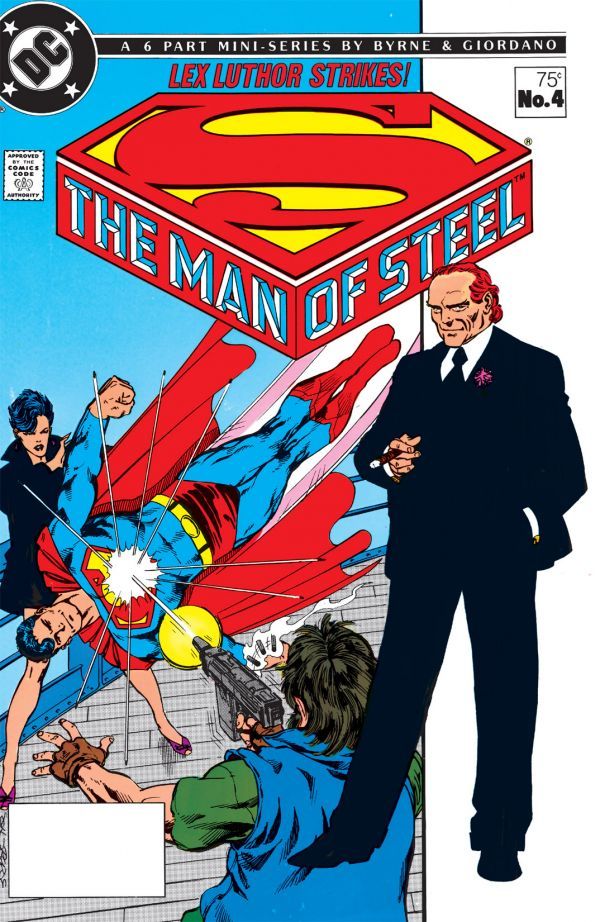
Other variants of The Man of Steel #1 (2)
Reviews
Reader reviews
No reader reviews yet.