
Superboy #1
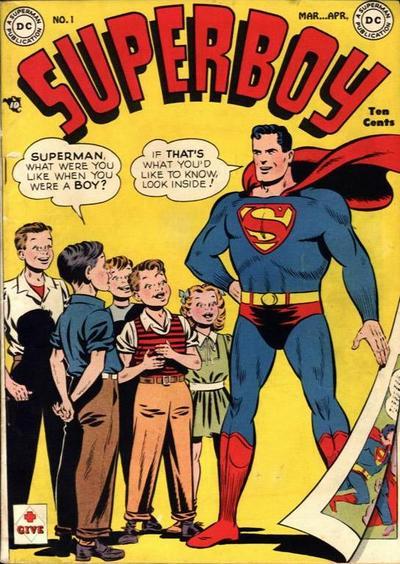
Superboy #1 (March–April 1949) was a watershed moment for DC Comics, making Superboy only the sixth DC superhero to headline his own solo title and proving itself the first new DC superhero series to find sustained success in the post–World War II market. By giving Clark Kent's Smallville years a dedicated home, the title cemented the rural American childhood mythology that would define Superman's origin for generations — a backdrop comics historian Les Daniels described as evoking a small-town 'dreamworld' of midcentury America. The series seeded an extraordinary run of firsts across its early issues, most notably the debuts of Lana Lang, the Superbaby concept, and ultimately the Legion of Super-Heroes, characters whose DNA runs through the DC Universe to this day. Its longevity — evolving from a bimonthly anthology into the backbone of the Legion franchise — makes this inaugural issue the foundation stone of one of DC's most far-reaching Silver Age mythologies.
In a 1949 tale from Superboy #1, the enigmatic mystic Brandar the Great makes a chilling prediction at a party attended by young Clark Kent: that Margo Griffiths, now a young nurse in Metropolis, will vanish on her 21st birthday. With Superman and Lois Lane drawn into the mystery, the story unfolds as the past and future collide, leaving only the question of whether fate can truly be seen—or changed.
ComicBooks.com Value
Show all 20 grades ▾
This exact issue on ebay
Read it digitally
Sell my copy
Have this issue — or a whole collection? Get a fair offer from us, skip the marketplace fees and the hassle.
We Buy Collections ▸History
Jerry Siegel first pitched the concept of Superman's boyhood adventures to Detective Comics, Inc. in November 1938, was rebuffed, tried again with a full script in December 1940, and again received no answer. While Siegel was stationed in Hawaii during World War II, DC directed Joe Shuster to produce the Superboy feature anyway, basing it in part on Siegel's earlier script; Siegel only learned of its publication through a letter from Shuster. After Siegel returned from service and sued, a court ruled that Superboy was his property — distinct from Superman — leading to a settlement in which DC acquired full rights to the character. The solo title launched in early 1949 under editor Whitney Ellsworth, with Siegel and Shuster's names already stripped from the bylines, and the distinctive logo crafted by letterer Ira Schnapp.
Trivia · 8 facts
- Cover date March–April 1949; went on sale January 8, 1949 (per copyright registration ad in Leave It to Binky #7); published by National Comics Publications, Inc. (DC).
- Superboy was the sixth DC Comics character to receive his own solo title, and the series became the first new DC superhero title to find success in the post–WWII market.
- Cover art pencilled by Wayne Boring and inked by Stan Kaye; the Superboy logo was designed by letterer Ira Schnapp.
- The issue contains three stories: 'The Man Who Could See Tomorrow!' (art by John Sikela), 'The Boy Vandals!' (script by Ed Hamilton, art by Al Wenzel), and 'Superboy Meets Mighty Boy!' (art by Al Wenzel); Whitney Ellsworth served as editor.
- The issue runs 52 pages in full color at a cover price of ten cents.
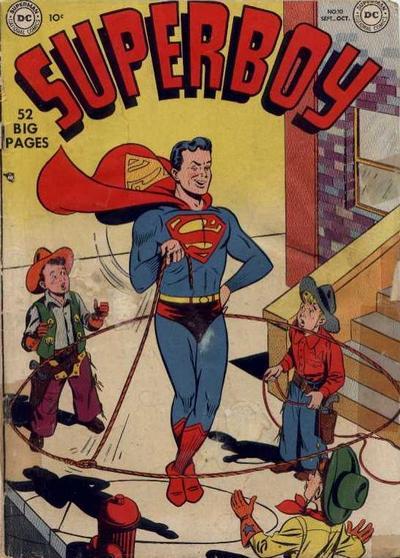
- No new major supporting characters debut in this specific issue — Lana Lang arrived in issue #10, and the name 'Smallville' first appeared on the cover of issue #2 — but this inaugural issue launched the title that introduced all of them.
- The entire issue was reprinted in 2001 as Millennium Edition: Superboy #1, which was selected by reader online voting and was the final release in DC's Millennium Edition reprint program.
- The series launched by this issue eventually evolved into the primary home of the Legion of Super-Heroes, with the title formally changing to Superboy and the Legion of Super-Heroes with issue #222.
Full credits
Reprints
Reprinted in Adventure Comics Featuring Superboy #5 (1949), Superboy #6 (1949), Captain Triumph Comics #17 (1949), Superboy #1 (1949), Superboy Annual #1953-54 (1953), Superboy Annual #1954-55 (1954), Colossal Comic Annual #[1] (1956), Superman Annual #1 (1960), Superboy #100 (1962), The Comic Book in America: An Illustrated History #[nn] (1989), Great American Comic Books #[nn] (2001), Millennium Edition: Superboy No. 1 #[nn] (2001), Superman: Cover to Cover #[nn] (2006)
Key issues in Superboy
Reviews
Reader reviews
No reader reviews yet.