
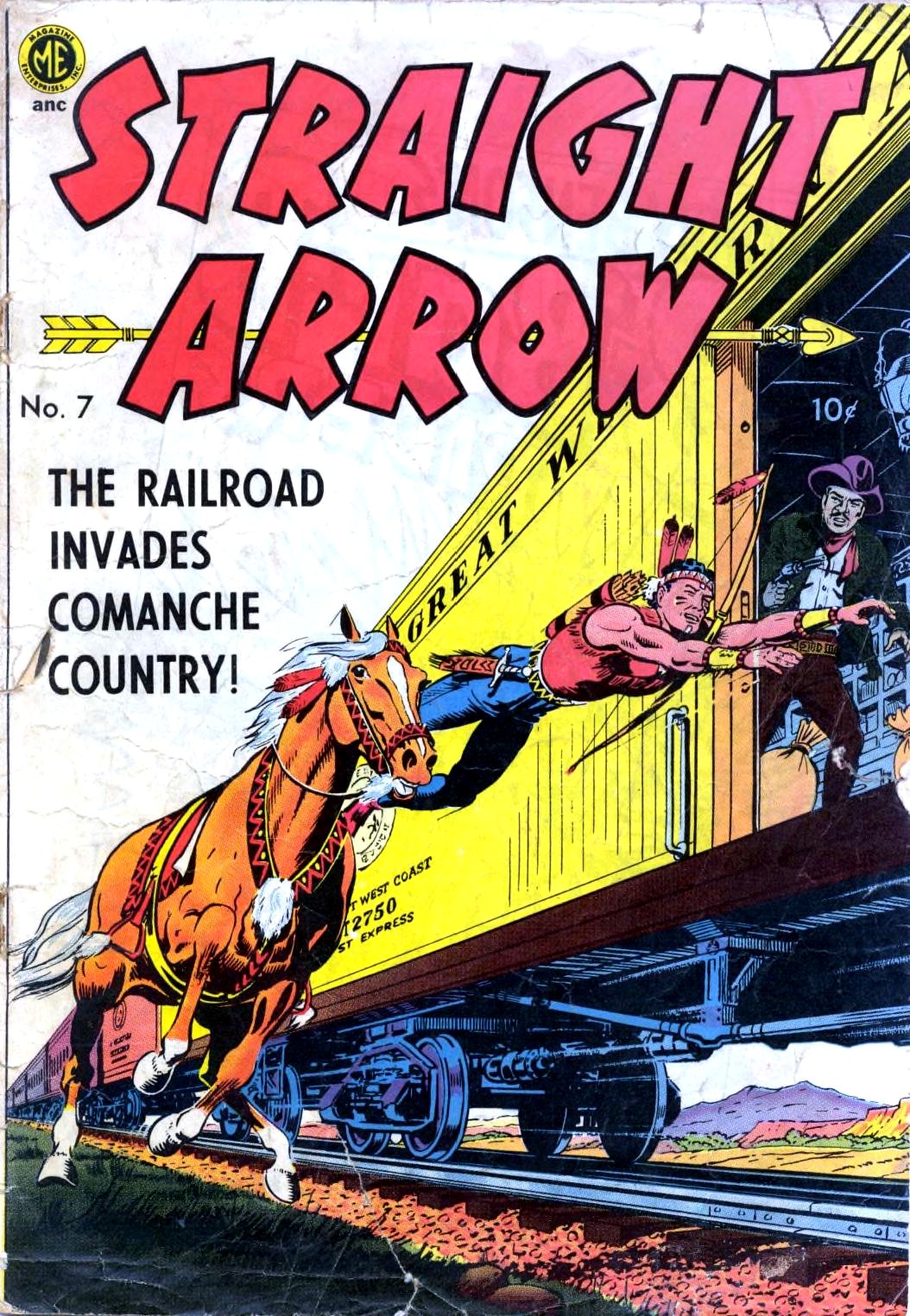
Straight Arrow #7
☆ Be the first to review + Add to your collection — Join freeStraight Arrow #7 (December 1950) is a representative mid-run chapter of one of the Golden Age's most unusual corporate-to-comics crossovers: a character conceived by the McCann-Erickson advertising agency entirely to sell Nabisco Shredded Wheat, yet one that achieved genuine creative momentum once translated to the page. The series as a whole was among the very few Golden Age titles to center a Native American protagonist—a Comanche orphan who lived a double life as rancher Steve Adams—at a moment when the Western genre dominated newsstands but rarely interrogated its own racial assumptions. Issue #7 demonstrates the title's hallmark mixed-content format: prose-adjacent adventure strips, the recurring 'Red Hawk' backup feature aimed at younger readers, and action set-pieces that range from outlaw train robberies to wilderness rescues, all packaged in 32 full-color pages at a dime. While no single first appearance has been documented for this specific issue, it holds its place as part of a 55-issue run that outlasted the radio show that spawned it by five years.
The issue contains two main stories. "The Sand Ship" follows a man staggering through the desert who discovers an ancient Spanish ship buried in the sand and searches for legendary treasure while battling mysterious attackers. The second story involves Straight Arrow discovering that white men are using fake "ghosts" and the Wah-Din-Din call to scare Indians away from a gold mine, leading him to head to Sundown Valley to stop the scheme; along the way he pursues the villains through caves and confronts those responsible for the deception and kidnapping plot.
Tension erupts across Comanche Country when someone begins sabotaging the water holes along the route of a new railroad, and Straight Arrow must ride from his golden cave to uncover the truth behind the deliberate drought and the violence it's stoking between settlers and Native Americans. As Indians and whites are driven toward open conflict, Straight Arrow works to expose the real villain pulling the strings—before hatred and revenge consume the territory entirely.
Across the burning desert, a determined sailor with a wooden leg hunts for a legendary Spanish galleon—one that holds proof of ancestry to a vast Spanish land grant—while Straight Arrow intervenes to protect the sailor's daughter, Rosemary, from the schemes of a ruthless cousin who'll stop at nothing to claim the fortune for himself. When the Comanche chieftain discovers a guide working against the girl, he springs into action to aid the search, navigating treacherous desert trails and hostile territory to uncover the truth of the Sand Ship.
When a sudden eclipse darkens the sky during a fierce battle between Cheyenne and Pawnee warriors, Red Hawk steps forward with bow in hand, convinced that the moon itself has declared war on the sun and must be stopped. As fear and superstition grip both peoples, the young Cheyenne warrior takes aim at the heavens, determined to restore the light and save his world from eternal darkness. A story rooted in the beliefs and courage of the plains Indians, where one brave's defiance against the forces of nature becomes legend.
When crooked gunslinger Croaker Smith and his gang exploit a legendary Indian curse—the skeletal ghost of the Wah-Din-Din—to drive the Comanches from their gold-rich territory, Straight Arrow must uncover the truth behind the supernatural scare tactic before innocents fall victim to the scheme. As young Yellow Calf surrenders to superstitious dread and a girl named Little Deer falls into the outlaws' hands, the masked avenger races to stop a deadly trap set in the Shining Mountains. Ghosts and greed collide in this tale of faith, cunning, and one man's stand against ruthless deception.
This single-page non-fiction feature celebrates the pioneering achievements of Royal Dutch Airlines, tracing the carrier's history from its first scheduled passenger flight in 1920 across the North Sea to its landmark victories and post-war expansion. The story highlights key milestones—including a 1934 handicap air race win from London to Melbourne and the airline's first transatlantic service from a war-damaged Dutch airport in 1946—that established it as one of the world's largest and most innovative aviation networks.
ComicBooks.com Value
Show all 14 grades ▾
Find on ebay
Read it digitally
Sell my copy
Have this issue — or a whole collection? Get a fair offer from us, skip the marketplace fees and the hassle.
We Buy Collections ▸History
The character was created by writer Sheldon Stark, who wrote all 292 scripts for the Straight Arrow radio program broadcast on the Mutual Broadcasting Network beginning in early 1949, sponsored throughout by Nabisco Shredded Wheat. When the show's popularity grew—reaching Nielsen's top-10 daytime rankings—Nabisco contracted Magazine Enterprises to produce a companion comic series; the first issue appeared in February 1950 with Gardner Fox handling most scripts and Fred L. Meagher as the primary interior artist. Editor Raymond C. Krank oversaw the title, and Bob Powell contributed additional interior art on many issues including #7; the series maintained a bimonthly schedule and continued until March 1956, well after the radio program ended in June 1951.
Trivia · 8 facts
- Published December 1950 by Magazine Enterprises as the seventh issue of the 55-issue run (February 1950–March 1956).
- Stories written by Gardner Fox (who scripted the majority of the series); interior art by Bob Powell and Fred Meagher; cover by Fred Meagher.
- Issue contains six features: 'The Flaming Trail!,' 'Four Against the 7th,' 'Robbery Rides the Rails!,' 'Red Hawk: Cheyenne Challenge,' 'The Rhyming Robber!,' and 'Fang – Hound of Terror.'
- The recurring 'Red Hawk' backup strip—present in this issue—was a standard series feature spotlighting a young Native American character, included to give younger readers a more age-proximate point of identification.
- The title character Steve Adams is a Comanche orphan raised by white settlers who reclaims his true identity as the warrior Straight Arrow; his dual identity is known to only one confidant.
- The Straight Arrow property originated as a radio series created by Sheldon Stark and sponsored by Nabisco Shredded Wheat; the comic series was produced by Magazine Enterprises under a Nabisco-controlled character license.
- Stories from the Straight Arrow series were reprinted internationally, including in Australian editions (Magazine Management) and Scandinavian anthology titles, indicating significant reach for a mid-tier Golden Age Western title.
- The comic series outlasted its radio source material by five years, demonstrating that the character's appeal had taken on a life independent of the broadcast property.
Full credits
Reprints
Reprinted in Crack Western #6 (1951), Straight Arrow Comics #4 (1951), Seriemagasinet #9/1953 (1953), Seriemagasinet #8-9/1954 (1954), Seriemagasinet #17/1954 (1954), Straight Arrow Comics #1 (1955), Battle Squadron Bumper Comic #[2] (1956), Straight Arrow Giant Edition #17 (1960), The Hundred Comic #95 (1964)
Reviews
Reader reviews
No reader reviews yet.