
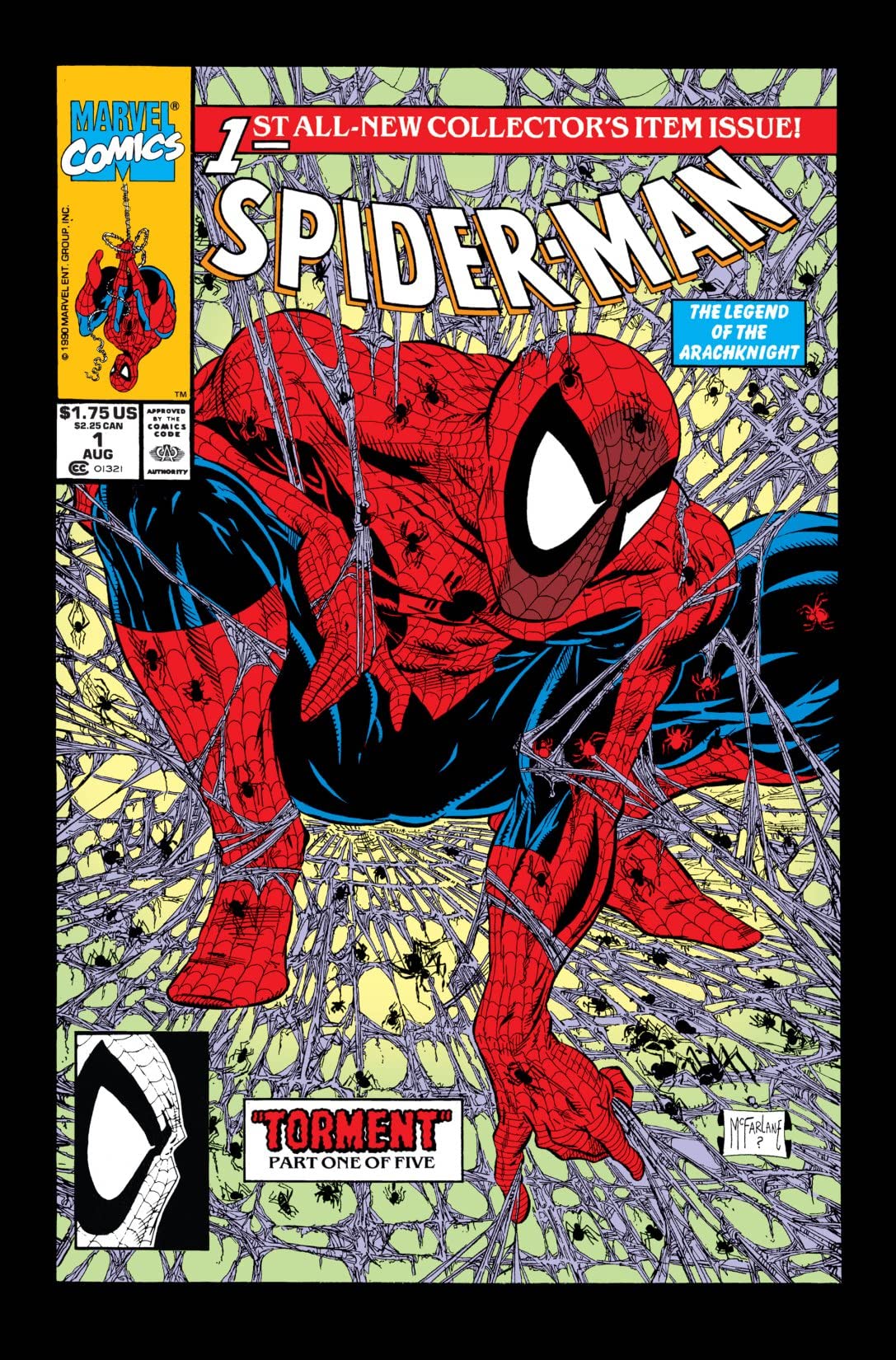
Spider-Man #1
Spider-Man #1 (August 1990) launched what became the web-slinger's fourth concurrent monthly title and marked the first time a single creator — Todd McFarlane — served as both sole writer and artist on a flagship Spider-Man series, a creative arrangement that was itself the product of hard-won negotiation. The issue's aggressive multi-variant publication strategy, deploying silver, platinum, and polybagged editions simultaneously, crystallized the collector-speculation mentality that would define and ultimately destabilize the direct-market industry for the rest of the decade. Narratively, the 'Torment' arc it opens pushed Spider-Man into horror-inflected territory — a more savage, magically controlled Lizard and the revenge-driven voodoo priestess Calypso — introducing a darker tonal register to the character that influenced the grim-and-gritty aesthetic of 1990s superhero comics broadly. The series' runaway success gave McFarlane the platform and commercial leverage that led directly to the founding of Image Comics in 1992, reshaping the creator-rights landscape of the entire American comics industry.
ComicBooks.com Value
Show all 17 grades ▾
This exact issue on ebay
CGC 9.8 ▾ $89.99–$350 2 listings
Raw — NM ▾ $4.95–$42.24 4 listings
Raw / ungraded ▾ $4.89–$79.99 21 listings
More listings for this title
Read it digitally
Sell my copy
Have this issue — or a whole collection? Get a fair offer from us, skip the marketplace fees and the hassle.
We Buy Collections ▸History
After a roughly 28-issue run on The Amazing Spider-Man, McFarlane told editor Jim Salicrup he wanted to write his own material and would leave that title; Salicrup countered by offering him a brand-new, adjective-free Spider-Man series where he would have full writer-artist control — an offer McFarlane later admitted surprised him, since he had expected to cut his writing teeth on a lower-profile book. The series was conceived partly with trade-paperback collection in mind, structured around self-contained arcs rather than the open-ended soap-opera continuity of existing titles, and Marvel also used it as a vehicle to experiment with higher paper quality and premium-priced polybagged editions. Colorist Bob Sharen and letterer Rick Parker rounded out the production team, with Salicrup editing and Tom DeFalco serving as editor-in-chief; the letters page of issue #1 was replaced by an editorial essay co-written by McFarlane with interjected comments by Salicrup. Growing friction over editorial control of story content — most famously a disputed panel in issue #16 — ultimately drove McFarlane to leave Marvel entirely, after which he co-founded Image Comics.
Trivia · 8 facts
- First issue of the adjectiveless Spider-Man ongoing series (Vol. 1), which ran 98 issues from August 1990 to September 1998 before being retitled Peter Parker: Spider-Man with #75.
- Todd McFarlane served as sole writer, penciler, and inker — his debut as a series writer — with colors by Bob Sharen and lettering by Rick Parker; Jim Salicrup edited, Tom DeFalco was editor-in-chief.
- Opens 'Torment' Part 1 of 5, in which Calypso uses voodoo drums and black magic to strip the Lizard (Curt Connors) of his remaining humanity and weaponize him against Spider-Man as revenge for the death of Kraven the Hunter.
- Calypso appears in this issue (pages 7 and 16) unnamed and not fully visible — her role as the hidden puppetmaster is the central mystery of the five-part arc.
- The series became the fourth simultaneous monthly Spider-Man title, joining Amazing Spider-Man, Spectacular Spider-Man, and Web of Spider-Man.
- At least seven distinct cover editions exist: the standard green direct edition, the green newsstand edition (polybagged), a silver direct edition, a no-price silver polybagged edition, a platinum edition (cardstock cover, silver ink logo, distributed to retailers), a gold second-printing direct edition, and a gold second-printing edition with UPC — making it one of the earliest and most elaborate multi-variant launches in Marvel history.
- The platinum variant, identifiable by its cardstock cover and absence of a cover price, was produced in an estimated run of approximately 10,000 copies and distributed as a retailer gift.
- The story has been reprinted in numerous collections including the Spider-Man: Torment trade paperback (first collected 1992), Marvel Collectible Classics: Spider-Man #2 (1998), Marvel Premiere Classic #27 (2009), a facsimile edition (October 2020), the Spider-Man by Todd McFarlane Omnibus (2016), and Spider-Man by Todd McFarlane: The Complete Collection (2021).
Cast · 5 characters
Full credits
Reprints
Reprinted in The Complete Spider-Man #1 (1990), Spiderman Special #1 (1991), Spider-Man #1 (1991), Star Magazine #8 (1991), El Hombre Araña / El Asombroso Hombre Araña #500 (1991), Spider-Man: Torment #[nn] (1992), Spider-Man: Torment #[nn] (1992), Superaventuras Marvel #119 (1992), Mega Marvel #3/1992 (1992), Mega Marvel #1/1993 (1993), Marvel Super Heroes the Amazing Spider-Man #[nn] (1994), Spider-Man #[1] (1997), Origins of Marvel Comics Revised Edition #[nn] (1997), Marvel Collectible Classics: Spider-Man #2 (1998), Der sensationelle Spider-Man #11 (1999), The 100 Greatest Marvels of All Time #3 (2001), Spider-Man: Torment #[nn] (2009), Spider-Man: Torment #27 (2009), Spider-Man: Torment #[nn] (2011), Coleccionable Spider-Man #1 (2014), Spider-Man Firsts #[nn] (2014), Poderosos Heróis Marvel #5 (2015), Spider-Man by Todd McFarlane Omnibus #[nn] (2016), True Believers: Spider-Man #1 (2017) + 8 more
Key issues in Spider-Man
Variants (7)
Reviews
Reader reviews
No reader reviews yet.