
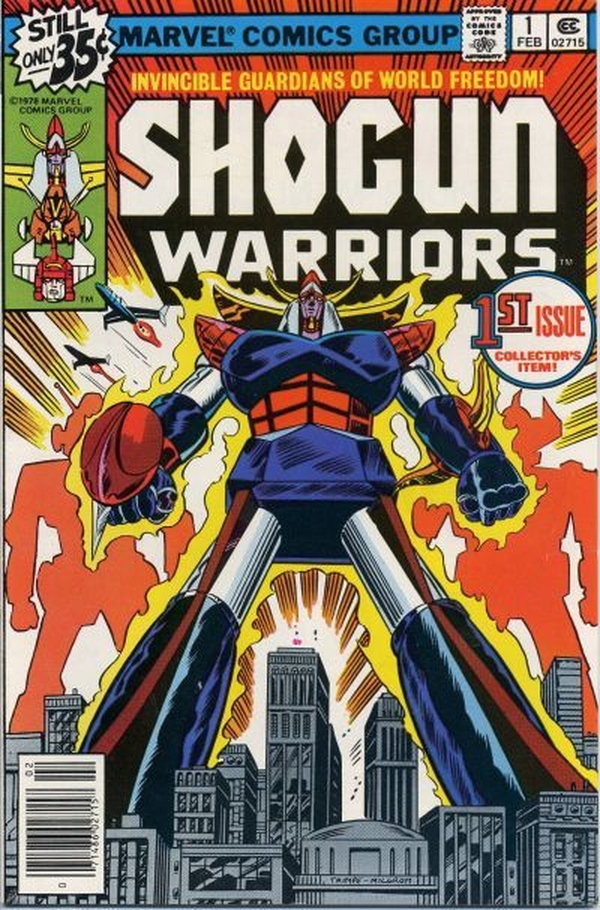
Shogun Warriors #1
☆ Be the first to review + Add to your collection — Join freeShogun Warriors #1 (February 1979) marks the debut of Marvel's most ambitious Japanese-mecha experiment of the Bronze Age, introducing Raydeen, Combatra, and Dangard Ace — three giant robots drawn from Toei anime and the Mattel toy line — into the shared Earth-616 continuity. It stands as one of the earliest American comics to formally transplant Japan's 'super robot' genre onto the page, predating the Transformers phenomenon by several years and helping condition a generation of readers for the mecha stories that would follow. Moench's deliberately international pilot cast — an American stuntman, a Japanese female test pilot, and an African oceanographer — was unusual for mainstream American comics of its era, reflecting a conscious effort to frame planetary-scale adventure through diverse human perspectives. The series also demonstrates the fertile, sometimes awkward, creative ground of late-1970s Marvel licensing, sitting alongside Star Wars, Godzilla, and Battlestar Galactica adaptations as the publisher aggressively pursued pop-culture tie-ins.
ComicBooks.com Value
Show all 18 grades ▾
This exact issue on ebay
CGC 9.8 ▾ $175–$199 3 listings
CGC 9.6 ▾ $67.63–$325 7 listings
CGC 9.2 ▾ $47.58–$225 4 listings
Raw — NM ▾ $10–$24.95 8 listings
Raw — VF/NM ▾ $13–$28.75 6 listings
Raw — FN ▾ $5.09–$14.99 3 listings
Raw — FINE ▾ $6–$19.99 2 listings
Raw / ungraded ▾ $3–$62 37 listings
More listings for this title
Read it digitally
Sell my copy
Have this issue — or a whole collection? Get a fair offer from us, skip the marketplace fees and the hassle.
We Buy Collections ▸History
The series grew out of a three-year licensing agreement between Marvel and Toei Animation, brokered in 1978 by Gene Pelc, Marvel's Japan representative, which gave Marvel access to robot designs from Toei anime programs including Wakusei Robo Danguard Ace and Chōdenji Robo Combattler V, folded into Mattel's existing Shogun Warriors toy brand. Stan Lee tapped Doug Moench — then primarily associated with darker material like Werewolf by Night and Deathlok — for the writing assignment; Moench, partly won over by his children's enthusiastic reaction to sample toys, wrote a complete series bible from scratch, since no Japanese story materials were provided. Herb Trimpe, fresh from his run on Godzilla, King of the Monsters (another Moench-Trimpe Mattel tie-in), designed all three robots by working directly from the toy figures, inventing every villain independently. To front-load the robots in the debut, issue #1 was structured in medias res, dropping readers into the first Raydeen battle with the origin rendered in flashback.
Trivia · 8 facts
- Cover date: February 1979; on-sale release date logged in Marvel Fandom as November 14, 1978. Story title: 'Raydeen!'
- First Marvel Comics appearance of all three title robots: Raydeen (piloted by Richard Carson), Combatra (piloted by Genji Odashu), and Dangard Ace (piloted by Ilongo Savage), as well as their mentor Dr. Tambura, the Followers of the Light organization, and antagonist Maur-Kon's faction the Followers of Darkness.
- Creative team: writer Doug Moench, pencils Herb Trimpe, inks Dan Green, colors Andy Yanchus, letters Jim Novak; cover pencils Herb Trimpe, cover inks Al Milgrom.
- Jim Shooter is credited as Editor-in-Chief on the Marvel Fandom database entry for this issue.
- The series was set within the Marvel Universe (Earth-616), with the three robots and their pilots formally integrated into shared continuity; the alien Lumina and Myndai races debuted here, though their names were not revealed until Official Handbook of the Marvel Universe #4.
- A Whitman variant edition of issue #1 exists alongside the standard newsstand edition; Whitman 3-packs bundling issues #1, #2, and #3 were also sold.
- The series ran for 20 issues (February 1979 – September 1980) before cancellation; Moench subsequently wrote a coda in Fantastic Four #226 (January 1981) that resolved the robots' in-universe fate — they are destroyed off-panel, and the three human pilots return to civilian life.
- Marvel licensed only three of the thirteen-plus robots from the Mattel toy line; Combattler V, Danguard Ace, and Raideen were used, while others including Voltus V, Great Mazinger, and Dragun were excluded entirely and their likenesses never appeared in the comic.
Full credits
Reprints
↩ Reprints [Marvel Hostess Ads] #33 (1979)
Variants (1)
Reviews
Reader reviews
No reader reviews yet.